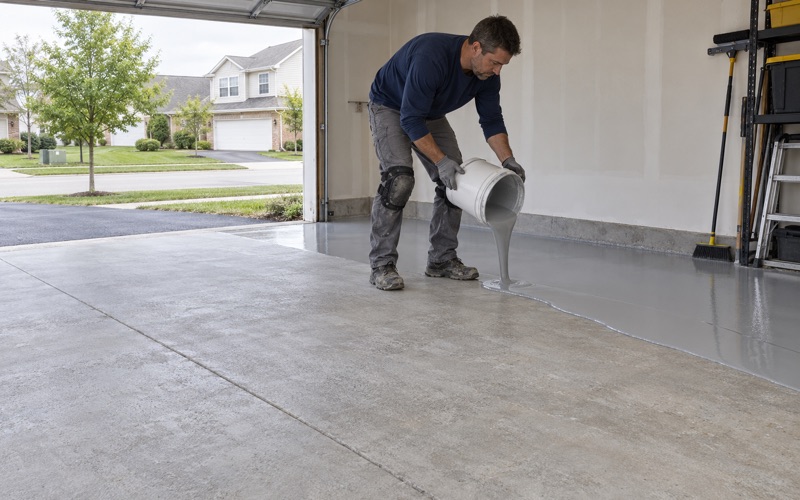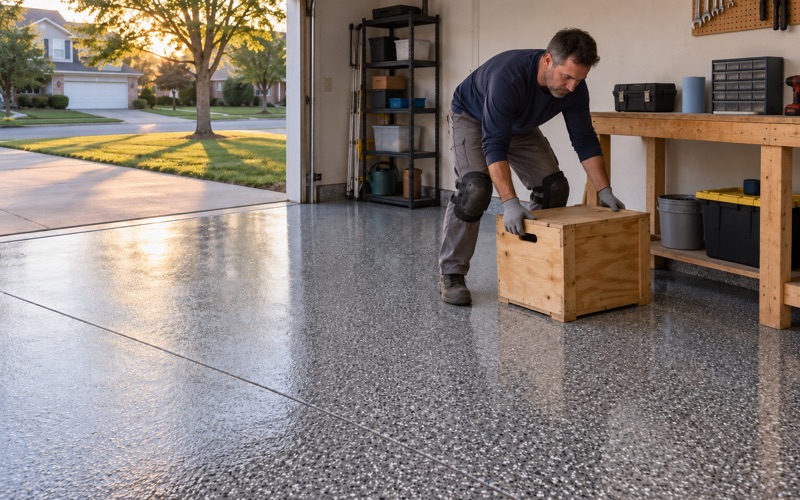
Romeoville Epoxy Flooring brings more than 20 years of slab work to every quote for epoxy flooring in Worth, and the floors we think hardest about are the ones where solvent lands every working day. A service bay or a home garage where brakes get cleaned is one of them. The question there is never just color or flake, but what the coating will face under the wheel.
Our answer starts with honesty about chemistry. No floor coating shrugs off every solvent, and resistance depends on the product, the solvent blend and how long the two stay in contact. So rather than promise a result, we show you how to test one, and we write the product, the system build and the finished thickness into the proposal so the test and the floor match.
Everything below follows the order we use on site: what is actually sprayed onto the floor, what the can’s own label says about the surfaces around it, and how to check a chosen system against your own cleaner before the whole floor is committed. The last section covers picking up runoff, because the label speaks to that too.
Brake Work on 111th Street Since 1972
A family shop and the floor under every brake job
On West 111th Street, T & A Auto Service has been family-owned since 1972, and its listing names brake repair alongside batteries, tires, suspension and engine work. We have never seen that shop’s floor and it is not our customer. It is simply the clearest local picture of a routine that repeats in bays and home garages all over the village.
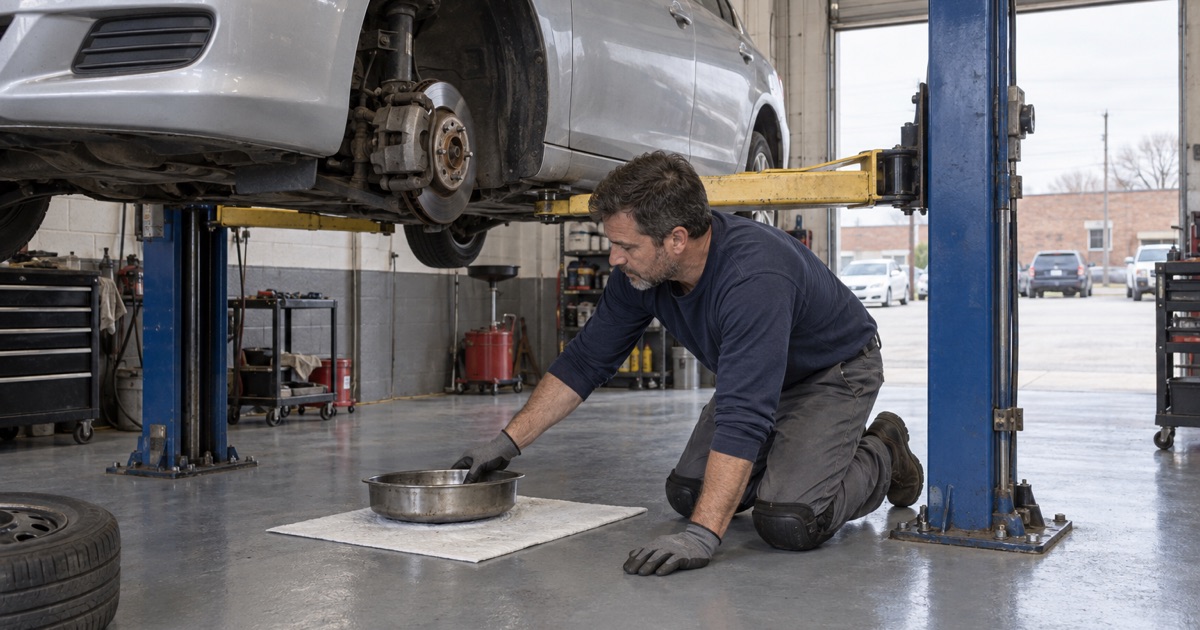
A brake job is where solvent meets concrete most directly. The usual method is to soak the brake assembly with brake parts cleaner and let it run off, which means the liquid ends up on the slab right under the wheel, every time. Whatever finish sits there is taking that runoff job after job, and that is the exposure a floor in a working bay should be chosen for.
Acetone, toluene and methanol
The non-chlorinated version of a widely sold cleaner, CRC Brakleen product number 05085, lists acetone, toluene and methanol on its label. Those are fast, aggressive solvents, chosen because they strip brake fluid and grease without leaving a film behind. That same strength is why they deserve respect on any surface they were not meant to clean.
The label also carries the words DANGER: EXTREMELY FLAMMABLE in capital letters. For a floor contractor that matters twice: once during a shop’s normal work, and again during installation, when nobody should be spraying cleaner near a freshly coated slab. We ask that solvent work stop in the room until the system has cured to the maker’s schedule.
Vapors that settle low
The same label notes that the vapors are heavier than air and can accumulate in low areas. In a garage that means the floor itself, the dip in front of a workbench and any pit or drain sump. Low spots are where vapor lingers longest against the coating, and they are also where a mechanic kneels while the brake drips.
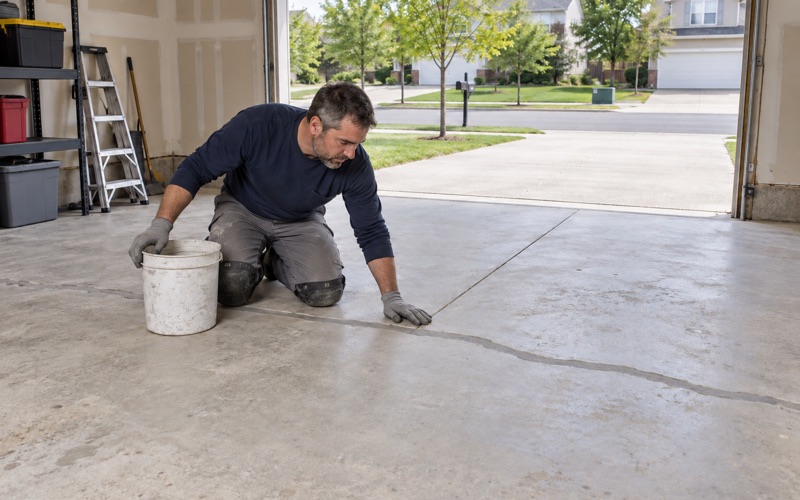
That is one more reason we pay attention to slope and low spots during the walk-through. A slab that ponds liquid toward one corner keeps solvent in contact with the finish far longer than a flat, even floor does. Where cracks and joints already collect liquid, we say so before quoting and close them with a semi-rigid polyurea joint filler as part of the system.
Looking for epoxy-flooring closer to Justice? See Justice Epoxy-Flooring.
What the Label Says About Painted Surfaces
The warning in step two
Directions on the 05085 label say to protect all rubber brake parts, plastic and painted surfaces from product and overspray, and not to apply it directly on painted surfaces. That sentence was written with a car’s finish in mind. It applies just as plainly to whatever is on the floor below, because a coated floor is a painted surface in the most literal sense.
One-part floor paint versus a two-part system
A one-part floor paint from a hardware store is exactly the kind of painted surface the label tells users to protect. It dries by evaporation or air cure, it goes on thin, and it was never formulated for repeated solvent soaks. In a bay where brake cleaner runs off every week, we would not count on it, and we tell customers that plainly.
A two-part system cures by chemical reaction between resin and hardener, and a build such as 100% solids epoxy under a polyaspartic or polyurea topcoat is far denser than a paint film. That density usually helps, but it is not a guarantee. How a given system handles acetone, toluene and methanol varies by product and by how long the liquid sits, and assuming either way is how floors get chosen badly.
The home mechanic in an older garage
Worth’s housing stock makes this a homeowner question as much as a shop question. About three-quarters of the village’s houses were built between 1950 and 1979, so most garage floors here are slabs 45 to 75 years old. A home mechanic doing brakes on a weekend is spraying the same cleaner onto that older concrete, often over whatever coating a past owner rolled on.
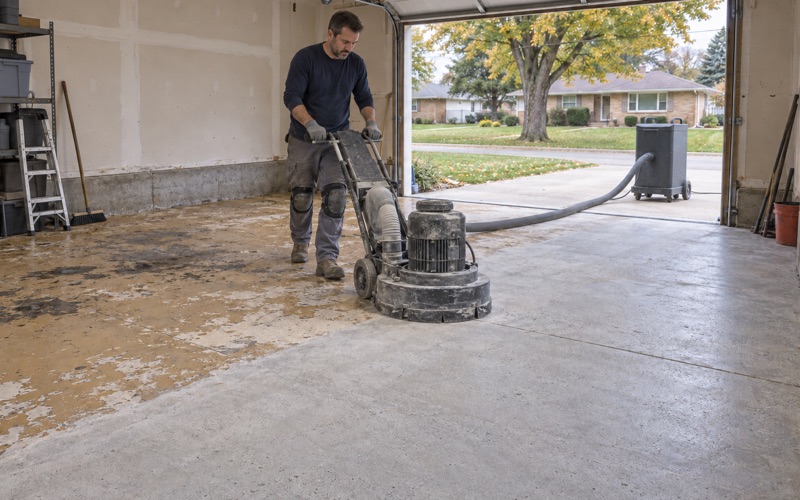
Old paint is the first thing we read. If an earlier one-part coating is still on the slab, it has to come off before anything new goes down, because a new system is only as well bonded as the layer under it. We open every slab with a diamond grinder or shot blaster, never an acid etch, so the new coat grips clean, profiled concrete.
Spot-Test Your Own Cleaner on a Cured Sample
Why your can, not a chart
Generic chemical-resistance tables are a starting point, but they rarely list the exact blend in the can on your bench. The reliable check is the cleaner you actually use, applied the way you actually use it, to a cured piece of the system you are actually buying. That turns a sales conversation into something you can see for yourself.
Shop owners sometimes ask whether a heavier build alone settles it. Thickness helps with impact and wear, but solvent resistance comes mainly from the chemistry of the top layer, the one the cleaner touches. That is why the topcoat choice, whether polyaspartic, polyurea or another option, gets tested rather than taken on faith.
Building the sample
We can lay a test panel or coat an out-of-the-way patch of the floor with the full proposed build, primer through topcoat, and let it cure to the manufacturer’s schedule. Testing a coating that is still young tells you little, since resistance builds as the cure finishes. Curing is timed against slab temperature and dew point rather than the calendar.
Once the sample is cured, the test mirrors real work. Wet the patch with your own brake parts cleaner, let it sit about as long as runoff normally sits under a wheel, then wipe it off. Repeat it on another day if brakes are a daily job in that bay, and keep the door open, since the product is extremely flammable.
Reading the result
Afterward, look and feel. A sound result shows no softening under a fingernail, no tackiness, no dulled or wrinkled area and no lifting at the edge of the wet spot. A mild gloss change may be cosmetic, while softening is a functional warning. If the sample fails, we change the topcoat or the system and test again rather than install and hope.
Results apply only to the product and blend tested, so switching cleaners calls for a fresh patch. That is also why our proposal names the product, the build and the finished thickness. What passed the test should be what goes down, and you should be able to check one against the other after the crew leaves.
Absorbent, Not a Hose Toward the Drain
What the label says about runoff
The 05085 label is direct about cleanup. Runoff should be collected and disposed of properly, spills are handled with absorbent and stored in closed containers, and the product is not to be dumped in sewers, floor drains, on the ground or into any body of water. A garden hose aimed at the floor drain is exactly what those lines rule out.
For a coated floor, that cleanup works in your favor. A sealed, seamless surface keeps liquid on top where absorbent pads or granules can pick it up, instead of letting it wick into open concrete. We set the finish texture so it wipes and absorbs cleanly while still giving traction to someone working beside a wheel.
Our own dust and debris
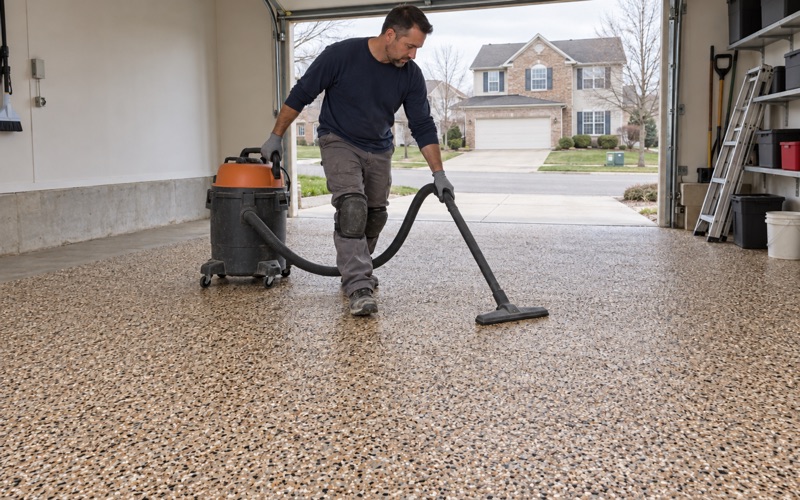
We hold ourselves to the same habit during installation. Grinding dust is collected at the grinder by vacuum and never washed toward a floor drain or storm inlet. Old coating removed from a garage that has seen years of solvent goes into bags and containers rather than across the slab, so the floor you get back starts clean.
Moisture, scheduling and paperwork in Worth
Moisture testing is a line item on every quote, whether by ASTM F2170 in-situ relative humidity probes or an ASTM F1869 calcium chloride test, and warranty exclusions are read out before the job is sold, moisture first. For a working shop, we schedule around the hours the bays have to stay open, including overnight and weekend windows.
The coatings we propose sit within the Illinois limit on VOC content in Part 223 of the Illinois Administrative Code, and that rule binds the applicator as well as the maker, so a product is never thinned past its limit to help it flow. Pricing is per square foot for the system actually proposed, not a national per-garage figure.
The Village of Worth requires contractors working there to register with it: a $110 registration, a certificate of insurance naming the village and a $10,000 surety bond, which we confirm before a date is set. The building department’s permit list names remodeling work but not flooring either way, so we ask first. Home jobs also get a written contract and the state’s consumer-rights pamphlet before work starts.
- 20+ Years on Concrete
- Moisture Tested Before Quoting
- Per-Square-Foot Written Quotes