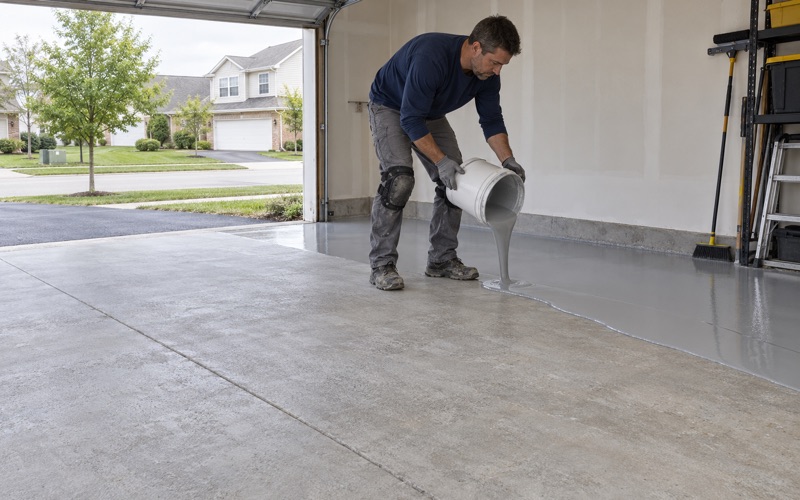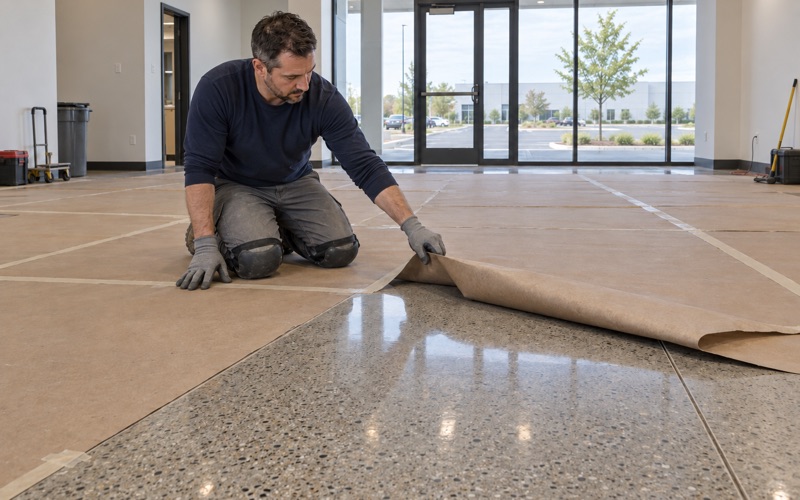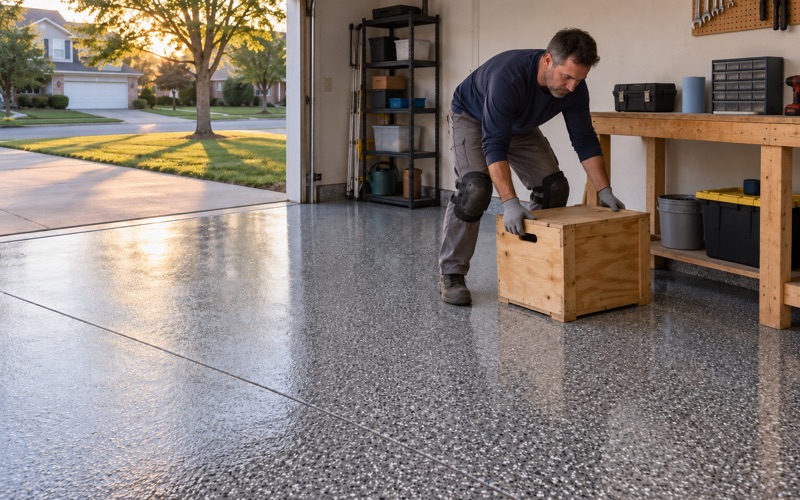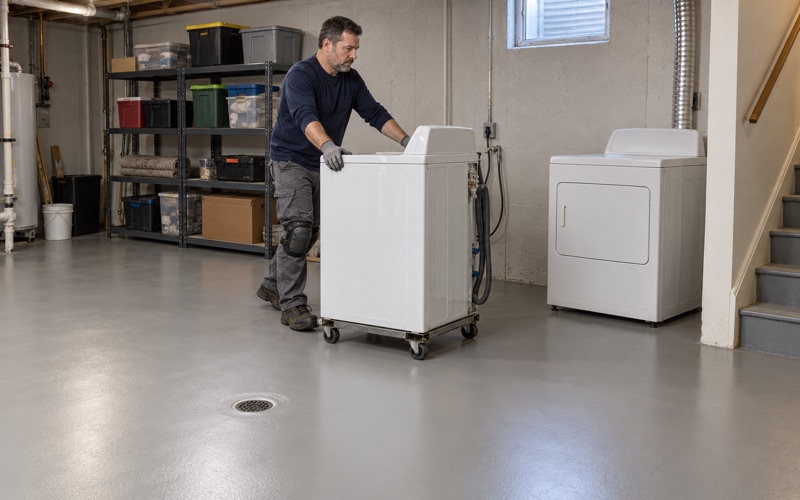
Romeoville Epoxy Flooring has spent more than 20 years installing epoxy flooring in Winfield, and the defect we plan against most carefully on sun-exposed and outdoor slabs is the pinhole. A pinhole is a tiny crater left in a cured coat where a bubble of air rose out of the concrete and broke the surface before the resin set. It looks minor, yet it is an open path through the film that dirt, salt brine and water find first.
Most pinholes are not a mixing mistake. They come from the slab underneath, from air held in the concrete that expands as the surface warms and pushes up into a fresh coat. That makes the start time as important as the product, and it is why we schedule the primer around what the slab temperature is doing rather than what the clock says.
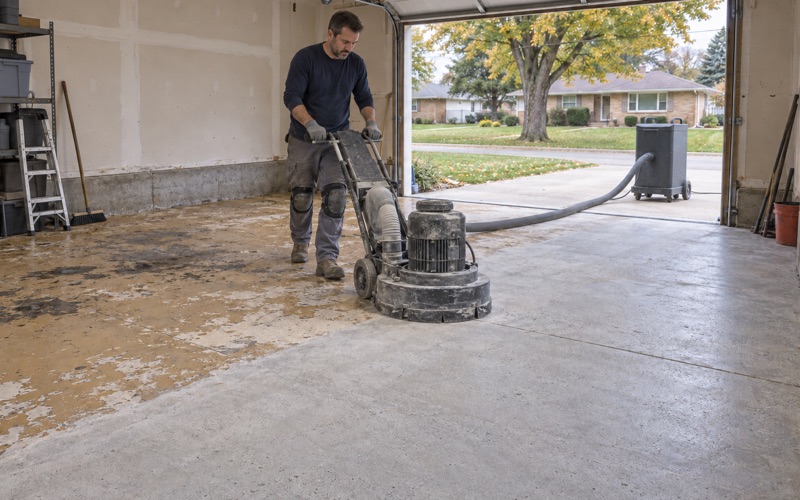
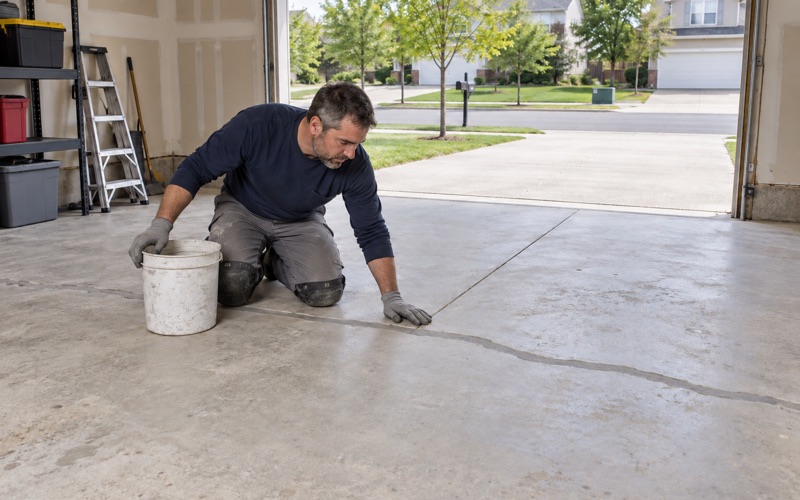
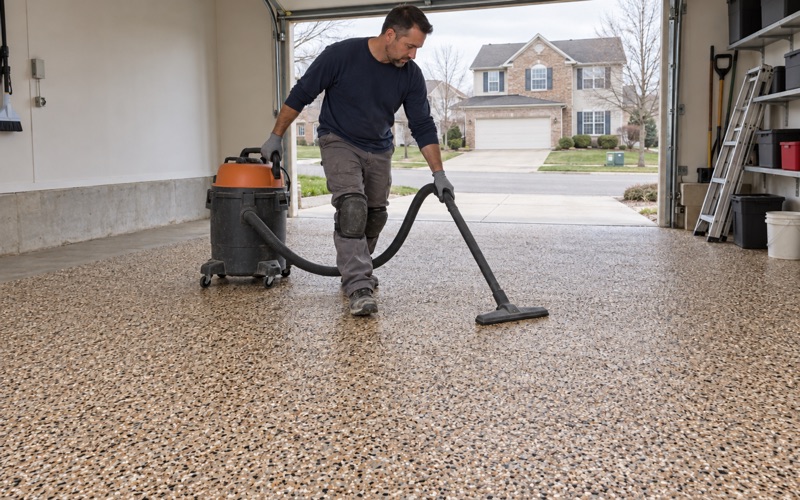
Every floor we take on is opened with a diamond grinder or shot blaster, never acid etched, and the proposal names the product, the system build and the finished thickness. Before any of that is priced, we read the cracks, joints and any old coating, and we say plainly when a slab needs repair before it can carry a coating at all.
What Winfield’s Slab Handout Builds Into the Concrete
The Village of Winfield publishes its own informational handout titled Slabs on grade, and its minimums tell us a good deal about the concrete we are likely to meet. It is short, but it is one of the few local documents that speaks directly to the slab a coating will sit on. Whether a particular slab was actually poured to it is something only that slab’s records can show.
Strength, thickness and the base underneath
The handout calls for a slab at least 3-1/2 inches thick, with concrete reaching a minimum compressive strength of 3,500 pounds per square inch. Where the slab sits below grade, a 4-inch base course of clean graded sand, gravel or crushed stone goes directly over the compacted fill. It also asks for a slope that drains away from the building and an expansion joint where the slab meets it.
That expansion joint matters to us. A coating bridged rigidly across a joint built to move will crack along it, so we stop the coating at the joint line and treat it with a flexible filler rather than burying it. Wire mesh or fiber reinforcing is recommended in the handout but not required, which is one more reason we read every crack before quoting.
Why the mix carries 5-7 percent air
The same handout specifies 3,500 psi concrete with 5-7 percent air entrainment. Air entrainment is deliberate: an admixture builds a dense network of microscopic bubbles into the paste so water freezing inside the slab has room to expand. It is the standard defense for concrete that sees weather, and through a DuPage County winter it is a sensible rule.
For a coater, those same bubbles are the complication. A slab built to hold air can give some of it back when conditions push it out, and an exterior patio, a garage apron or a slab under strong afternoon sun is where conditions push hardest. Winfield adopted the 2024 International Building and Residential Codes in November 2024, but this local slab rule is the detail that shapes how we coat.
Air in the slab, bubbles in the coat
Concrete is porous even when it looks dense. As a slab warms, the air in its pores and entrained voids expands and has to go somewhere, and the easiest exit is up through whatever liquid is lying on the surface. A bubble that rises into fresh primer and breaks after the resin has begun to gel leaves a crater the coat cannot flow back over.
That is outgassing, and it explains why two crews using the same product on the same day can get different results. One started while the slab was heating and chased bubbles all afternoon. The other waited for the slab to peak and coated it as it cooled.
Looking for epoxy-flooring closer to North Aurora? See Epoxy-Flooring Services in North Aurora.
Timing the Primer to a Cooling Slab
A primer manufacturer’s data sheet puts the rule plainly: on substrates likely to exhibit outgassing, apply during falling ambient and substrate temperature, because applying during a rising temperature can cause pinholing. That instruction comes from a product written for exterior roofing work, not a floor system we install, but the physics it describes holds for any resin laid over porous concrete.
Rising versus falling temperature
When the slab is warming, the air inside it is expanding and pushing outward, so every open pore is a potential bubble. When the slab is cooling, that air contracts and tends to draw the primer down into the pores rather than blow through it. The same coat applied three hours later can lay down clean simply because the direction of the temperature changed.
We take the slab’s own temperature with a surface thermometer, not just the air reading, because a sunlit slab can run well ahead of the air around it. The substrate trend, rising or falling, is the reading that decides when the first coat goes down.
A late-day start after the peak
On an exposed slab the practical answer is a late-day start, after the sun has come off the surface and its temperature has stopped climbing. A morning start on a patio that will face full sun by noon is the schedule most likely to produce pinholes, even when the product, the mix ratio and the crew are all correct.
That timing has a cost we name in the proposal. It can push a job into an evening shift or split it across two days, and we would rather schedule that honestly than promise a one-day floor that ends up pocked. Curing is planned against slab temperature, and when conditions will not cooperate we say the job waits.
What we confirm before mixing
Before mixing we confirm the slab is inside the product’s stated temperature range and that its surface sits safely above the dew point, and we log the readings. Moisture testing is its own line in the scope rather than something sold after a floor has blistered. None of these readings replaces the falling-temperature rule on an outgassing-prone slab; each simply has to pass as well.
Patios, Aprons and Sun-Struck Garage Slabs
The slabs most prone to outgassing are the ones an air-entrainment rule is written for: concrete that lives outdoors or close to it. They are also the slabs where a careless schedule shows soonest, because a pinholed exterior coat lets water and deicer under the film within a season or two.
Patios and exterior slabs
An exterior patio takes direct sun, cools quickly at dusk and is typically poured with air-entrained concrete built for freeze-thaw. All three point the same direction: coat it late, after the surface has peaked. We also choose an exterior-rated topcoat, because plain epoxy left in sunlight yellows and chalks, and polyaspartic topcoats hold their color better in that exposure.
A coating does not waterproof a patio or stop water moving through the slab. It protects the surface it covers, and we say so at the quote so nobody expects it to fix a drainage problem underneath.
Garage aprons and the driveway edge
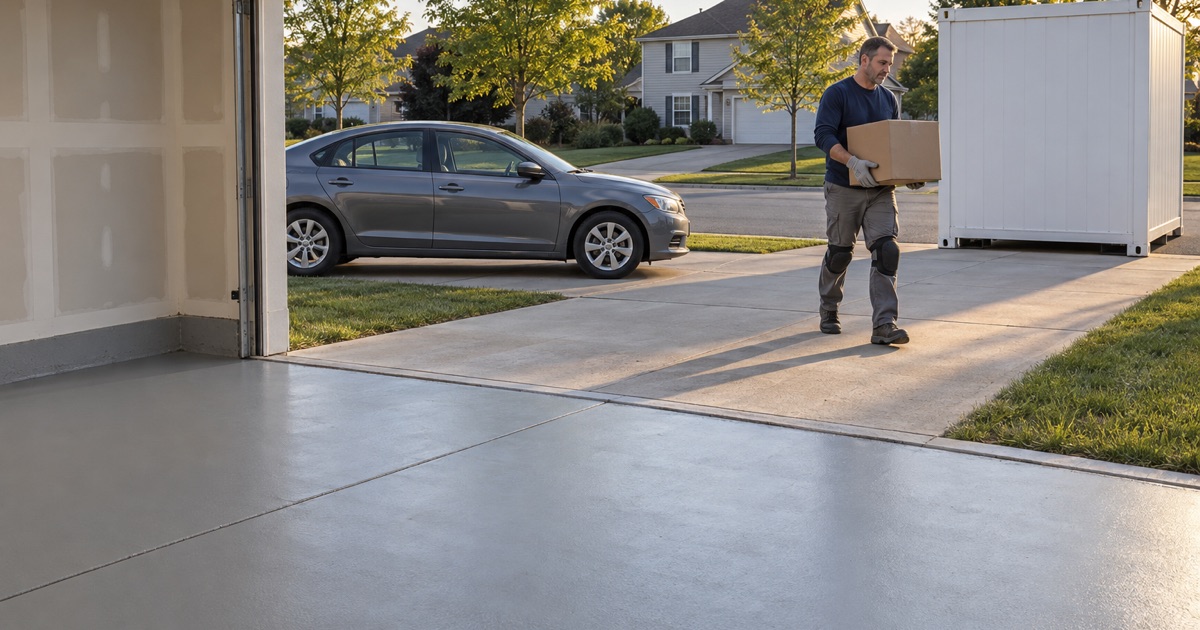
A garage apron sits half inside and half out, so its temperature can swing differently from the slab behind the door. The expansion joint the handout asks for where a slab meets the building often falls right at this line, and we treat it as a moving joint. Calcium chloride brine and rock salt tracked in on tires concentrate here too, so the system is built for that exposure.
Detached and west-facing garages
A detached garage under a dark roof, or an attached one with a west-facing door left open on summer afternoons, can heat its slab far more than an interior basement floor. Those floors get the same treatment as a patio: we close the space, let the slab settle and start the primer once it has turned the corner and begun to cool.
When an unheated garage cannot be held in the right range, we say plainly that the job is better left for spring. A floor laid into the wrong conditions costs more to fix than a few weeks of waiting.
Finding and Filling Pinholes Before the Body Coat
Timing reduces outgassing but does not guarantee a slab will give up no air at all. Our sequence treats the primer as a sealing coat and the gap before the body coat as an inspection window, so a pinhole is caught while it is still a small repair rather than a flaw locked under the finish.
A penetrating primer first
After grinding, with the dust collected at the grinder rather than washed toward a drain or storm inlet, we lay a penetrating primer thin enough to soak into the opened surface. Its job is to fill and seal the pores that would otherwise vent into the thicker coats above. Applied on a falling slab temperature, it gives the air below less reason to move.
The primer is matched to the slab and the system, often a 100% solids epoxy, and the exact product is written into the proposal. Every coating we select falls within the Illinois limits on VOC content for architectural coatings, which bind the installer as well as the manufacturer.
Inspecting the cured primer
Once the primer has cured enough to walk on, we inspect it under raking light, a low-angle beam that throws a shadow into every crater. Pinholes show as tiny dark points, often clustered over a porous patch, a cold joint or an old repair. We mark each cluster so nothing is missed when the next coat goes on.
Filling before the body coat
Marked pinholes are filled with a tight scrape coat or a thickened resin pressed into each crater, then lightly sanded once cured so the next layer bonds cleanly. Only then do the body coat, the vinyl flake or quartz broadcast and the topcoat go down. Skipping this step lets pinholes telegraph through, because a thicker coat bridges a crater without filling it.
Warranty exclusions are read out before the job is sold, with moisture named first. Every home job also gets a written contract and the state’s Home Repair: Know Your Consumer Rights pamphlet before work starts, as the Illinois Home Repair and Remodeling Act requires.
Registering with the village first
Winfield’s Building Department asks contractors to register before working in the village, and it notes that building permits are required before most interior or exterior improvements are made. Illinois issues no state license for floor coating work, so we confirm the village’s own registration, bond and insurance requirements before a start date is set.
- 20+ Years on Concrete
- Moisture Tested Before Quoting
- Per-Square-Foot Written Quotes