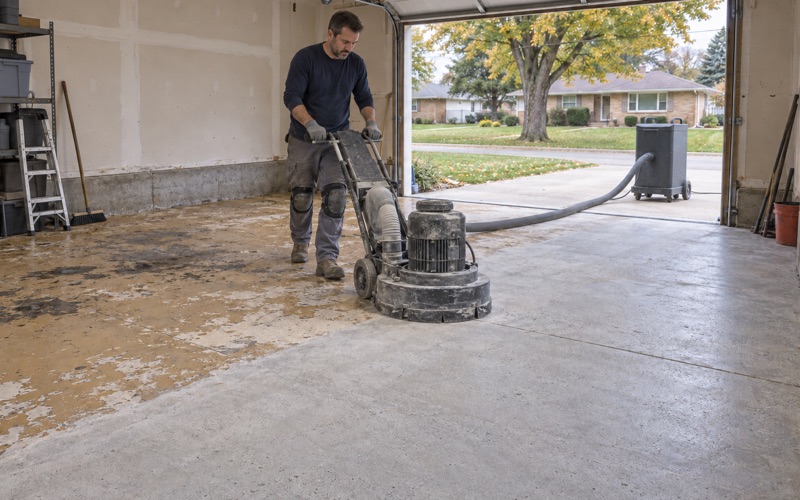
Romeoville Epoxy Flooring installs epoxy flooring in Warrenville for homeowners and food businesses who need a floor that keeps grease, brine and daily scrubbing away from the concrete underneath. With more than 20 years on Illinois slabs, we open every surface with a diamond grinder or shot blaster before any resin goes down, and we never acid etch. That mechanical profile is what a coating actually bonds to.
Our scope starts with the slab, not the color chart. We test for moisture as a listed line item, read the cracks, joints and any old coating before we quote, and tell you plainly when concrete needs repair or replacement first. The proposal names the product, the system build and the finished thickness, so you can check what went down against what we priced.
This page is about one floor problem that gets less attention than it deserves: animal fat. A butcher counter, a cutting room or a garage used for processing game puts fat on the floor day after day, and on bare cement it does more than leave a dark patch. Below we explain why, and what a resin floor has to do about it.
A New Meat Counter on Route 59, and What Fat Does to Cement
Warrenville Fresh Market and the aisle-by-aisle remodel
The longtime grocery at 2S501 IL Route 59, the former Tom’s Market, was bought in early 2026 by Raj Patel and his brother, who already run two small grocery stores in Bensenville. The city’s announcement described plans to reopen as Warrenville Fresh Market, keep the store open during renovations, and install new flooring, shelving and coolers aisle by aisle.
Part of that plan was a new fresh meat department, a Carniceria with a new meat case and equipment, and a later city post marked the grand opening with a bakery and butcher shop open daily from 6:00 a.m. We have no relationship with the store, and which flooring product went into those aisles is not something we know.
Why a meat counter is a floor problem
A meat counter is a different floor from the produce aisle. Trim, juice and rendered fat land behind the case and around the cutting table every shift, and foot traffic presses that film into any pore, joint or grout line it finds. The cleaning crew can mop the top of it away; what has already soaked into cement is a separate matter.
Saponification in the pores
Concrete and cement grout are strongly alkaline, mostly from the calcium hydroxide in the cement paste. Researchers writing in the Japan Concrete Institute proceedings in 2017 describe what happens when fat or oil meets that alkali: saponification, the same reaction that turns fat into soap, producing fatty-acid salts and glycerin. Those salts can expand inside the capillary pores and damage the microstructure from within.
Over time the expected result is a surface that darkens first, then softens and crumbles where fat has sat the longest, such as along the base of a counter. Cement grout between quarry tiles is just as exposed as a bare slab, which is why a tiled floor is not automatically safe from it.
Laboratory evidence, slow in the field
It is worth being honest about the strength of that evidence. The same authors note that degradation from oil or fat is not often observed or reported, and their tests assumed oil spilled on a mortar floor and left there a long time. A 2022 RUDN University immersion study found large strength losses, but those were samples sitting in oil, not a working floor.
So we do not tell anyone their concrete will fail on a schedule. The useful conclusion is narrower: fat left on bare cement for years is a slow, real way to lose a surface, and a floor that never lets fat reach cement paste removes the question entirely.
Looking for epoxy-flooring closer to Hinsdale? See Hinsdale Epoxy-Flooring.
Seamless Resin and an Integral Base at a Butcher Counter
Nonporous comes before tough
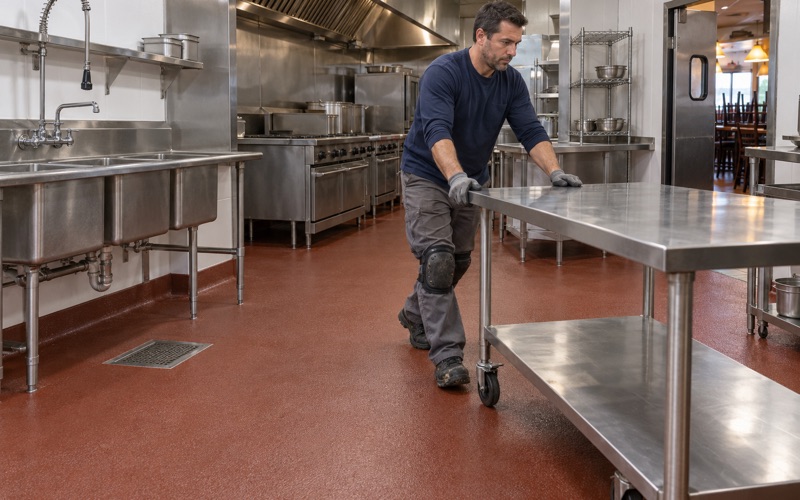
For a meat room the property that matters most is that the floor has no pores at all. A 100% solids epoxy body coat or a urethane cement system laid over a properly ground slab is continuous: there is no grout line, no open pore and no seam where fat can collect. Urethane cement in particular is chosen where hot-water washdown and cooler doors bring temperature swings.
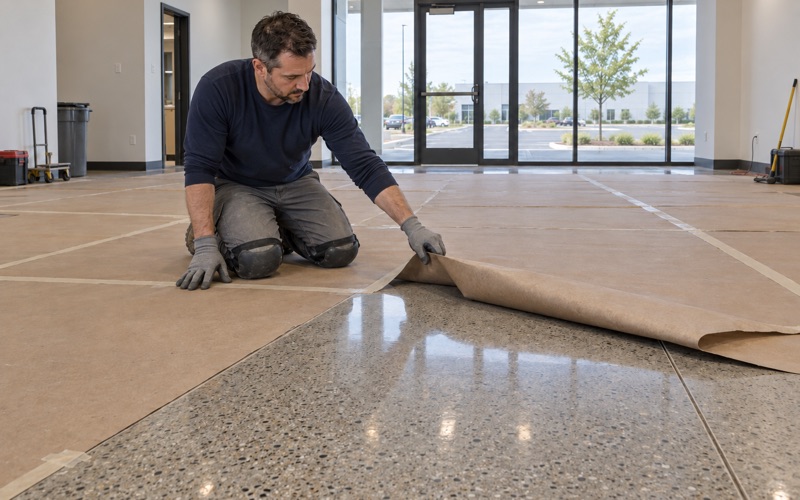
Before any of that, the slab has to accept it. We grind or shot blast to the ICRI surface profile the system calls for, and where an old floor is already saturated with fat, we cut back to clean, sound concrete rather than sealing contamination underneath. A coating bonded to grease is a coating that lets go.
An integral cove base at the wall
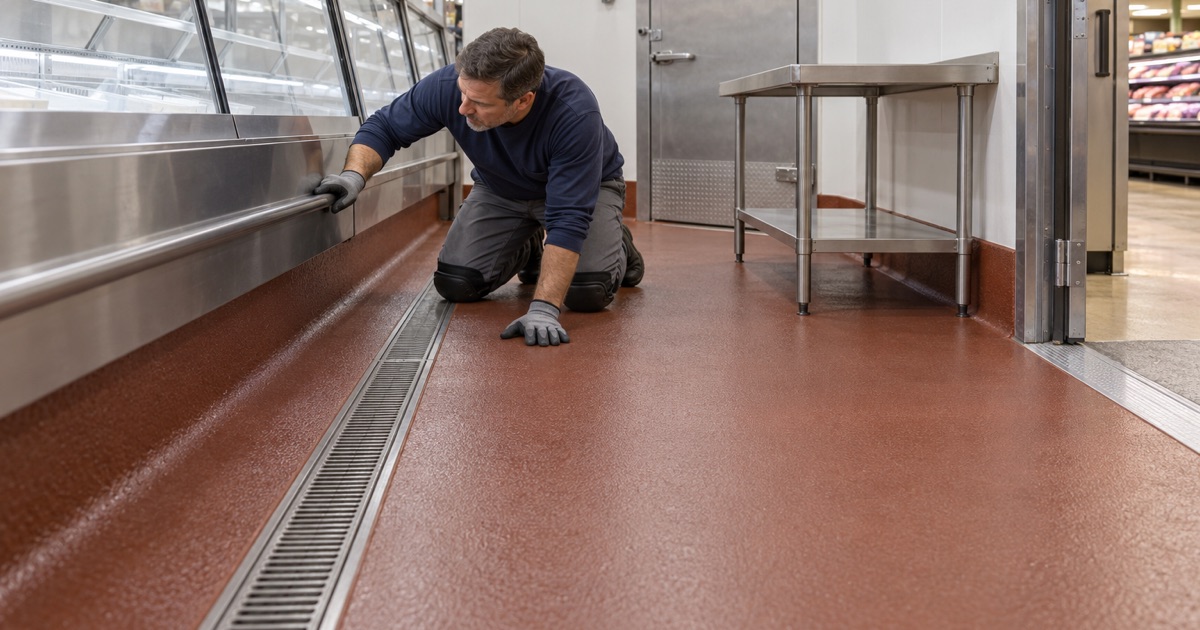
The floor-wall joint is where fat collects and where mops push it. An integral cove base carries the resin up the wall in a continuous radius, so there is no corner for trim to lodge in and no crack between floor and wall for juice to wick down. Around the meat case and cutting table, the cove follows every curb.
Drains deserve the same attention. A floor sloped toward a trench or floor drain should carry the resin right into the drain body and seal around it, because a ring of bare concrete at the drain lip is where washwater and fat sit longest. That ring is one of the first places we look on an existing floor.
Texture that still cleans
A greasy floor is a slippery floor, so a meat room needs grip. We broadcast quartz aggregate into the body coat and lock it under the topcoat, choosing a profile coarse enough to hold a boot on a fat film but fine enough that a deck brush still reaches the bottom of it. Too much texture becomes a place for fat to hide.
For a food business in Warrenville, we specify the floor so it is ready for DuPage County Health Department plan review before the permit is issued, and commercial occupancy work also passes through the Warrenville Fire Protection District. We prepare the floor documentation; approval belongs to those agencies, and we do not certify compliance ourselves.
Daily Degreasing, and Recoating Before Wear Reaches Concrete
A degreasing routine the coating can live with
Resin protects concrete only while it stays intact, and cleaning is what keeps it intact. At a butcher counter that means degreasing daily rather than letting a film build: scrape solids, apply a degreaser compatible with the topcoat, scrub with a deck brush or auto-scrubber, and rinse to the drain. Fat left overnight on a textured floor turns sticky and holds grit.
We hand over the product data with each floor so the store or homeowner knows which cleaners the topcoat tolerates. Strong solvents and metal scrapers both shorten a coating’s life, and a floor scrubbed with the wrong chemical can dull and soften long before traffic would have worn it.
Watching the traffic paths
Wear does not arrive evenly. Behind the counter, at the cooler door and along the path a pallet jack takes from the back room, the topcoat thins first. Once the texture is polished smooth there or the color has worn through to the body coat, the floor is telling you the next layer down is cement, and that is the moment to act.
Recoat timing
A recoat is far cheaper than a rebuild. While the body coat is still sound, we abrade the surface, clean it of fat, and apply a fresh topcoat, sometimes with new aggregate in the worn lanes. Wait until fat has reached bare concrete and the job becomes grinding out contaminated cement, patching and starting the system over.
For a store that keeps its doors open from early morning, we schedule that work overnight or across a slow weekend window, one zone at a time, much the way a remodel goes aisle by aisle. Cure is planned against slab temperature and dew point, especially near coolers, rather than against the clock alone.
The Home Version: Deer Processing and Frying in the Garage
The same chemistry applies at home. A Warrenville garage where a hunter breaks down a deer each fall, a family renders lard, or a turkey fryer runs on the slab puts fat on bare concrete in exactly the way a meat counter does, just less often. The answer is the same too: keep fat off cement paste.
Processing on a coated garage floor
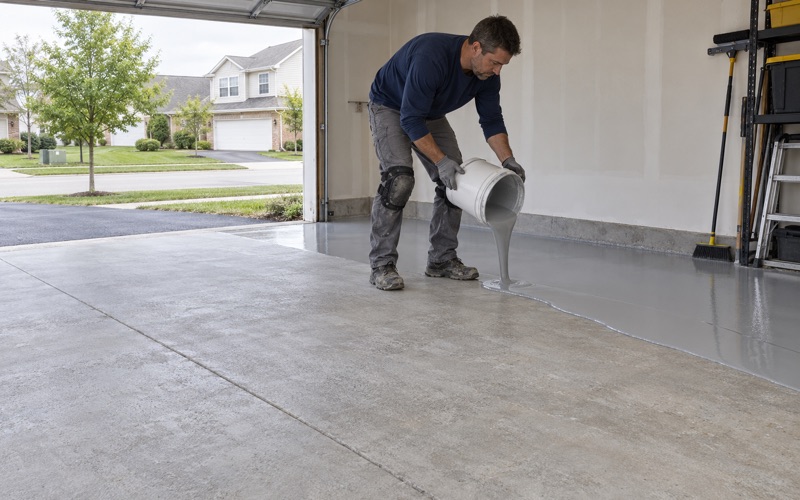
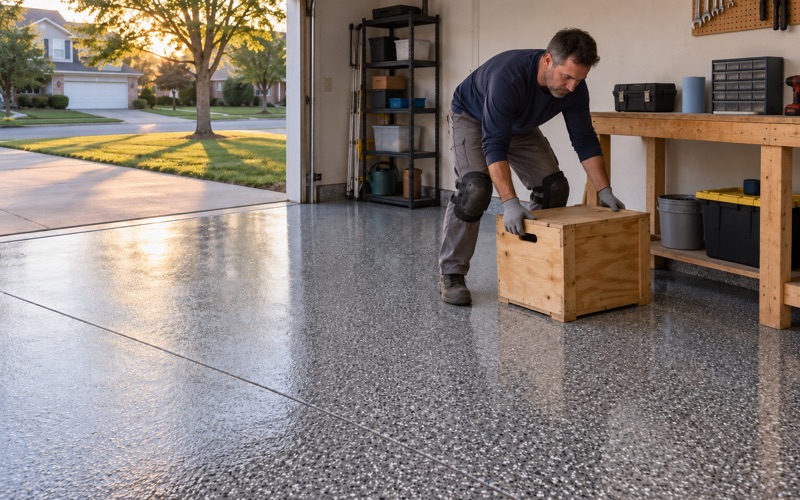
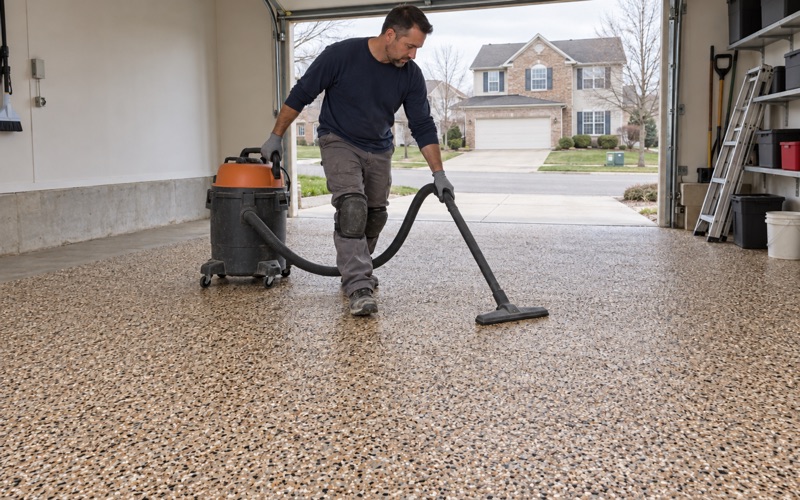
For a home processing area we usually build a 100% solids epoxy base with a vinyl flake or quartz broadcast and a polyaspartic topcoat, which cleans easily and resists hot tire pickup the rest of the year. A short integral base along the wall where the table stands keeps blood and fat out of the joint between slab and foundation.
Cleanup matters as much as the coating. Scrape and degrease the same day you finish processing, rinse toward the door rather than leaving a film, and keep hot fryer oil on a tray instead of the floor. A coating handles spills; it does not handle a pool of fat left for a week.
Older slabs and spring curing
Warrenville’s housing peaks in the 1970s, with 1,650 units from that decade and 62.1 percent of the stock built between 1970 and 1999, so a garage slab 30 to 55 years old is the usual starting point. Every one predates the ASTM E1745 vapor retarder standard, which is why moisture testing sits in our scope rather than arriving as an upsell after blistering.
An unheated garage also governs the calendar. Resin needs the slab warm enough, and far enough above the dew point, to cure properly, and when a garage cannot hold that in winter, we say plainly that the job waits for spring. Our garage systems are also built for the calcium chloride brine and rock salt that ride in on tires.
Permits, paperwork and price
The city’s permit page lists flooring among work that does not need a building permit, so a residential garage coating is normally not a city permit question. Every home job still gets a written contract and the Illinois consumer-rights pamphlet before work starts, as the Home Repair and Remodeling Act requires, and warranty exclusions are read out first, starting with moisture.
Pricing is per square foot for the exact system proposed, not a national per-garage figure. Grinding dust is captured at the grinder and never washed toward a drain, and the coatings we choose fall within Illinois VOC limits. If your garage doubles as a processing room for a few weekends a year, tell us, and we will build the floor for it.
- 20+ Years on Concrete
- Moisture Tested Before Quoting
- Per-Square-Foot Written Quotes