Romeoville Epoxy Flooring brings more than 20 years of slab work to epoxy flooring in Summit, and this page looks at one kind of room in particular: the floor people dance on in dress shoes. Event halls and party rooms carry a load most floors never see, delivered through heel tips rather than tires or pallets. The question an owner faces is which finish wears that traffic and which one dents.
Our answer starts below the coating. We open every slab mechanically, with a diamond grinder or a shot blaster, and we never acid etch it. Moisture is tested as a priced part of the scope rather than sold after a floor has blistered. A resin system is only as firm as the concrete it is bonded to, so that concrete decides how the finished floor behaves under a heel.
The proposal we hand over names the product, the build of each coat and the finished thickness, so an owner can check what went down against what was quoted. We also read the warranty exclusions aloud before anything is signed, moisture first. A hall owner should know exactly what a new floor is expected to survive and what it is not.
A Summit Banquet Hall Built for Weddings and Quinceaneras
Valladolid Banquet Hall sits at 6254 South Archer Road in Summit. Its own site describes a spacious setting for weddings, galas and social gatherings, with a balcony, high ceilings, oversized RGB chandeliers, an LED dance floor and a midnight taquiza. Its profile lists room for up to 350 guests at weddings and quinceaneras, which makes it a useful picture of what an event floor in this village is asked to do.
A guest list measured in heels
A full wedding or quinceanera puts a few hundred people on one floor for an evening, many of them in dress shoes and stilettos. They come through the entry, cross to their tables, line up for food and walk to the dance floor and back again for hours. That is the traffic pattern any Summit event room is built around, whatever its size.
We should be clear about what we know. Valladolid is not a customer of ours, and we have not seen its floors, its dance floor or its build-out. We use it here because a public hall of that size makes the question concrete, and because the same reasoning applies to any banquet room, restaurant party space or social hall in the village.
Existing rooms, existing slabs
Summit takes its name, in use since 1836, from the highest point on the Chicago Portage between the Chicago and Des Plaines rivers, just north of the city. Most of the village’s housing was built before 1960 and very little has been added since the 1970s. Floor work here is nearly always on an existing slab rather than a new pour, and an event room is no exception.
Looking for epoxy-flooring closer to Crestwood? See Epoxy-Flooring Services in Crestwood.
What a Spiked Heel Does to a Floor
Flooring makers put a high heel or spiked shoe at around 1,000 psi and over. AHF, a resilient flooring manufacturer, says forces in that range may visibly damage resilient floorings and other commercial floor coverings, and that the smaller or sharper the impact area, the more damaging the indentation. That figure is the maker’s round number for heels in general, not a reading taken at any Summit hall.
Small contact, concentrated pressure
The logic holds even without a measurement. Body weight that spreads across a whole sole in a flat shoe is pressed into the tip of a stiletto, a tiny fraction of a square inch. A trade article puts a capped stiletto tip at about one-twentieth of a square inch, which is why heels find soft spots that sneakers and loafers never notice.
The warranty line owners miss
Armstrong’s residential warranty guide for its vinyl sheet flooring lists what is not covered, and spiked heel shoes are on that list beside cuts from sharp objects. The maker has already decided that heel dents in its vinyl are the owner’s problem. A hall that chose resilient flooring for its looks may find that the dimples by the dance floor are not a warranty claim at all.
We read our own exclusions the same way, out loud and before the sale. Moisture comes first, because it is the most common reason a bonded floor lets go, and the condition of the slab underneath comes next. An owner who knows which damage is covered can plan maintenance and budget for it instead of finding the fine print after the first busy season.
Bonded resin has no soft layer
A resin system fully bonded to sound concrete behaves differently. There is no cushion, foam backing or soft wear layer for a heel tip to sink into, so the pressure passes straight into the slab beneath. On a well-prepared floor, heel traffic shows up as scuffing and topcoat wear rather than dimples, and scuffs are something a cleaning routine and a recoat can address.
That is not the same as dent-proof. A coating does not repair a hollow, cracked or soft slab, and heel points are exactly what find those spots, cracking a thin film over a void or breaking through where the concrete underneath is weak. The strength of the finished floor is borrowed from the concrete, which is why the slab gets our attention before any color is chosen.
The Floor Around the LED Dance Floor
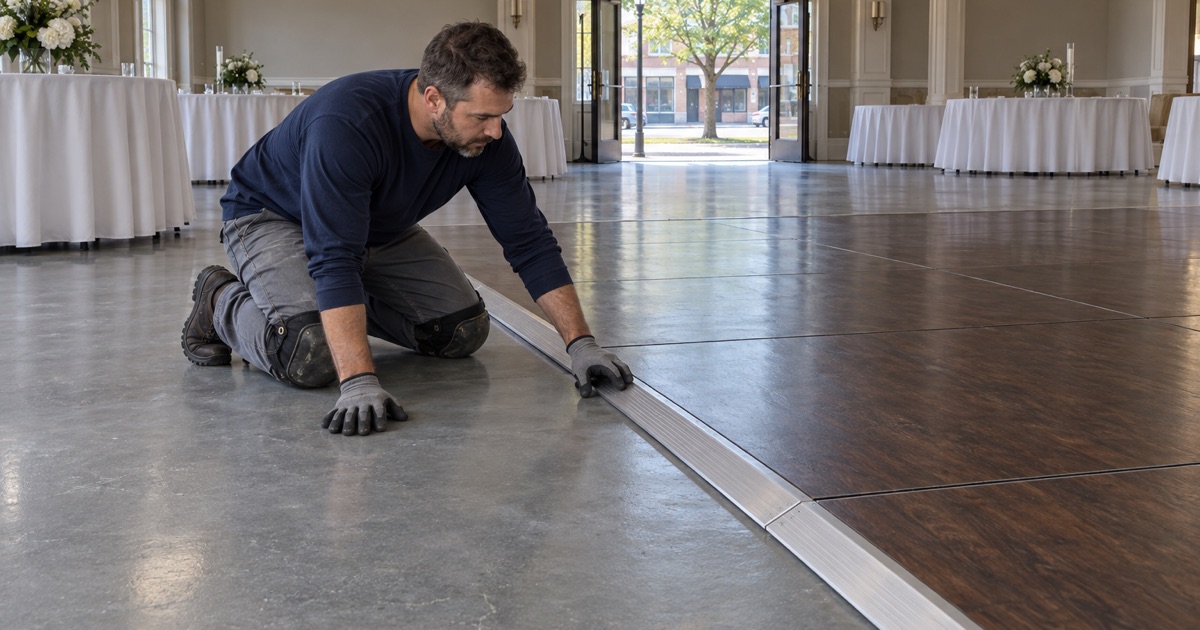
An LED dance floor is usually a set of modular panels laid on top of the room’s floor, and it only covers the area where those panels sit. Everywhere else, the slab finish carries the evening: the entry, the aisles between tables, the buffet line, the bar and the path guests take to reach the dancing. Those are the areas we would look at first in a Summit banquet room.
Entry and arrival
The entry is where parking-lot grit meets a new pair of heels. Sand and road grit carried in on shoes act like an abrasive under a heel tip, so the first stretch inside the door wears fastest. We recommend walk-off matting at the door and a topcoat chosen for abrasion resistance in that zone, with a recoat planned there sooner than in the rest of the room.
Winter adds rock salt and calcium chloride brine to that grit. Both leave a white film on a coated floor when they dry, and both are best removed with a neutral cleaner rather than left to grind under foot traffic. A light-colored floor shows that residue sooner, which helps a manager keep the entry clean before it dulls the finish.
Aisles and the route to the dance floor
Guests repeat the same few routes all night: table to bar, table to buffet, table to dance floor. On a resilient floor those lanes collect the dimpling that makers warn about. On a bonded resin floor the same lanes show as a duller path in the gloss, which tells a manager where the next maintenance coat belongs well before the build underneath is touched.
The border where portable panels meet the slab is a transition guests cross constantly, often in a hurry when a favorite song starts. We check that edge zone for low spots, old patches and cracks, because stepping off a raised panel is an awkward, heel-first stride. A weak patch there will show first, and it is far cheaper to repair before coating than after.
Table areas and the serving line
Table areas take a different kind of heel traffic: guests standing, shifting their weight and turning in place during toasts, speeches and photos. That twisting motion scuffs more than it dents, which is why the topcoat in these zones is chosen for scuff resistance rather than raw hardness alone.
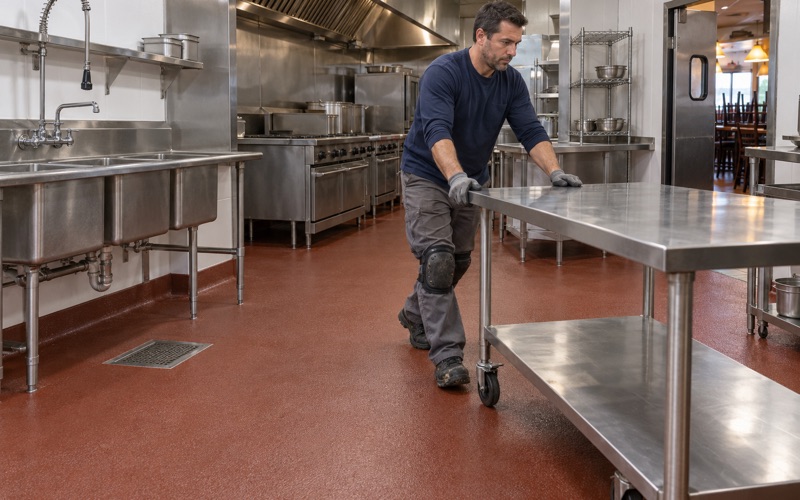
A hall that serves a buffet or a late-night meal also has a kitchen and service area behind the dining room. In Summit those floors come under the Cook County Department of Public Health, and we specify them for county plan review before the permit is issued, including coved floor-to-wall junctures under FDA Food Code 6-201.13. That review comes before any choice of color or finish.
Sound Slab First, Then a Scuff-Resistant Topcoat
Everything above comes down to two decisions made in order. The slab has to be sound enough that a heel point has nothing to find, and the topcoat has to be chosen for the wear a dress shoe actually causes. Getting the first one wrong cannot be fixed by spending more on the second.
Reading the slab before we quote
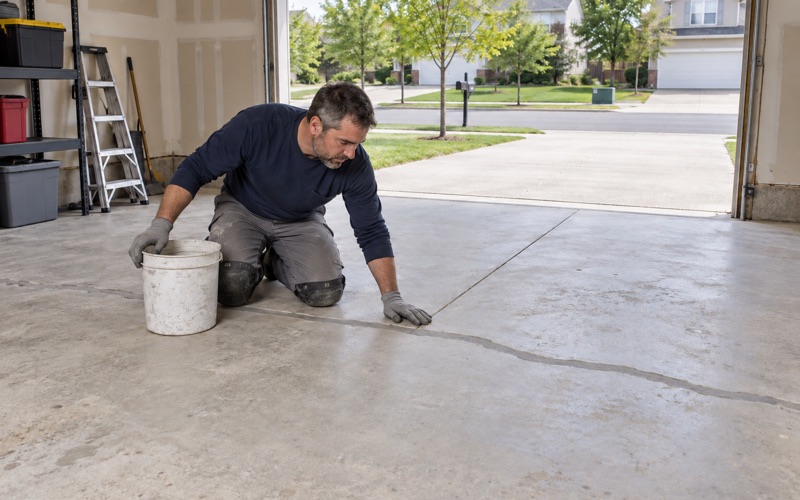
Before we price an event-room floor, we walk it and read the cracks, joints and any old coating, and we sound suspect areas for hollow spots. If the slab needs repair or replacement before it can be coated, we say so plainly. A banquet room that has been tiled, carpeted and refinished over the years can hide all three, so we expect to find something under the old surface.
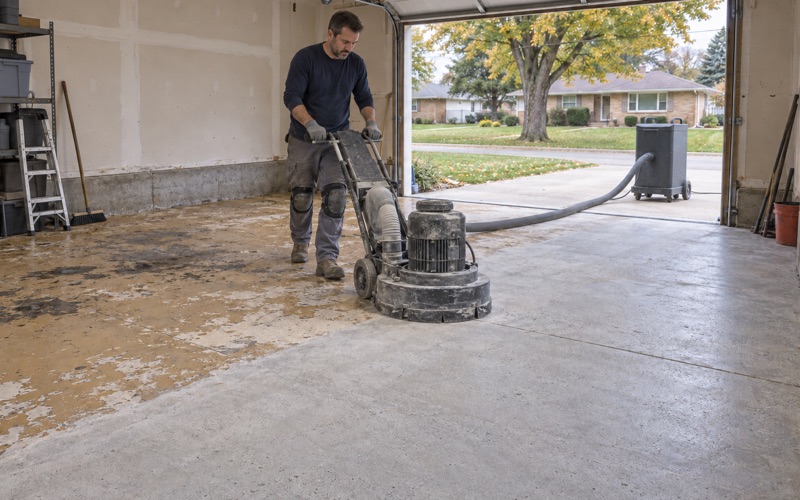
Preparation is mechanical. A diamond grinder or shot blaster opens the surface to the ICRI CSP profile the primer calls for, and the grinding dust is collected at the machine rather than washed toward a floor drain. Moisture is tested as a line item, with ASTM F2170 in-situ relative humidity probes where the system calls for them, before a single coat is mixed.
Choosing the topcoat for dress shoes
For heel traffic we think in layers: a 100% solids epoxy body coat bonded to the prepared slab, then a topcoat picked for scuff and wear resistance, such as a polyaspartic or a polyurethane. That scuff-resistant topcoat is the sacrificial layer. When the busiest lanes start to dull, it can be abraded and recoated without disturbing the build underneath.
Gloss level matters as much as chemistry. A satin finish hides fine heel scuffs better than a high gloss, and a vinyl flake or quartz broadcast breaks up wear patterns visually. Every product we propose is also chosen within the Illinois VOC limits for floor coatings, which bind the installer as well as the manufacturer, so the room can be reopened to guests without a lingering solvent smell.
Scheduling around a booked calendar
A hall that books weddings and quinceaneras every weekend cannot close for a week. We schedule event-room work around that calendar, using weekday and overnight windows, and we time each coat against slab temperature and dew point rather than a fixed day count. The room goes back into service when the coating is ready for heels, not just dry to the touch.
Illinois issues no state license for flooring or coatings work, so before a job is scheduled we confirm the Village of Summit’s own contractor registration, bond and insurance requirements with its Building and Public Works department at 7321 West 59th Street. On Archer Road we also confirm which side of the Summit and Bedford Park line an address falls on, since 6400 South Archer is Bedford Park and the permit desk depends on it.
- 20+ Years on Concrete
- Moisture Tested Before Quoting
- Per-Square-Foot Written Quotes