Romeoville Epoxy Flooring installs epoxy flooring in Shorewood for clinics, garages and commercial spaces, and after more than 20 years of grinding and coating slabs we open every treatment-room job with one question: what has to be found on this floor after a patient leaves? In a room where fine needles are used, the answer shapes the color, the texture and the edges of the system we propose.
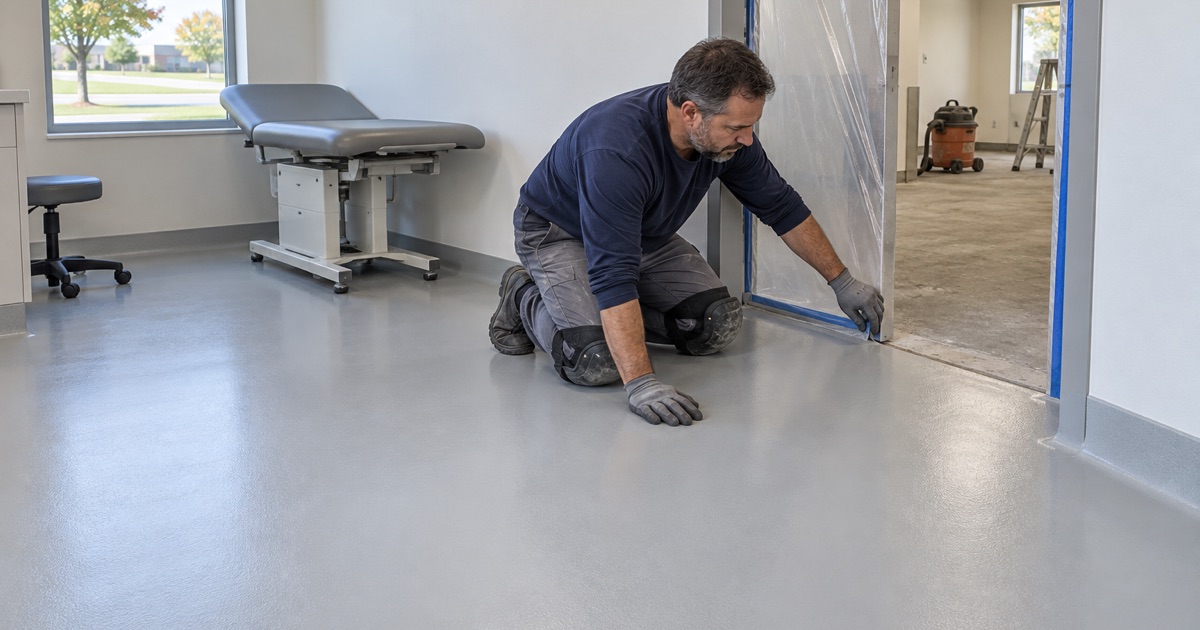
That question pushes us toward a smooth, light, solid-color resin floor in the treatment area, with joints filled and the base of each wall coved, while grip texture stays in the lanes where people lift and carry. A floor that hides small debris can look clean when it is not, and a clinic owner deserves to know that before choosing a finish.
Our proposals name the product, the system build and the finished thickness, so a practice manager can check what went down against what was quoted. Before any of that, we walk the slab, read its cracks, joints and old coating, and tell you plainly if the concrete needs repair first.
Dry Needling on Jefferson Street and the Floor Under the Table
Shorewood is a village in Troy Township, Will County, and its outpatient rehab sits along the main corridors. Athletico Physical Therapy at 700 W. Jefferson Street lists dry needling among its services, alongside work conditioning and functional capacity evaluations. We have not worked in that clinic and have not seen its floors; we name it because it shows the kind of room this page is about.
What dry needling leaves behind
Dry needling uses fine, solid needles placed through the skin, and a session may use more than one. Used needles belong straight in a sharps container, but in any busy room one can slip from a glove, fall off a tray or roll off the edge of a table. Hair-thin and short, it lands on whatever floor the clinic chose.
That makes it a floor question before it is a procedure question. A dropped needle on a dark, speckled surface can lie unseen until someone kneels, sits or steps on the spot. The floor will not stop it from falling, but the right finish decides whether staff can spot it in the moment it lands.
One building, two kinds of floor
A clinic that runs needling tables and work-conditioning lanes under one roof is asking a single slab to do two jobs. The treatment area needs a surface that reveals small objects and wipes down easily. The conditioning area, where patients push sleds, lift boxes and repeat job tasks, needs footing. We design those as two zones rather than averaging them into one compromise finish.
The decision is easier to make before a buildout than after. Once tables and conditioning equipment are bolted in, re-zoning a floor means moving everything twice. When a Shorewood clinic plans a renovation, we prefer to mark the needling rooms and the conditioning lanes on the drawings, so the grinding, base coats and finish breaks follow those lines from the start.
Looking for epoxy-flooring closer to Burr Ridge? See Burr Ridge Epoxy-Flooring.
When a Dropped Needle Becomes a Contaminated Sharp
OSHA’s bloodborne pathogens standard, 29 CFR 1910.1030, defines contaminated sharps as any contaminated object that can penetrate the skin, including needles. Under paragraph (d)(4)(iii)(A)(1), contaminated sharps shall be discarded immediately or as soon as feasible in containers. A used needle on the floor is therefore not litter for the evening mop; it is something the clinic has to find and put away now.
Found now, not swept up later
The words as soon as feasible put the weight on finding the needle quickly. A needle that disappears into the floor pattern cannot be discarded until somebody stumbles across it, possibly with a mop head, a knee or a shoe sole. A floor that makes small objects visible turns the rule from a hope into a routine the staff can actually follow.
We are careful about what this means. OSHA does not prescribe a floor color or texture, and nothing in the standard calls for a particular coating. The link between a light, smooth floor and quick sharps retrieval is our reasoning as floor installers, offered so a clinic can weigh it alongside its own exposure control plan.
Forceps or a magnet, not fingers
The same standard says broken glassware that may be contaminated shall not be picked up directly with the hands, and the same caution makes sense for a needle. On a smooth floor a dropped needle can be lifted with forceps or drawn up with a magnet. On a deep broadcast texture the tip catches between chips and tempts someone to pinch it out by hand.
Retrieval tools only help if the floor cooperates. A magnet sweeps a smooth surface in one pass, and forceps close cleanly on a needle lying flat against a level topcoat. Neither works well when the shaft is lodged between quartz grains, so the choice of finish decides whether the clinic’s retrieval routine is quick or awkward.
Why Flake and Quartz Hide Small Sharps
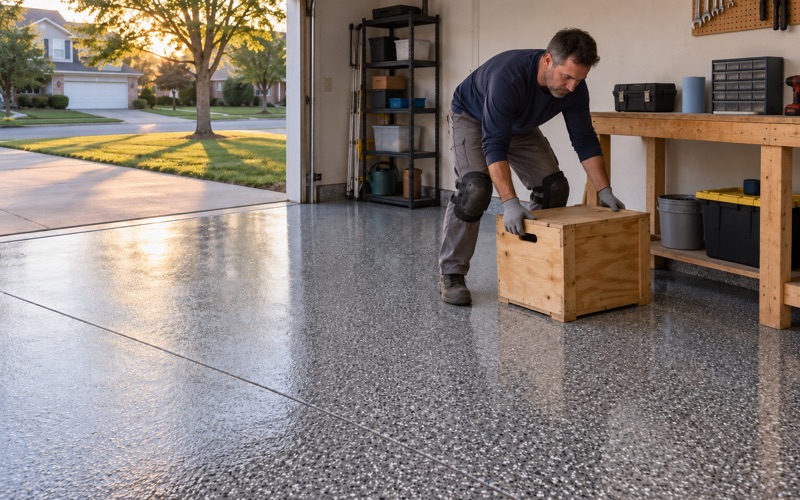
Vinyl flake broadcast and quartz aggregate broadcast are two of the most popular epoxy finishes we install, and in a garage or a warehouse aisle they earn that popularity. They hide dust, tire marks and wear, and the texture adds grip. In a needling room those same strengths work against the clinic, because a floor designed to camouflage debris will camouflage a needle too.
A busy pattern swallows a thin line
A multicolor flake blend is built from thousands of small, contrasting shapes and edges. A needle is a short, thin metallic line, and against that background it reads as one more fleck. Light glancing off a quartz broadcast does something similar, scattering small glints that a steel shaft blends straight into.
Texture causes a second problem. A broadcast floor has peaks and valleys by design, and a needle that lands on it can wedge into a valley rather than lying flat. A mop then pushes it deeper or carries it to another part of the room, which is exactly the outcome the clinic most wants to avoid.
Where flake still belongs in the same clinic
None of this rules flake or quartz out of the building. Hallways, storage rooms and staff areas away from the treatment tables can carry a textured broadcast without the same concern. We map the plan with the clinic, mark where needling happens, and confine the busy finishes to rooms where nothing that fine is ever handled.
Owners sometimes want one finish throughout for a uniform look. We can coordinate colors so a flake hallway and a solid treatment room still read as one design, but we will not recommend broadcast texture under a needling table, and we explain why in the written proposal rather than leaving it to a conversation that gets forgotten.
A Smooth, Light, Coved Treatment Floor With Grip Kept to the Work Lanes
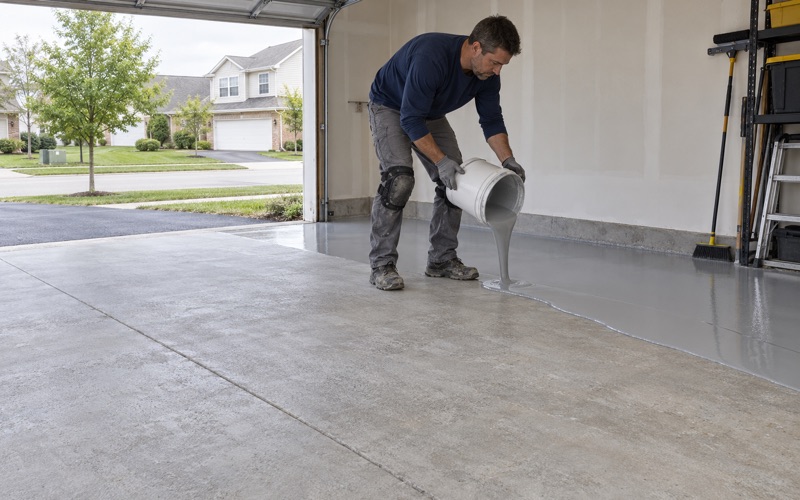
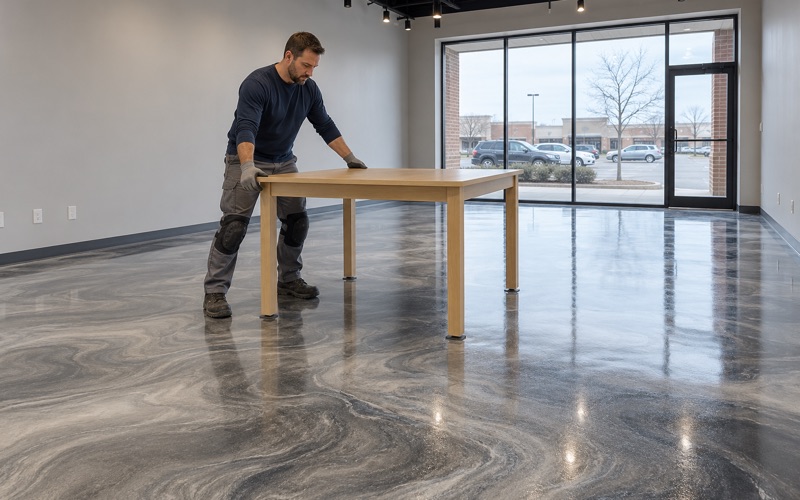
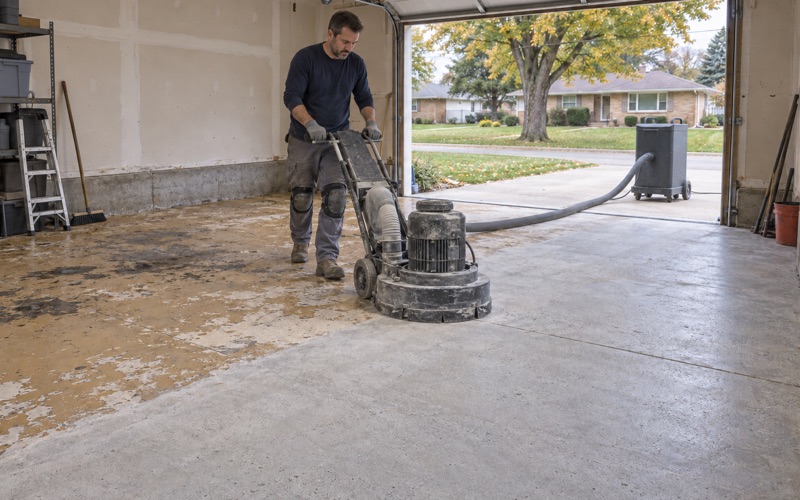
For the needling area we propose a smooth solid-color system in a light, even tone. A typical build starts with diamond grinding or shot blasting to the ICRI CSP profile the primer calls for, never acid etching, then a 100% solids epoxy body coat and a polyaspartic or polyurea topcoat for wear and stain resistance. The proposal names the exact product and finished thickness before anything is scheduled.
Choosing the tone
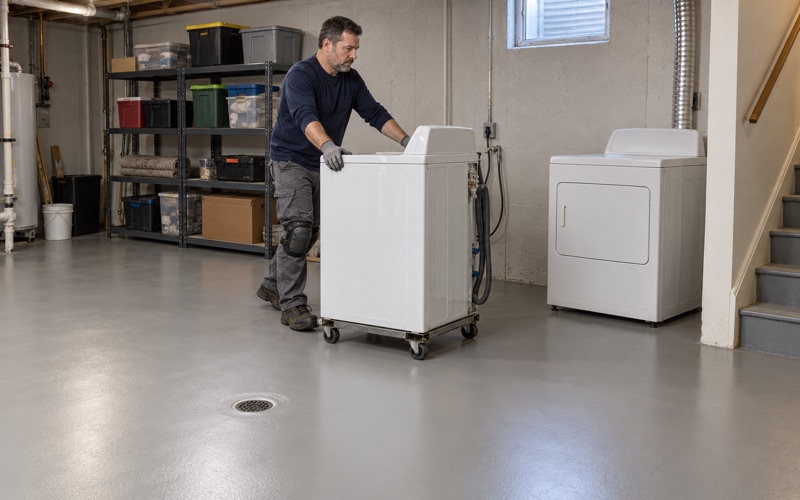
A light gray or pale neutral usually works better than bright white, which shows every scuff, and far better than a dark color that hides small objects. The goal is an even field with no mottling, so a steel needle reads as a clear line against it. Judge a sample under the clinic’s own lighting before the color is ordered, since different fixtures change how a gray reads.
Filled joints and a cove at the wall
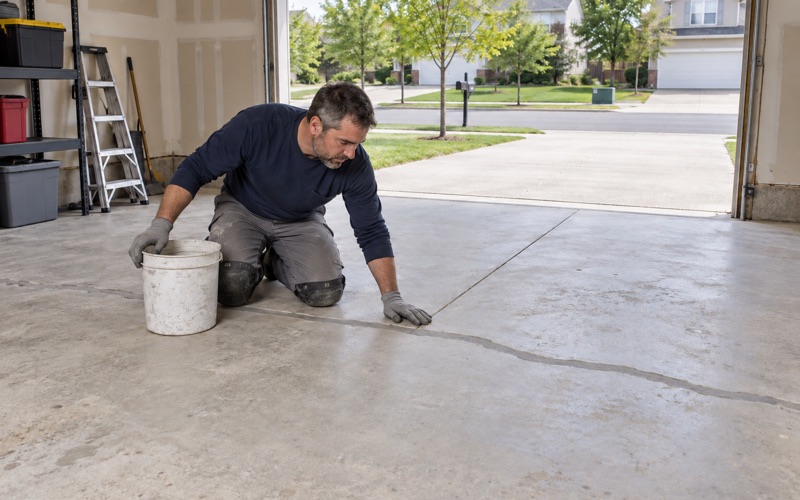
Sawcut joints and cracks are where small objects hide and where cleaning fluid collects. We fill control joints flush with a semi-rigid polyurea joint filler and repair the cracks we judge sound enough to coat, so the surface has no slots for a needle to drop into. Where the resin turns up the wall as a cove, there is no corner gap behind the table legs.
A smooth, seamless surface also serves another part of the standard. Under 29 CFR 1910.1030(d)(4)(ii)(A), contaminated work surfaces shall be decontaminated with an appropriate disinfectant after completion of procedures. Floors are not named in that line, but a continuous, nonporous resin surface takes a wipe-down far better than grout lines or bare concrete. We make no infection-control claim for the coating itself.
Keeping grip texture in the work-conditioning lanes
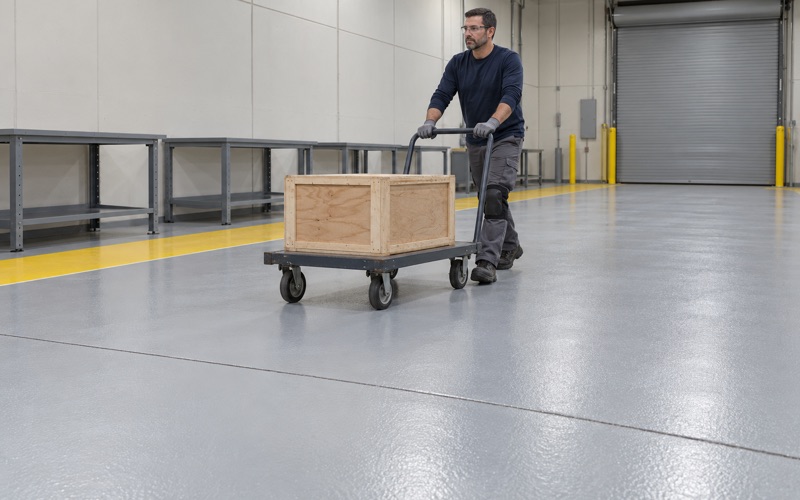
Work conditioning and functional capacity evaluations ask patients to carry, push and pivot under load, and wet shoes or spilled water there call for traction. We lay a broadcast or textured topcoat only in those lanes and stop it at a clean line short of the treatment tables. Patients get footing where they need it, and staff keep a clear field of view where needles are used.
The boundary between zones needs no raised strip or trip edge. Both finishes share the same base coats and meet flush, so the change shows up as a color or sheen line rather than a bump. A contrasting border in the topcoat can also mark where needling ends and conditioning begins, which helps new staff remember which floor is which.
Moisture, cure and registration before the first coat
A clinic slab on grade gets moisture testing as a scoped line item, using ASTM F2170 in-situ relative humidity probes or ASTM F1869 calcium chloride tests, because a smooth light floor shows every blister. We schedule cure against slab temperature and dew point, and we read the warranty exclusions aloud before the job is sold, starting with moisture.
Illinois issues no state license for flooring or coatings work, and we claim none. What Shorewood does require is that every contractor working in the village register: $120 a year, a $10,000 License and Permit Bond for a general contractor or $5,000 for a subcontractor, and $500,000 in general liability insurance. We confirm that registration with the Village of Shorewood Building Department at One Towne Center Blvd. before a start date is set.
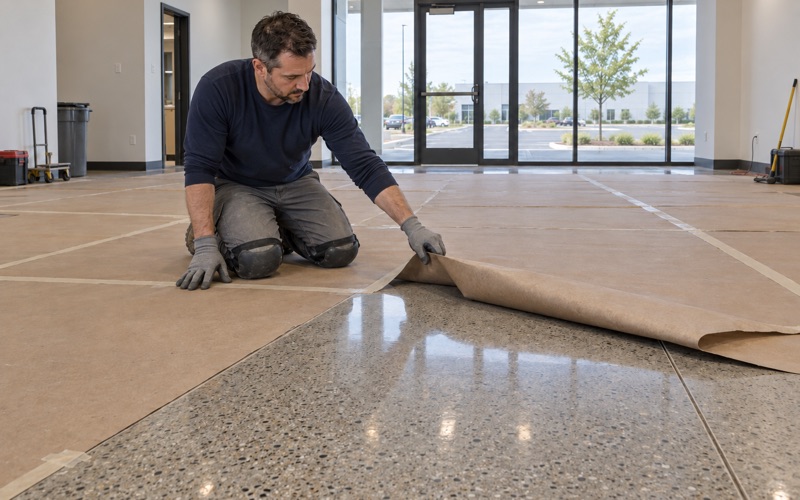
Grinding inside a working clinic also means planning around patient hours. Dust is collected at the grinder rather than washed toward a drain, and the work can be phased room by room or moved to evenings and weekends so treatment schedules keep running.
If your Shorewood practice is weighing a new floor for a treatment room, we start with a walk-through of the space, a moisture test plan and a zone map. The quote that follows is priced per square foot for the system actually proposed, with the textured lanes and the smooth treatment area listed as separate lines.
- 20+ Years on Concrete
- Moisture Tested Before Quoting
- Per-Square-Foot Written Quotes