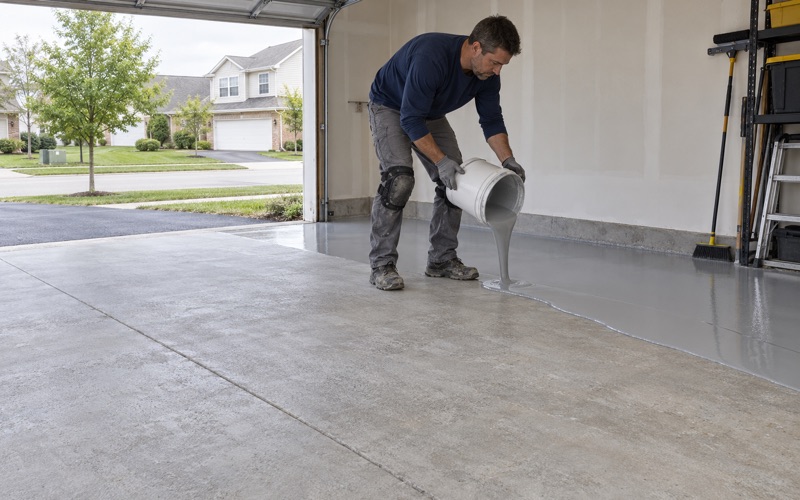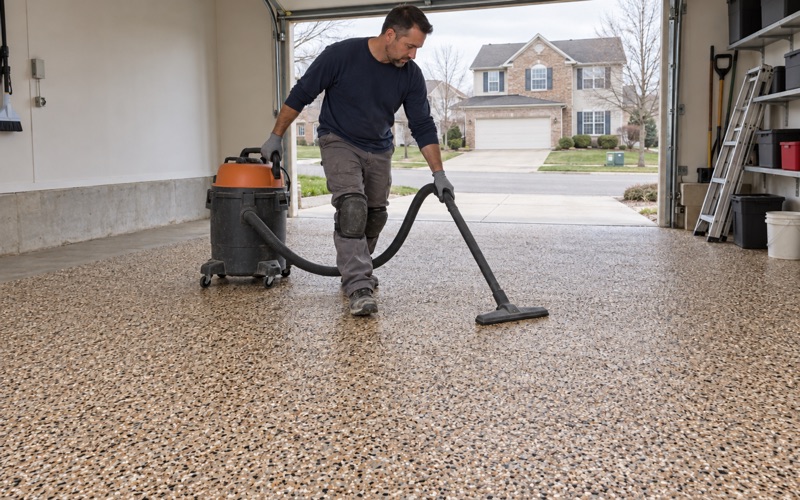
Romeoville Epoxy Flooring installs epoxy flooring in Richton Park for homeowners who want a garage floor that holds up to the car that uses it every day. After more than 20 years of coating slabs, we have learned that the hardest moment in a garage floor’s life is rarely the first winter. It is often the first evening a warm car rolls in and parks.
That moment has a name in our trade: hot tire pickup. A coating that has not finished curing, or one that was never built for vehicle heat, can soften under a hot tire and lift away with the tread when the car backs out. The result is a bare patch shaped like a tire footprint, usually right where the floor gets the most use.
This page walks through how we plan around that problem in Richton Park. We cover what coating makers themselves publish about return to service, why a car straight off the highway is a different case from one that sat in a parking lot, and how we pick a system and a parking date that fit the way a household actually drives.
Why a Highway Village Thinks About Tire Heat
A village on Interstate 57
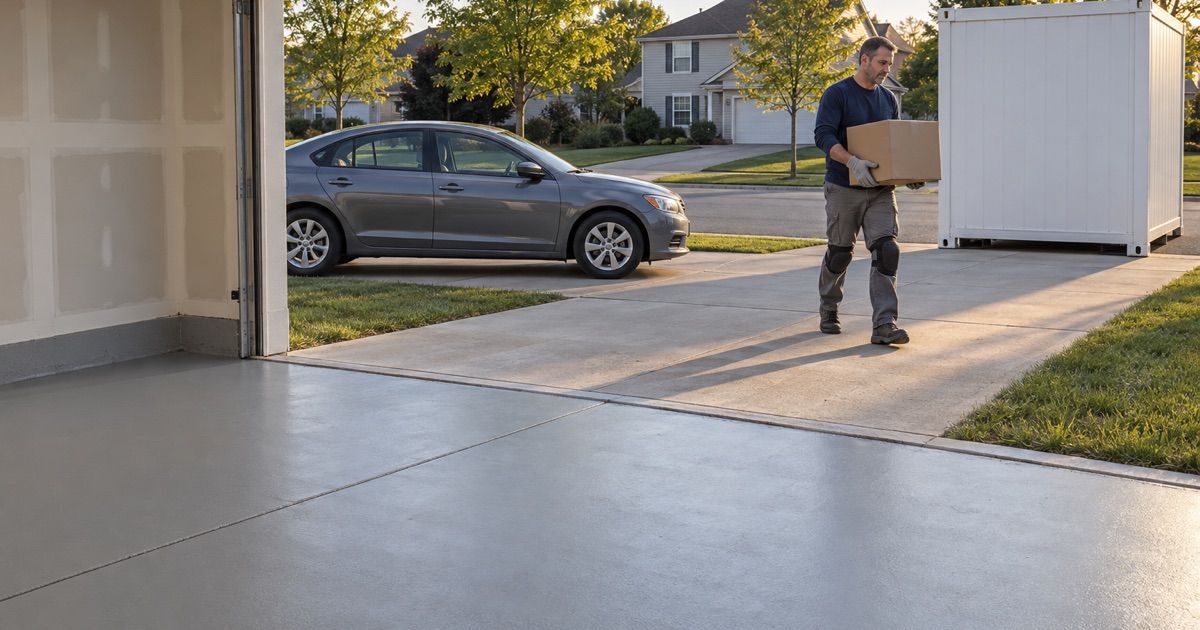
Richton Park is a village on the southern border of Cook County, and Interstate 57 runs right through it. The village’s own economic development page counts over 70,000 daily vehicles traveling through Richton Park on Interstate 57, and it puts about 20,000 a day on each of three other commercial corridors. Those are corridor figures the village publishes, not a survey of anyone’s commute.
What the figures do tell us is that highway traffic is part of the local picture, with the Sauk Trail interchange tying the expressway to the village’s shopping and its light industrial parks. For a garage floor, the question is narrower and more personal: how warm are the tires on the car that will park on this slab, and how soon after the coating goes down?
What hot tire pickup is
Hot tire pickup is a coating lifting where warm tires sit. Tires heat up as they flex on the road, and a sustained run at highway speed warms them more than a short trip across a parking lot. When a hot, softened tire rests on a coating for hours, it can bond to the film, and as the tire cools and grips, the coating comes up with it.
The failure usually shows in the tire lanes first, in two neat rectangles where the car parks every night. It is often blamed on the product, but in our experience it traces back just as often to a floor that was driven on too early, a slab that was never opened up properly, or a thin one-part paint asked to do a two-part system’s job.
Where the bond starts
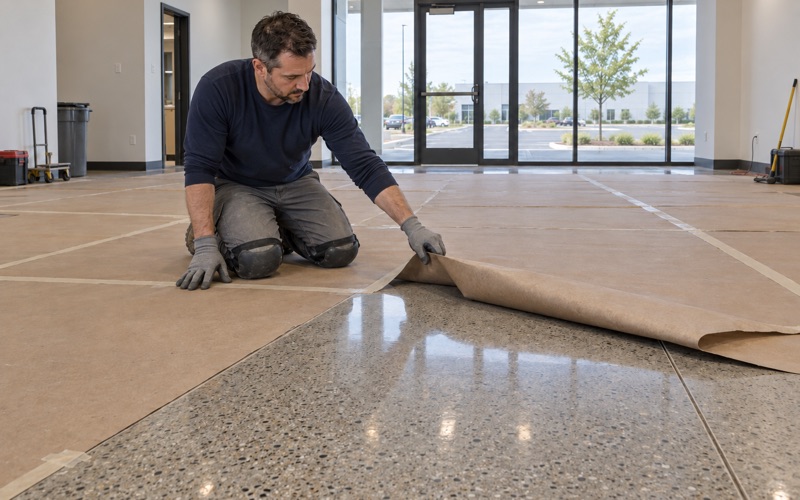
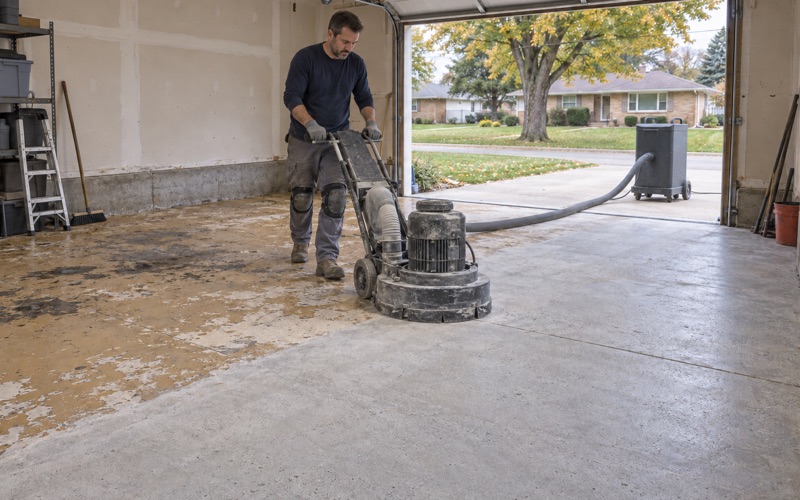
A coating can only hold onto a surface it can grip. We open every Richton Park slab mechanically with diamond grinding or shot blasting to a measured ICRI CSP profile, and we do not acid etch. A tire pulls hardest at the edge of the contact patch, and an open, clean profile is what keeps the base coat anchored when that pull comes.
Grinding dust is collected at the grinder and never washed toward a floor drain or a storm inlet, so the slab stays dry and clean for the primer. The tire lanes get extra attention during prep, since that is where old sealers, oil and patch material tend to sit and where a weak spot shows first.
Looking for epoxy-flooring closer to Lemont? See Epoxy-Flooring in Lemont.
Cool Tires and Hot Tires on a Maker’s Schedule
What one data sheet says
Coating makers publish return-to-service times, and one of them draws the line we care about most. The technical data sheet for INSL-X Hot Trax, a one-part acrylic garage floor paint sold as resisting hot tire pick-up from cars, lists light foot traffic at 24 hours and heavy foot traffic at 48 hours. It then separates the cars: Cool tires - 5 days; Hot Tires - 7 days.
That two-day gap is the maker’s own acknowledgment that a warm tire asks more of a fresh film than a cool one does. The same sheet lists vehicular traffic at 5 days under its standard drying conditions of 77 degrees and 50 percent relative humidity, so the 7-day figure is the extra margin it gives the hot-tire case.
Why cool, humid weather stretches the clock
The Hot Trax sheet also says high humidity and cool temperatures will result in longer dry, recoat and service times, and it says not to apply the paint below 50 degrees surface or air temperature. That matters in an attached garage in late fall, when the slab is colder than the air in the house and the door has been opening onto damp mornings.
We schedule curing against slab temperature and the dew point spread at the slab surface rather than against the calendar. When an unheated garage is too cold for the system we are proposing, we say so and book the job for spring instead of pushing a coating through conditions its maker warns against.
One maker, not a universal rule
The Hot Trax numbers belong to one product, and cure schedules vary from one coating to the next. A 100% solids epoxy, a polyaspartic topcoat and a one-part acrylic each carry their own sheet, and that sheet is the one that governs your floor. Our proposal names the product, the system build and the finished thickness, so you can read the same schedule we are working from.
Two-part systems usually publish their own foot-traffic and vehicle-traffic times, and those can be shorter or longer than a one-part paint depending on the chemistry and the temperature. We read those figures against the conditions measured on your slab that week, and the more cautious of the sheet’s time and our own reading becomes the plan.
The First Night the Driven Car Parks
The date that matters
Most homeowners ask when they can walk on the new floor. The better question for a commuter’s garage is when the driven car comes back in. A car that comes home off a highway drive and parks at once brings hot tires straight onto the coating, and that is the case the maker’s longer hot-tire figure is written for.
So we set that date in the plan, not just the day the crew leaves. Whatever the chosen product’s sheet says for hot tires, adjusted for the conditions actually measured on your slab, becomes the first parking night, and we write it down so nobody in the household has to guess at it.
A second car outside for the first week
In practice, the simplest plan is often a second car parked outside, in the driveway or on the street, for the first week. Where a household has one car that must come in, we look at the cool-tire figure on the sheet and talk through letting the car sit outside for a while after a drive before it rolls onto the new floor.
That is a judgment call, not a promise, and we would rather lengthen the wait than shorten it. No coating is immune to lifting if it is loaded too soon, and the cost of waiting a few extra nights is far smaller than the cost of regrinding and recoating a pair of tire lanes.
What goes in the written plan
Every home job we take gets a written contract and the Home Repair: Know Your Consumer Rights pamphlet before work starts, as the Illinois Home Repair and Remodeling Act requires. Along with the system and thickness, that paperwork is where the return-to-service dates go, foot traffic first and then the first night for each car, so the schedule lives on paper.
Warranty exclusions are read aloud before the job is sold, and moisture comes first on that list. Driving on the floor before the stated return-to-service date is another exclusion worth hearing in plain words, because it is the one a busy household is most tempted to stretch.
Choosing a System for a Commuter’s Garage
One-part paint versus a two-part system
A one-part paint such as an acrylic dries by evaporation, and Hot Trax is described that way on its own sheet. It is a fair choice for light use, and its maker markets it for hot tire resistance. A two-part system cures by chemical reaction into a harder, thicker film, and for a car that parks warm every night we see it as the safer match.
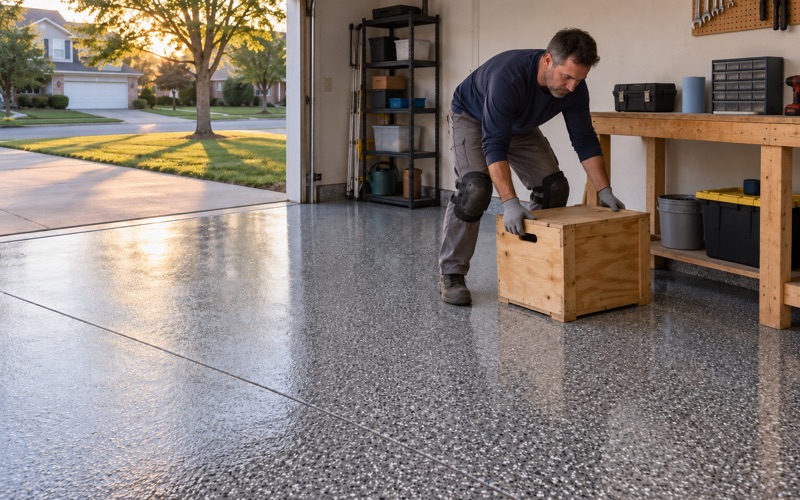
In a commuter’s garage we usually propose a 100% solids epoxy base, often with a vinyl flake or quartz aggregate broadcast, finished with a polyaspartic or polyurea topcoat. Fully cured, that build holds up better under warm tires than a thin paint film, though no coating can honestly be called proof against lifting.
Reading the slab before quoting
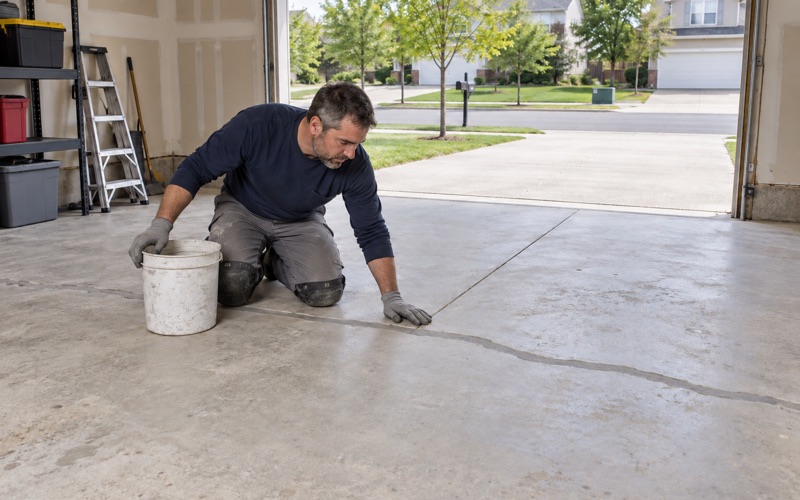
Richton Park’s housing stock leans toward the 1970s and 1980s, when more than half of the village’s homes were built, so many garage slabs here have decades of use behind them. We read the cracks, joints and any old coating before we quote, and we say plainly when a slab needs repair or replacement before it can carry a new system.
Moisture testing is a line item in our scope, using ASTM F1869 calcium chloride kits or ASTM F2170 relative humidity probes as the slab calls for. A floor that pushes vapor can blister under a coating no matter how good its tire resistance is, and we would rather find that out before the job than after the first winter.
Permits, registration and the price
The Village of Richton Park Building Department at 4455 Sauk Trail requires permits for all concrete work and says cosmetic work such as painting needs none, but it does not name floor coatings either way. We ask the department before scheduling, and we confirm the village’s annual contractor registration, insurance and bond requirements, since Illinois issues no state license for flooring or coatings work.
Pricing is quoted per square foot for the system actually proposed, not from a national per-garage figure. That lets you compare a one-part paint and a full two-part build on the same slab, with the cure schedule and first parking night attached to each, and choose the one that fits the way your household uses the garage.
- 20+ Years on Concrete
- Moisture Tested Before Quoting
- Per-Square-Foot Written Quotes