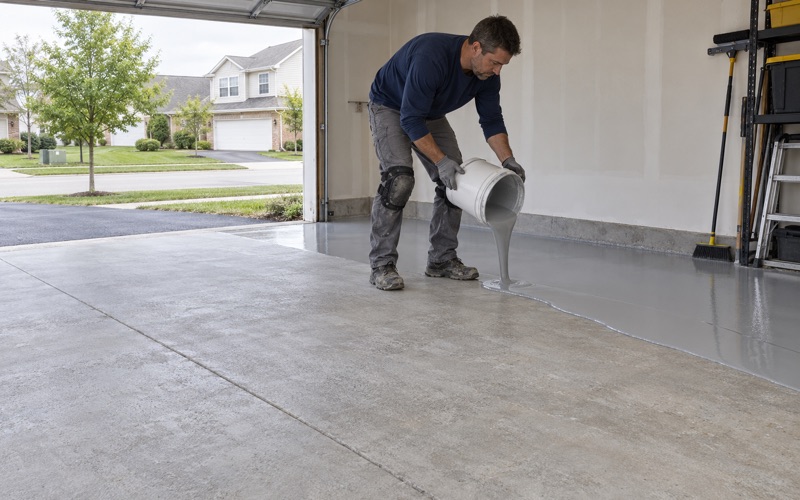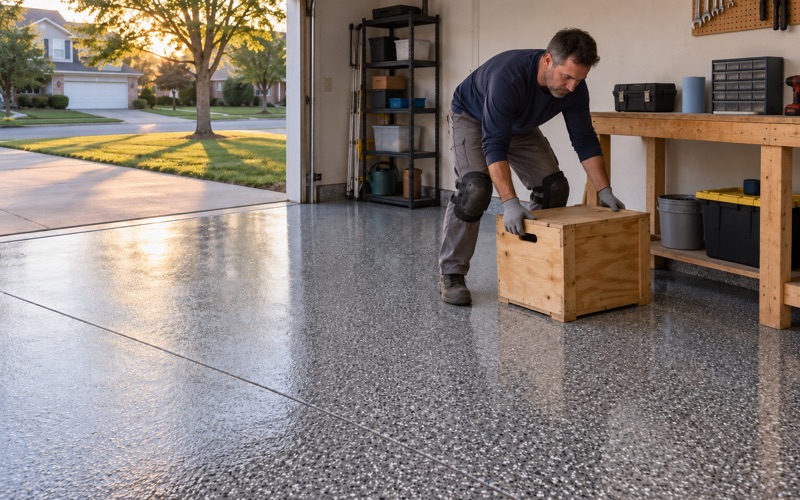
Romeoville Epoxy Flooring has installed epoxy flooring in Palos Heights garages, basements and shops through more than 20 years in the trade, and a lot of that work ends up under somebody’s hobby. Here it is often a bike stand. Our floors are two-part resin systems built over a slab we have opened with a diamond grinder or shot blaster, never acid etched.
That preparation matters for one reason on this page: a floor that holds a bike stand catches whatever drips off a hydraulic brake. A one-part paint and a properly bonded two-part coating behave very differently when that fluid lands on them, and the difference shows up within minutes, not years.
Every proposal we write names the product, the system build and the finished thickness, so you can check what was quoted against what went down. Moisture testing sits in that scope as its own line, and the warranty exclusions are read out before anything is sold, with moisture at the top of the list.
A Harlem Avenue Bike Shop and the Fluid in Its Brakes
Palos Heights is a Cook County city on the southwest edge of Chicago, and its stretch of Harlem Avenue is a reminder of how many riders live around it. Mountain, fat, BMX and e-bikes all pass through local service benches, and many of them now carry hydraulic brakes rather than cables.
Richard’s Bicycles and the riders it services
Richard’s Bicycles, at 11933 S. Harlem Ave., lists bicycle service, repair and tune-ups on its own site, along with custom mountain-bike builds and component brands including SRAM and Shimano. We have never worked on that shop, and we have not seen its bench or its floor. We name it because it shows what riders in this city are buying and maintaining.
Riders who buy from a shop like that often learn to do the routine work themselves. Hydraulic brakes need an occasional bleed to push air out of the line, and that job happens on a bike stand, in a garage or basement, over whatever finish the floor happens to have.
What DOT fluid does to a painted floor
SRAM’s 2018 HydroR bleed manual specifies only DOT 4 or DOT 5.1 fluid for its hydraulic brakes. The same warning says DOT fluids will damage painted surfaces, and that any fluid touching one should be wiped off immediately and cleaned with water. Park Tool’s bleed guide adds that the fluid can irritate skin and eyes and damage paint and other finishes.
A bleed is not a tidy job. Fluid escapes at the syringe fitting, the bleed port and the caliper, and a drop that runs down a fork leg lands wherever the stand happens to sit. That is the moment a floor either holds the fluid on top or lets it start to work.
Why one-part floor paint counts as a painted surface
Many garage floors are finished with one-part floor paint from a can, rolled onto bare concrete. Under the brake maker’s own warning, that is exactly a painted surface. Fluid that sits on it can soften or lift the film, and a stand that stays in the same corner for years puts every bleed on the same few square feet.
Rolling another coat of paint over the damage repeats the problem. The new film is the same chemistry as the old one and sits on a bond the fluid has already worked into, so the next bleed finds the same weak spot.
Looking for epoxy-flooring closer to Western Springs? See Western Springs Epoxy-Flooring.
Two-Part Chemical-Resistant Floors Under a Bike Stand
What we install in place of paint is a two-part system: a resin and a hardener that react into a cross-linked film rather than drying out of a solvent. That chemistry is the reason a coating can resist fluids a paint cannot. It is not a reason to ignore a spill.
Opening the slab first
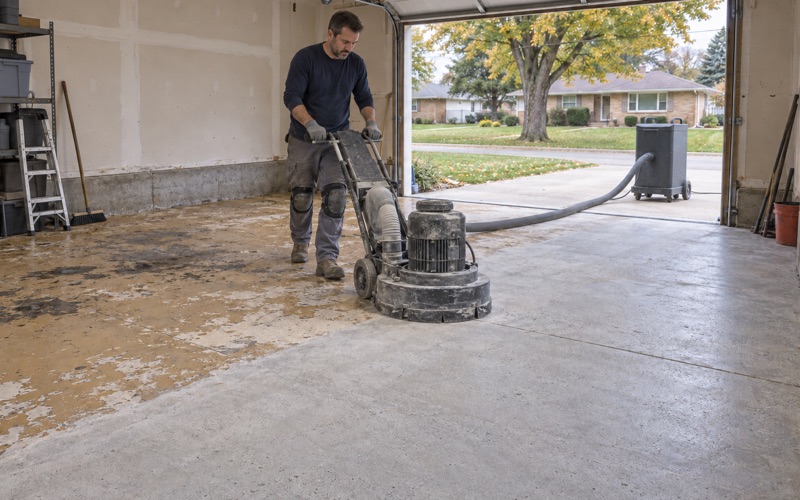
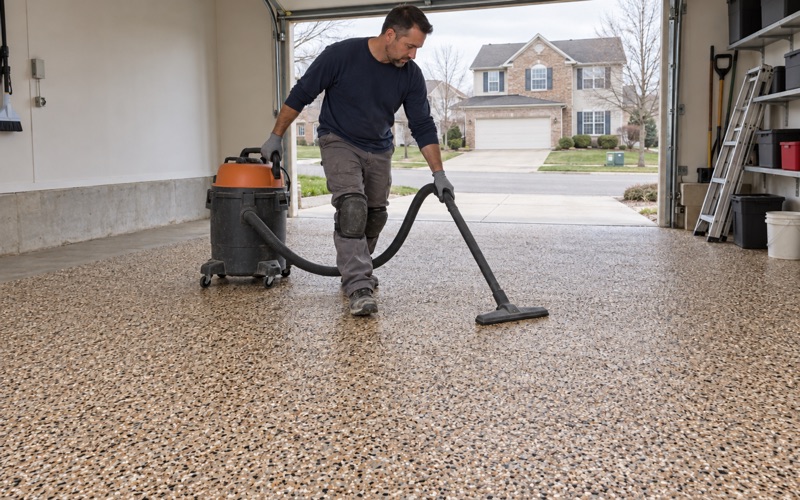
A coating holds only as long as its bond does. We open every slab mechanically with a diamond grinder or shot blaster to an ICRI CSP profile suited to the system, and the dust is collected at the grinder, never washed toward a floor drain. An old painted finish comes off completely in that step rather than being coated over.
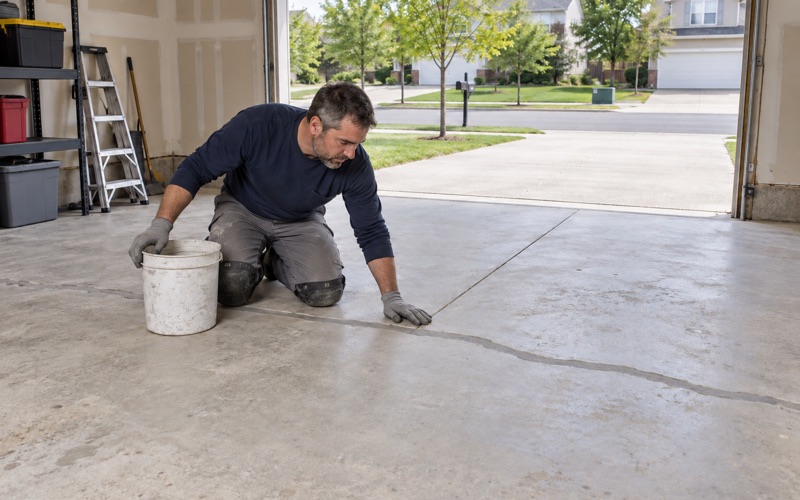
Before we quote, we read the cracks, joints and any old coating on the slab. When a slab needs repair or replacement before it can carry a coating, we say so plainly. Joints and cracks under a work area get a semi-rigid polyurea joint filler, so fluid has no open seam to run into.
Checking the data sheet for brake fluid and alcohol
No floor coating is immune to brake fluid. What we do is check the manufacturer’s data sheet for the specific system, looking for glycol-based brake fluid and for isopropyl alcohol, the cleaner riders reach for after a spill. A 100% solids epoxy base with a polyaspartic or polyurea topcoat is a common build, but the data sheet decides.
Even with the right system down, a spill is still wiped up promptly. Resistance buys time to find the drop and clean it, within whatever exposure the data sheet states. It is not permission to leave a puddle under the stand overnight.
Color and edges where the stand lives
A solid light color or a fine vinyl flake broadcast makes a dark drip easy to spot before it spreads. We keep the texture under a work stand modest, enough grip for socks and shop shoes without a coarse surface that holds fluid in its valleys and makes wiping harder.
Where the stand sits against a wall, we finish the coating tight to the wall or carry it up as a short cove, so a drop that rolls off the tray has no raw concrete seam to soak into. Bare concrete at the edge is where a spill disappears first.
Drip Trays, Rags and Cleanup During a Bleed
We give no advice on bleeding brakes; that belongs to the brake maker’s manual and your bike shop. What we can speak to is the floor under the job, and a few habits that keep any coating, ours or anyone else’s, looking the way it did the day it cured.
A drip tray under the bike stand
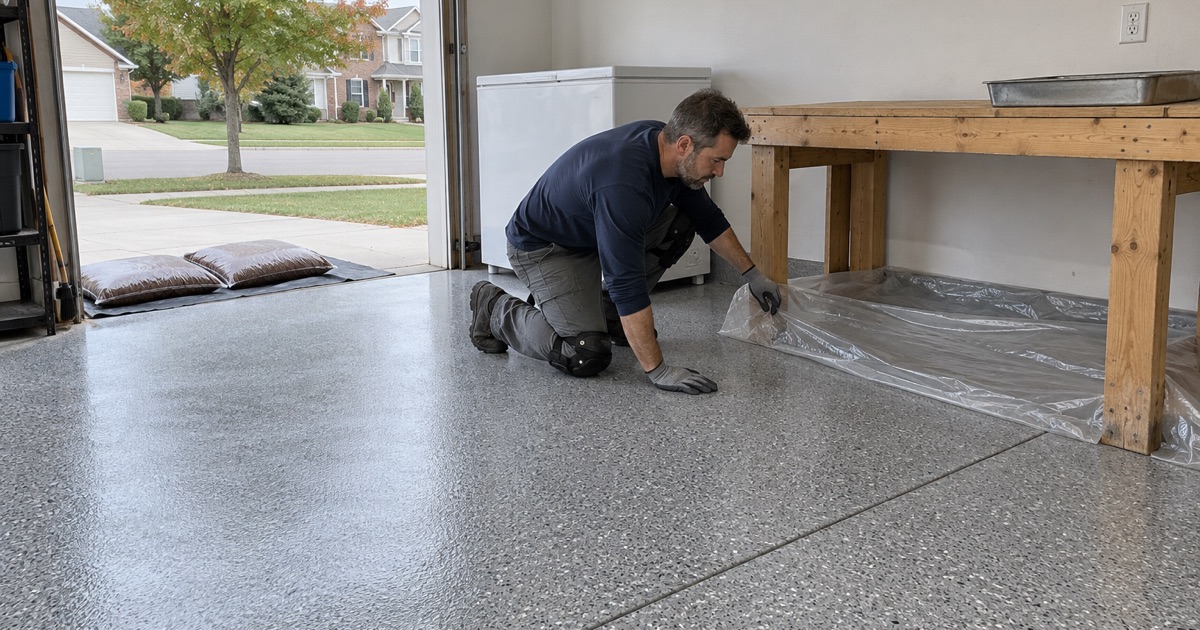
A shallow drip tray or a folded shop rag set under the caliper, and another under the lever, catches most of what escapes during a bleed. On a coated floor the tray is the first line and the coating is the second. On bare concrete or a painted floor, the tray is the only line there is.
Riders often park the stand on the same spot for years. A rubber mat under the stand’s feet helps too, so the clamp base and a rolling tool cart are not grinding grit into the topcoat right where the fluid lands.
Isopropyl alcohol and a water rinse
Park Tool’s guide names isopropyl alcohol as a good cleaner for neutralizing spilled DOT fluid, and SRAM’s manual says to clean with water. On a two-part floor we confirm that the coating’s data sheet allows alcohol before the first job, so a cleanup step never becomes a second problem for the finish.
Wipe the drop first, then clean the spot. Spreading fresh fluid across a wider patch with a wet rag puts more of the floor in contact with it, and the goal is to keep that contact small and short.
Disposal of used fluid and rags
SRAM’s manual says used DOT fluid must be recycled or disposed of under local and federal rules, and never poured down a sewer or drain, into the ground or into water. A rinse that runs across the garage toward a floor drain does exactly that by a different route. Rags and tray contents are bagged and kept for proper disposal.
That matches how we treat our own work. Grinding dust from a floor job is collected and carried off, never rinsed toward a drain or a storm inlet, and the same discipline fits the small amounts of fluid a bleed leaves behind.
The Home Repair Corner in a Palos Heights Garage
Most bleeds in Palos Heights do not happen at a shop bench. They happen in an attached garage or a basement corner where a rider has hung a work stand, a pegboard and a few bottles, often on the same floor where the family car parks.
DOT fluid versus mineral oil
Not every hydraulic brake uses the same fluid. SRAM’s manual says to use only DOT fluid and never mineral oil in its brakes, while Shimano’s hydraulic brakes use mineral oil instead. The two are not interchangeable and do not clean up the same way, so a rider who works on both should know which drop is on the floor.
Mineral oil is not the glycol-based fluid SRAM warns about, but it still needs wiping up and cleaning with whatever the coating’s data sheet allows. When we plan a repair corner, we ask which brake systems you run, so the data sheet check covers both fluids and both cleanups.
Which garage slabs we are working with
Census figures put owner occupancy in Palos Heights at 93.4 percent, and about 1,020 owner-occupied homes are single-family attached units. For a townhouse owner, a garage floor sits inside the association’s rules as well as your own preferences, so we confirm what the association allows before scheduling anything.
The city also reports teardown-and-replacement permits for existing houses and new construction on vacant lots, so some slabs here are new pours. A young slab still gets moisture testing as a scoped line, with ASTM F2170 in-situ relative humidity probes or ASTM F1869 calcium chloride testing, before any resin goes down.
Registration, contract and cure timing
Palos Heights is a city, and its Building Department at 7607 W College Drive takes contractor registration in person or by mail only; emailed registrations are refused, and permits are picked up in person. Illinois licenses no flooring or coatings contractor, so we confirm the city’s registration, bond and insurance rules before a job goes on the calendar.
Every home job gets a written contract and the Home Repair: Know Your Consumer Rights pamphlet before work starts, as the Illinois Home Repair and Remodeling Act requires. Cure is scheduled against slab temperature and dew point, and when an unheated garage is too cold, we say plainly that the floor waits for spring.
- 20+ Years on Concrete
- Moisture Tested Before Quoting
- Per-Square-Foot Written Quotes