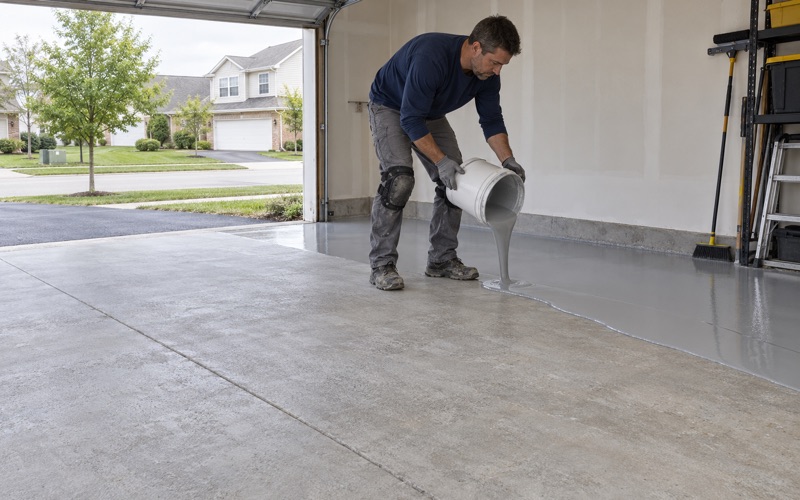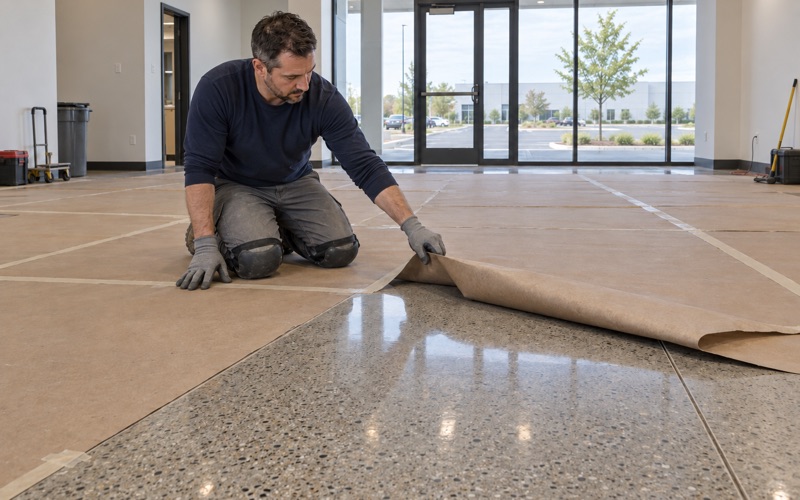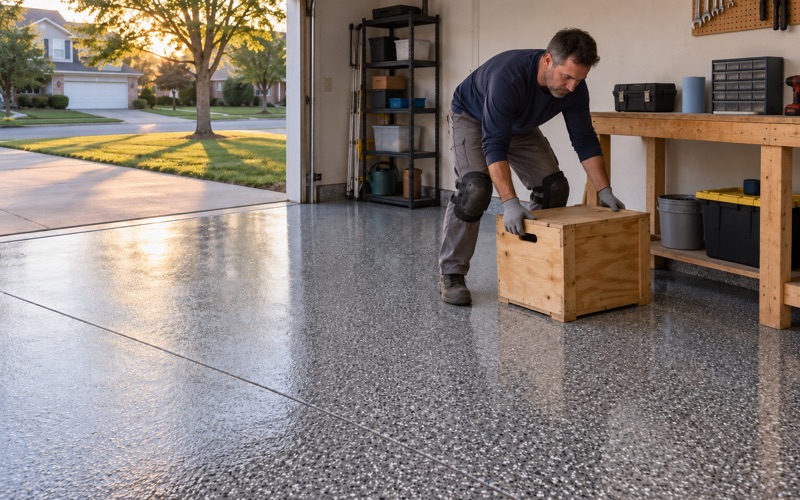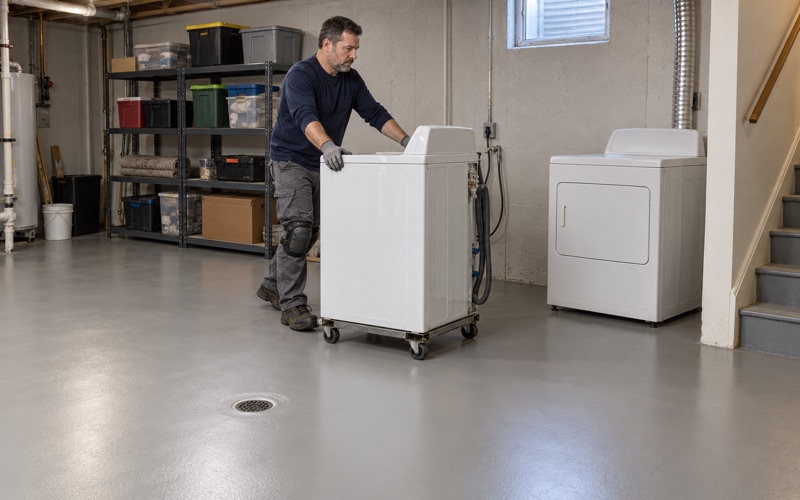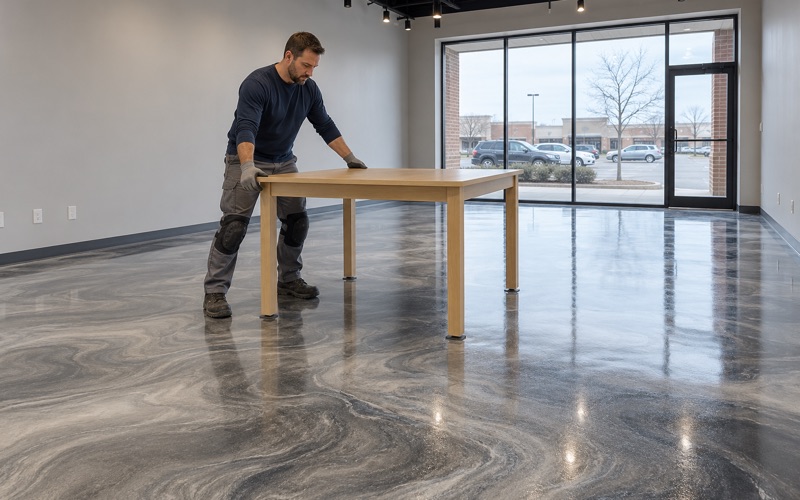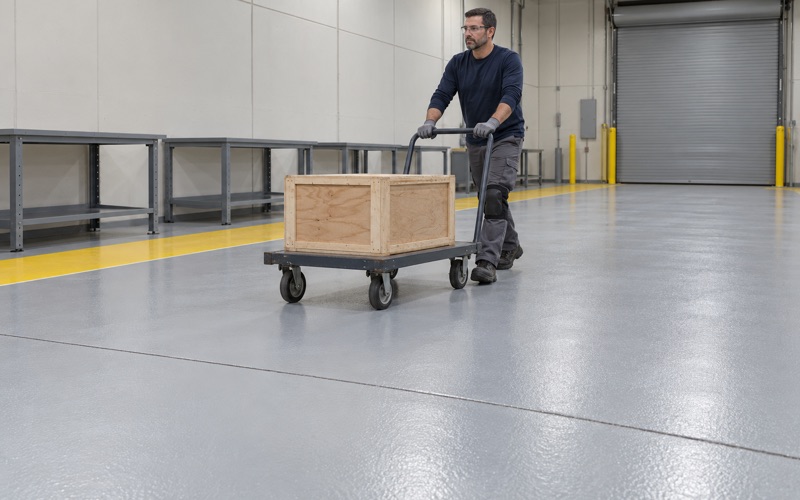
Romeoville Epoxy Flooring has spent more than 20 years putting down epoxy flooring in Mokena and across Will County, and the floors we think hardest about here are the ones that have to be swept clean many times a day. A salon is the clearest example. Every haircut ends up on the floor, and the finish either lets a broom clear it or holds onto it.
Most of this page is about that one kind of room: a salon floor, and in particular the full-service salons that senior living communities now include down the hall from the dining room. The decisions that matter there, from surface texture to the topcoat to how the floor meets the wall, also decide whether any coated floor stays easy to keep clean.
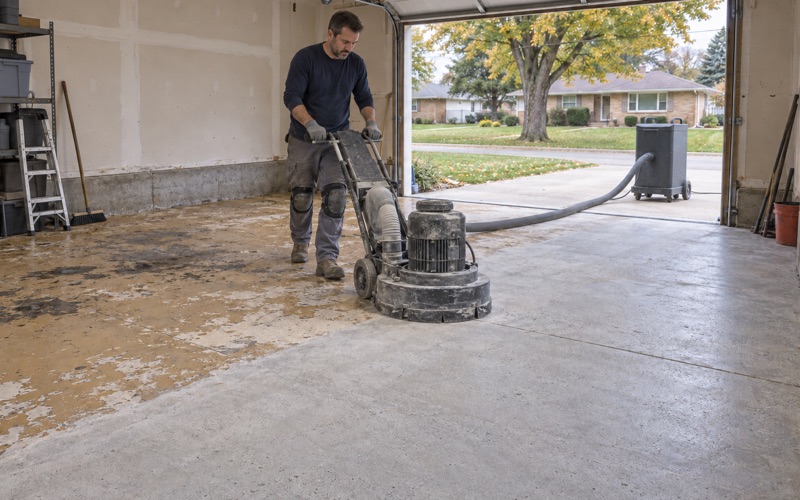
Before any of that, the slab gets opened with a diamond grinder or a shot blaster rather than an acid etch, and its moisture is tested as a priced part of the scope. Our proposal names the product, the system build and the finished thickness, so a salon owner or facility manager can check what went down against what was quoted.
A Salon Down the Hall in a Mokena Senior Community
Clarendale of Mokena and Its Salon
Clarendale of Mokena, on Wolf Road, broke ground in August 2014 as the village’s first senior living community and held its open house in September 2015. The three-story building on an 11.4-acre site holds 156 units: 60 independent living, 56 assisted living and 40 memory care. When Inland Real Estate Acquisitions bought it in April 2026, the community was 94 percent occupied.
Among the amenities named in that sale coverage was a full-service salon and spa, alongside a bistro, a pub, a fitness studio and a theater room. We have not seen that salon, do not know who operates it or what its floor is, and have never worked there. It is simply a clear local example of where this kind of room now sits.
A Small Room Inside a Building That Keeps Running
A salon in any building is a small room carrying heavy wear in a few spots: the chair bases, the path to the shampoo bowls and the doorway. Inside a larger community it also sits in a building that keeps operating around it, so floor work has to fit a short, planned closure rather than a week of disruption down a resident corridor.
We schedule commercial floors around the hours a building has to keep running, including overnight and weekend windows, and we collect grinding dust at the grinder instead of letting it drift into a hallway. Cure times are set against slab temperature and the dew point spread at the surface, not a calendar promise made before anyone has looked at the room.
Looking for epoxy-flooring closer to Warrenville? See Epoxy-Flooring Services in Warrenville.
What Illinois Cosmetology Rules Say About a Salon Floor
The Two Sentences That Name the Floor
The state’s sanitary standards for barber, cosmetology, esthetics, hair braiding and nail technology work sit at 68 Ill. Adm. Code 1175.115. Section (b)(20) says hair clippings shall not be allowed to accumulate and shall be disposed of in a covered container. Section (b)(21) says floor surfaces shall be kept clean, orderly and in good repair.
Those rules bind licensed salons, so whether a particular senior community’s salon falls under them depends on how that salon is licensed, which is a question for its operator. Where they apply, the floor is not a matter of taste. Failure to follow the sanitary standards is treated as unprofessional conduct under Section 4-7 of the Act.
What Clean Means in the Rule
The same section defines clean as the removal of soil, dust and the like by washing, sweeping, clearing away or any other appropriate method. For a salon floor, that definition points straight at the finish. A surface that lets a broom or a vacuum pick up every clipping in one pass meets it easily; one that traps hair makes the stylist fight it.
Hair is the main soil on a salon floor, and it behaves unlike road grit or sawdust. It is light, it clings, and it drifts into corners whenever a door opens. A finish that sheds it under a broom saves time between clients and keeps the covered-container rule from turning into a scramble at closing.
Good Repair Is a Floor Condition
Good repair is the phrase owners tend to overlook. A coating that has chipped at a chair base, peeled at a doorway or lifted along a crack is, on its face, a floor out of good repair. The rule also requires compliance with building, state fire, plumbing and electrical regulations, so the floor sits inside that larger list.
We hold no license or certification for salon work, and Illinois licenses no flooring or coatings contractor at all. What we offer is narrower and more practical: a floor built so the duty the rule places on the salon is easier to meet every working day, and a plain account of what that floor can and cannot do.
Why Cut Hair Hides in Flake and Quartz Textures
The Problem With a Heavy Broadcast
Vinyl flake broadcast and quartz aggregate broadcast are popular because they hide dust, add grip and look good in a garage. On a salon floor, the peaks those broadcasts leave behind become small traps. Fine cut hair, especially short clippings from a trim or a clipper cut, settles into the valleys between chips where broom bristles ride right over it.
Open control joints, unfilled cracks and old chips do the same thing on a larger scale. Hair packs into them, holds water from a mop and darkens along the line. A room that looks freshly swept from the chair can show a gray seam running across the floor by the end of a busy week.
Choosing a Smooth or Fine-Textured Finish
For a salon we lean toward a smooth or finely textured surface: a 100% solids epoxy body coat with any light broadcast fully encapsulated under the topcoat, or a solid color with only a fine slip additive in the final coat. The aim is a floor a broom or a vacuum clears after each client, without hair catching on the profile.
Grip still matters around wet shampoo areas, so texture is a balance rather than an absence. We talk through that trade-off with the owner before quoting and put the chosen texture in writing, so the finish that arrives is the finish that was described.
Joints, Cracks and the Wall Line
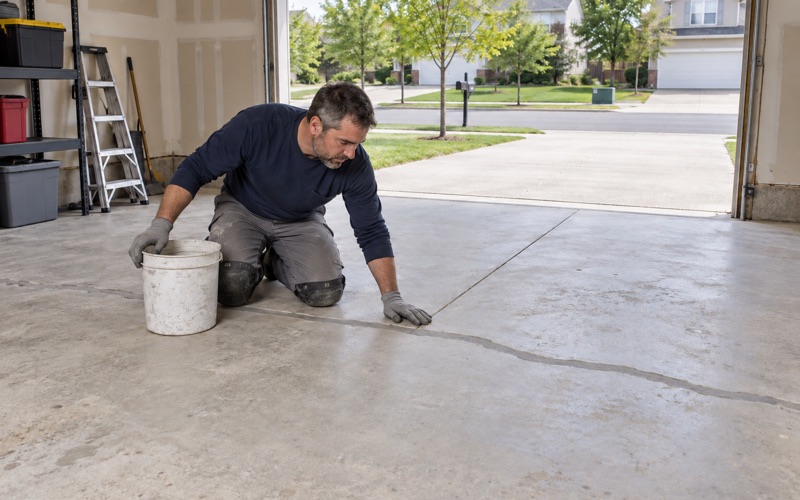
Before coating we read every crack, joint and patch of old coating. Control joints are filled flush with a semi-rigid polyurea joint filler so the surface runs continuous, and cracks are routed and filled rather than bridged with coating alone. If a slab needs repair or replacement before it can carry a coating, we say so plainly.
The wall line gets the same attention. An integral cove carried up the base of the wall closes the corner where hair otherwise piles against a baseboard, so a vacuum nozzle or a dust mop follows the curve instead of pushing clippings into a gap. The coved edge can then be wiped in the same pass as the floor.
Shampoo Bowls, Chair Bases and Keeping the Floor in Good Repair
Drips at the Shampoo Station
The same sanitary standards require shampoo bowls and sinks to be clean and free of hair and residue after each use, and work stations to be cleaned and disinfected with a hospital grade disinfectant. Rinse water, conditioner and color drip off the bowl onto the floor beneath it, and that floor gets wiped down along with the station.
That is why we finish salon floors with a topcoat meant to wipe clean, typically a polyaspartic over the epoxy build, rather than a porous sealer that lets residue soak in. A closed surface lets a drip be lifted with a cloth instead of scrubbed out of the pores, and it holds up to the repeated wiping a station gets.
Chair Bases and Rolling Stools
The chair base is where a salon floor usually fails first. A hydraulic chair turns on the same spot thousands of times, stylists roll stools in tight arcs around it, and the footrest takes heel strikes all day. A coating with weak adhesion shows it there first, as a crescent of worn or chipped finish around the base.
Adhesion starts with the profile. Grinding the slab to the right ICRI CSP range gives the epoxy something to grip, and moisture testing with ASTM F2170 in-situ relative humidity probes or ASTM F1869 calcium chloride tests tells us whether vapor will push the coating off from below. Warranty exclusions are read out before the sale, with moisture named first.
Repairing Without Redoing the Room
Good repair is ongoing, not a one-time result. A chip at a chair base can usually be ground out, filled and recoated in a short window, and a worn topcoat can often be screened and refreshed without stripping the whole system. Catching a small chip early keeps a salon on the right side of the floor rule without a full closure.
We also look at what sits on the floor. A shampoo station bolted down before the topcoat cured, or a rubber mat that holds water against the surface, can each start a failure. Planning those details with the owner before the coating goes down costs far less than repairing them afterward.
Where the Work Begins in Mokena
Mokena requires contractors to register with the village’s Community Development Department at 11004 Carpenter Street, with a $150 fee, a certificate of $500,000 general liability coverage, $500,000 in workers’ compensation and a $10,000 surety bond. We confirm that registration before a job is scheduled, since Illinois offers no state flooring license to lean on.
The village exempts painting, tiling and carpeting from permits but does not name floor coating either way, and it asks anyone whose project is not listed to check with Community Development before starting. We make that call as part of planning. Pricing is quoted per square foot for the system we actually propose, built around the room in front of us.
- 20+ Years on Concrete
- Moisture Tested Before Quoting
- Per-Square-Foot Written Quotes