Romeoville Epoxy Flooring installs epoxy flooring in Minooka for garages and shop floors that carry more than a parked car, and we bring 20+ years of grinding, priming and coating concrete to each one. Some of the hardest-working floors in the area belong to people who handle asphalt: street crews, paving hands and homeowners who patch their own driveways. Those slabs meet release agents, fuel and sticky residue that a showroom garage never sees.
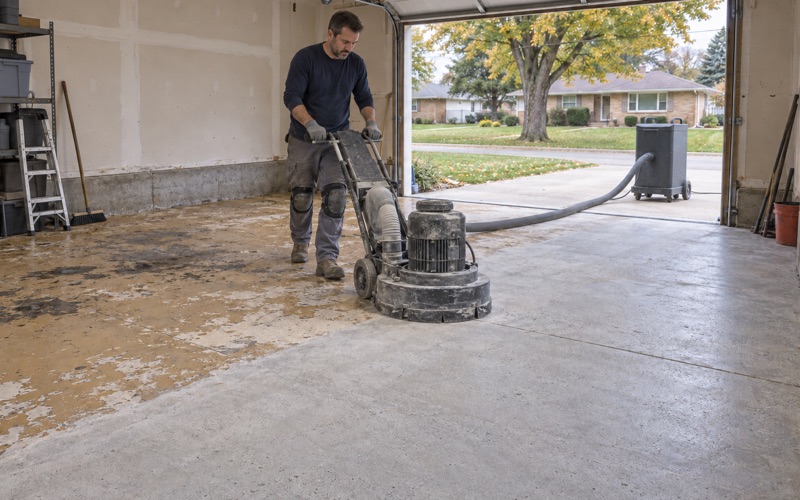
The work starts with the concrete itself. Every slab is opened mechanically with a diamond grinder or shot blaster, never acid etched, and moisture testing is a line in the scope rather than something offered after a coating has already lifted. The proposal names the product, the system build and the finished thickness, so the installed floor can be checked against the quote.
This page looks closely at one kind of floor: the one where asphalt tools come home to be cleaned. It covers which fluids actually reach the coating, where the cleaning belongs, and what a fuel-resistant topcoat can and cannot do for the people who work on it.
Minooka Patches Its Own Streets, and the Asphalt Comes Back Inside
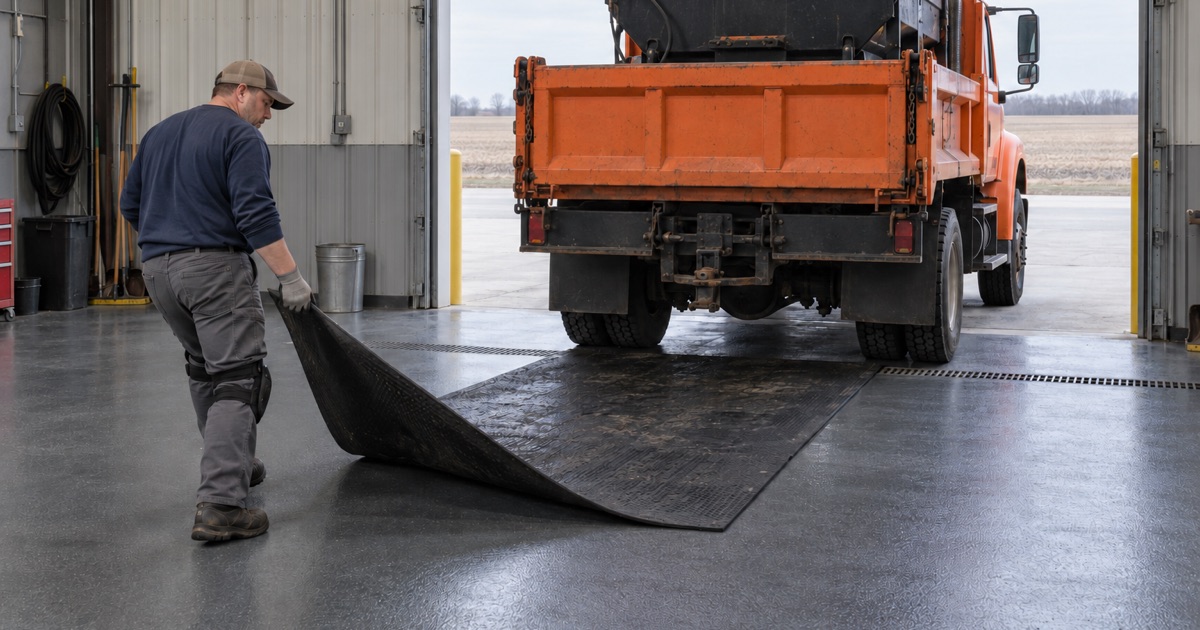
The Village of Minooka Public Works Department keeps its headquarters at 608 Twin Rail Drive, inside the village in Aux Sable Township, Grundy County. The department lists ten maintenance and operations staff and maintains about 63 miles of roadway, and its street work includes signs, ditch mowing and asphalt patching. We have no relationship with the village and have never seen that shop floor.
We use it as the example because it describes a kind of building that exists all over this area. Any crew that does its own asphalt patching has to bring the tools back somewhere at the end of the day, and that somewhere usually has a concrete floor under it.
What rides home on the tools
A crew that patches streets is likely to bring asphalt back on truck beds, rakes, shovels, lutes and boot soles. Those tools get treated before the job so the mix will not bond to them, and they get cleaned after it. Both steps tend to happen indoors once the weather turns, which puts the chemistry right on the floor.
On bare concrete, that residue presses into the open pores and stays there. On a coated floor the questions change: where the cleaning happens, which products touch the coating, and whether the topcoat was chosen for fuel and asphalt solvents at all. Those are the three questions the rest of this page answers.
Release agents and approved product lists
A release agent is applied to equipment so that asphalt does not stick to it. The Illinois Department of Transportation keeps an Approved List of Asphalt Release Agents for Vehicles Transporting Hot Mix Asphalt among its Bureau of Materials qualified product lists, and industry e-blasts relayed revisions to it in 2023 and 2024.
For a floor, the point is simple. A product built to stop asphalt from bonding is also built to sit on surfaces, and the overspray and drips from a truck bed or a tool rack land wherever the work is done. We ask for the safety data sheet of whatever goes on the tools before we choose the topcoat for that room.
Diesel’s narrow role in one state’s guidance
The Minnesota Department of Transportation’s guidance on asphalt sludge is a useful primary example of how a road agency handles this. It says diesel is not allowed as a truck bed release or as a release agent for other asphalt equipment and tools. Diesel may be used to clean equipment, such as removing asphalt from shovels, but only when an asphalt cleaning agent is not available.
That same guidance notes that cleaning with diesel can produce an asphalt sludge, and it says to catch the sludge in a container such as a 5-gallon bucket and store it in a labeled drum with the lid closed. It also says to use no gasoline or any other solvent, because doing so may create a very hazardous environment. This is Minnesota practice, not an Illinois rule, and we have not read IDOT’s position on diesel.
Looking for epoxy-flooring closer to Palos Heights? See Epoxy-Flooring Services in Palos Heights.
Where the Cleaning Happens: Bucket and Tray, Not the Floor
The best coating in the building does less than a good habit. When asphalt is scraped off a shovel over a bucket, almost nothing reaches the floor. When it is scraped off over open concrete or a fresh topcoat, the floor becomes the catch basin, and no system is designed to be one every working day.
A cleaning station kept off the coating
We suggest setting aside one spot for tool cleaning, usually near the door the trucks use, with a rigid drip tray or containment mat under a rack and the bucket. The coated floor runs up to the edge of that station rather than serving as it. A tray that catches drips can be emptied; a floor that catches them has to be scrubbed.
When the station sits on the coating anyway, we plan the floor around it. That can mean a heavier build in that zone, a topcoat chosen for the specific fluids, and a texture that does not trap residue. We would rather settle that in the proposal than discover it a year later in a stain shaped like a tool rack.
Sludge, drips and daily cleanup
Asphalt that does land on a coated floor comes up far more easily when it is caught early. A plastic scraper and the cleaning product the crew already uses on its tools usually handle a fresh drip. What hurts a topcoat is the same fluid left to sit through a weekend under a parked truck bed.
We talk through the cleaning routine before choosing the finish, because the routine decides how the floor ages. A crew that wipes up at the end of every shift can live with a different topcoat than a shop where the floor is only scrubbed once a month. Neither answer is wrong, but the choice should match the building.
Coating a shop that has to stay open
A public works building or contractor’s shop rarely gets to close for a week. Warehouse, shop and kitchen floors are scheduled around the hours a building has to keep running, including overnight and weekend windows, and large rooms can be done in sections so trucks still have somewhere to park.
Grinding dust is collected at the grinder rather than swept or blown around the room. That matters in a shop full of stored tools and equipment, and it keeps the prep from turning into a second cleanup job for the people who work there.
What a Fuel-Resistant Topcoat Is For, and What It Is Not
A fuel-resistant topcoat is a top layer chosen because its chemistry tolerates splashes of diesel, fuel and asphalt solvents better than a basic coating does. It is a safety margin for the drips that get past the tray. It is not permission to clean tools directly on the floor, and it does not turn a coating into containment.
Choosing the top layer
Most of our shop floors start with 100% solids epoxy as the body coat, then take a polyaspartic or polyurea topcoat, and some heavy-use rooms are better served by urethane cement. Each manufacturer publishes a chemical resistance chart, and we read it for the specific fluids that room will see before we write the product into the proposal.
We do not assume one product handles everything. A topcoat that shrugs off a quick wipe of diesel may still soften under long contact with an aggressive solvent. Where the chart is silent on a fluid, we say so in writing rather than guess, so the customer knows which drips need prompt attention.
Splash resistance versus soaking
Resistance ratings are almost always about exposure time. A splash wiped up within the hour is a very different test from a puddle that sits overnight under a drip from a release agent sprayer. The same topcoat can pass one and fail the other, which is why habits at the cleaning station matter as much as product choice.
Warranty exclusions are read out before the job is sold, and moisture is named first. Chemical exposure outside what the manufacturer rates is the next thing we cover, because a coated shop floor will meet chemicals a garage floor never does.
Texture and footing near the station
A floor that gets slick from release agent or diesel needs footing as much as resistance. A quartz aggregate broadcast gives a crew traction in the wet zone around the cleaning station, while a vinyl flake broadcast suits the drier areas where trucks park and residue is rare.
Texture also affects cleanup. A coarse profile holds more residue in its valleys, so we tune the grit to the room rather than using the roughest finish everywhere. The goal is a surface that grips under boots and still lets a scraper and mop do their job.
A Homeowner’s Sealcoat and Patch Tools in the Garage
The same questions apply on a smaller scale at home. In Minooka, 48.0 percent of the housing was built between 2000 and 2009, ownership runs at 91.6 percent, and 85.7 percent of owner households live in detached houses. Many of those owners seal and patch their own driveways, and the buckets and squeegees end up in the garage.
Storing driveway products on a coated floor
Driveway sealer and cold patch arrive in pails that drip at the rim and leave rings where they stand. We suggest keeping them on a shelf or a tray instead of directly on the coating, with the lids pressed tight. A sticky ring left for a season is much harder to lift than one wiped the same day.
Cleaning a squeegee without hurting the floor
Clean sealcoat and patch tools outside or over a bucket, using the cleaner the product label calls for. Avoid splashing gasoline or other strong solvents on the garage floor, because they can damage a topcoat and create a fire hazard in an enclosed space. A topcoat that tolerates fuel is a backstop, not a workbench.
Paperwork before the work
Illinois licenses no general, flooring or coatings contractor, so we confirm Minooka’s own rules before scheduling. The village requires every trade and subcontractor to register before any permit issues, at $100 a year for a general contractor and $50 for a subcontractor, renewed by April 30. Whether a floor coating alone needs a Minooka permit was not stated on the village page, so we check.
Every home job gets a written contract and the state’s Home Repair: Know Your Consumer Rights pamphlet before work starts, as the Illinois Home Repair and Remodeling Act requires. Prices are quoted per square foot for the system actually proposed, and curing is scheduled against slab temperature and dew point, so an unheated garage may have to wait for spring.
- 20+ Years on Concrete
- Moisture Tested Before Quoting
- Per-Square-Foot Written Quotes