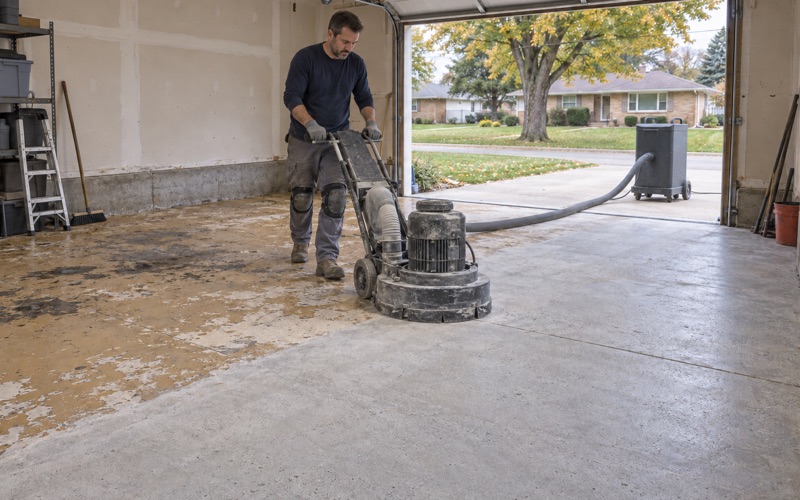
Romeoville Epoxy Flooring has spent more than 20 years installing epoxy flooring in Matteson and across the south suburbs, on garage slabs, basements, shops and commercial floors that have to stay in service. Our work starts with the slab itself, opened by a diamond grinder or shot blaster rather than acid, with a moisture test written into the scope before any resin is mixed.
This page is about a less obvious part of floor work here: what happens when the floor belongs to a machine. In an automated warehouse, a coating crew is not the only thing moving across the concrete, and the order of who stops, who steps in and who signs off matters as much as the product. The same thinking scales down to a home garage.
Every proposal we write names the product, the system build and the finished thickness, so a facility manager or homeowner can check what went down against what was quoted. We read cracks, joints and old coatings before pricing, and we say plainly when a slab needs repair or replacement first. Pricing is per square foot for the system we actually propose.
Matteson’s Largest Taxpayer Runs on Robots
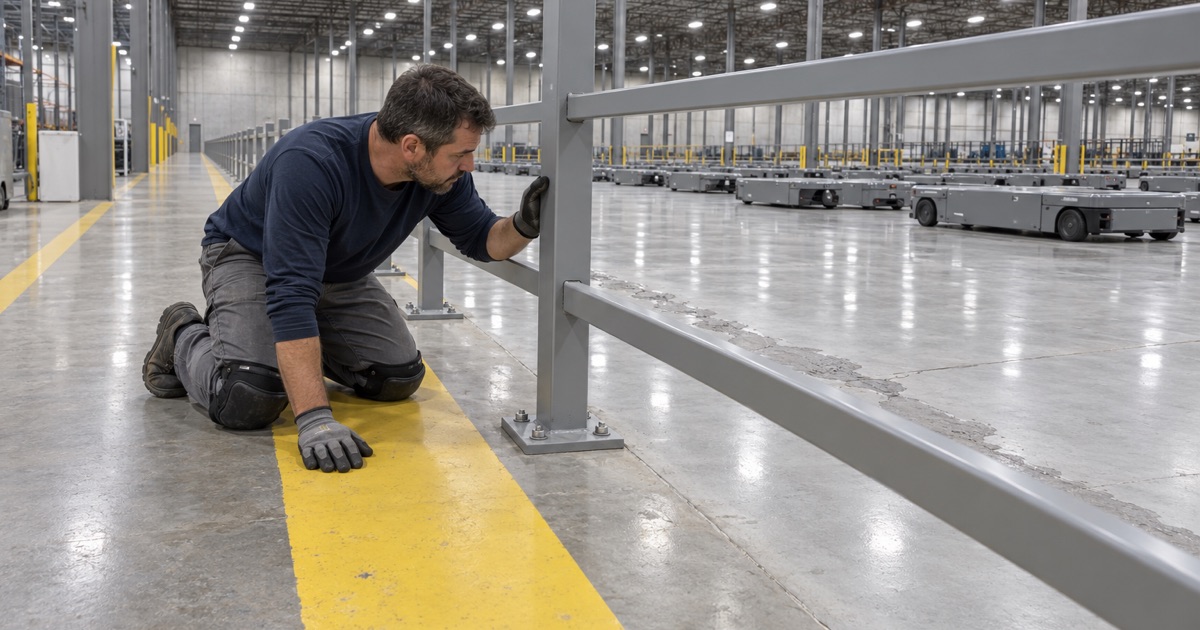
Most epoxy flooring decisions start with traffic: cars, carts, forklifts, or foot traffic in a kitchen. In Matteson, one of the most consequential floors in the village carries traffic with no driver at all. Understanding why that matters starts with the building’s place in the local economy and with how federal safety guidance describes the machines on it.
A fulfillment center at the top of the tax roll
The village’s annual financial report for fiscal 2025 lists Amazon’s fulfillment warehouse as Matteson’s largest employer, at 1,000 workers, and its largest principal taxpayer, at 11.192 percent of equalized assessed value. The next taxpayer on that list sits at 4.222 percent. When one building carries that share of a tax base, how its floors are kept up is a local question as well as a technical one.
In June 2020, CBS Chicago reported that Amazon planned two new 855,000-square-foot fulfillment centers in Markham and Matteson, the first of their kind in Cook County, using the newest generation of Amazon robots to sort and ship orders. That project made Amazon Robotics part of the village’s industrial landscape, and it changed what floor work inside a modern warehouse can involve.
Robots that drive themselves
OSHA’s technical manual describes industrial mobile robots as machines that navigate autonomously within their operating environment to reach specified locations, and that are not intended for a seated or standing driver. Nobody is steering. The same guidance warns that such a robot could drive into a worker, a hazard OSHA compares to the struck-by and caught-between risks that vehicles pose.
That warning reframes a routine repair. A spalled joint or a failing patch in a conventional warehouse is a job for a crew with cones and a forklift detour. Where drive units travel on their own, the floor is part of the machine’s working area, and anyone kneeling on it to grind or trowel is standing in the path of equipment with no driver to stop it.
Looking for epoxy-flooring closer to Bellwood? See Epoxy-Flooring in Bellwood.
Where Drive Units Run, the Floor Is a Restricted Space
The phrase that does the most work in this part of the page is restricted space. It comes from federal robotics safety guidance, and it changes the floor from a surface people cross into an area people enter only under control. That shift decides who may stand on the concrete, when they may stand there, and what has to be switched off first.
What OSHA’s robotics guidance says about entry
The OSHA chapter on industrial robots is blunt: entry into the restricted space is hazardous because the worker involved may not be familiar with the hazards. Normally, it says, the robot application automatically reaches a safe state when a worker enters the safeguarded space. Floor work cannot lean on that alone, because a coating crew stays in the zone for hours, not seconds.
The manual is guidance, not a standard, but it points to one that is. Power and other hazardous energy sources, it says, should be controlled in accordance with 29 CFR 1910.147, the federal rule requiring lockout/tagout whenever maintenance or servicing is performed on equipment. We read floor repair inside a robotic zone as servicing in exactly that sense.
Why repair there is servicing, not open-floor work
Patching, grinding or recoating the surface the robots travel on is work on the robot system’s own environment, done within its reach. The people who enter are the operator’s staff or those the operator admits under its procedures, the robots in that zone are brought to a stopped, safe state, and hazardous energy is isolated under the operator’s lockout program before anyone kneels down.
OSHA’s accident examples make the point in hindsight. One lists lockout/tagout that was not applied, or not properly applied, which would have prevented repowering an assembly robot. A floor crew working between moving units, trusting the traffic to route around them, is the scenario that guidance exists to prevent, and it is never how floor work in an automated zone should be planned.
What we do and do not claim about that building
We have no relationship with Amazon and have never worked inside the Matteson building. We have not seen its floors, its procedures or its maintenance, and nothing on this page describes them. We also do not perform lockout or robot servicing; that belongs to a facility’s operator. What we bring is the floor side of the plan, sized to fit inside someone else’s safety program.
Planning Floor Repair as a Zone Shutdown
Once floor repair is understood as servicing, the planning looks less like a coating job and more like a maintenance outage. The floor contractor’s role is narrower than people expect and the schedule is tighter, but the slab preparation underneath is the same work we do on every floor, from a two-car garage to a distribution building.
Building the schedule around the operator’s people
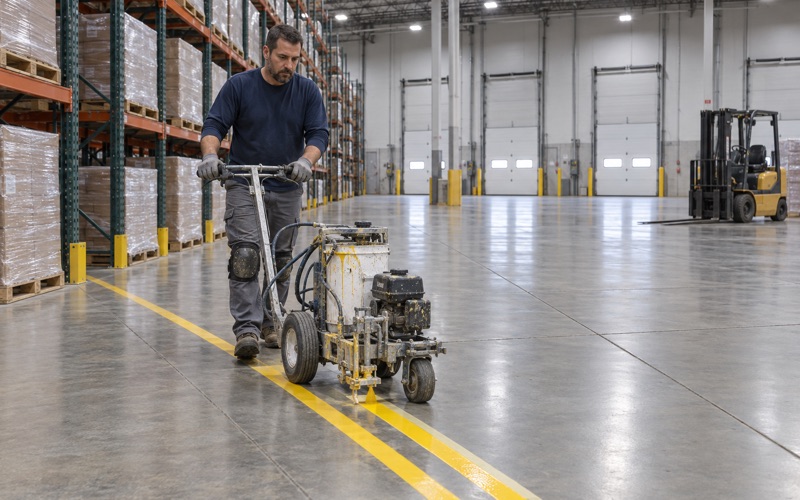
In any robotic warehouse, floor repair becomes a scheduled shutdown of a defined zone, planned with the operator’s own safety and maintenance staff rather than squeezed between shifts on a guess. Before a grinder arrives, the plan names which zone goes down, when its robots stop, who verifies the lockout, and when the area is handed back. Our part is an honest duration for each step.
We already schedule warehouse, shop and kitchen floors around the hours a building has to keep running, including overnight and weekend windows. A robotic zone tightens that discipline. The grind, the repair, each coat and the cure all need a real clock time, because every hour the zone sits idle is an hour the operator is planning around, and an overrun spills into the next shift.
Choosing products that hand the zone back quickly
A shutdown window limits what a floor product can be. Fast return to service usually points toward polyaspartic and polyurea topcoats or fast-setting repair materials rather than a long-cure build, and the cure is scheduled against slab temperature and dew point, not the calendar. A coating that looks finished but is still soft at handback fails the moment traffic resumes.
Just as important, nothing that changes how the robots read or travel the floor goes down without the operator’s sign-off. Color, sheen, texture and the finish of any repaired patch inside a drive area are the operator’s decision. We put the product, system build and finished thickness in writing so that review has something concrete to approve before the zone ever goes down.
Opening the slab and keeping the dust contained
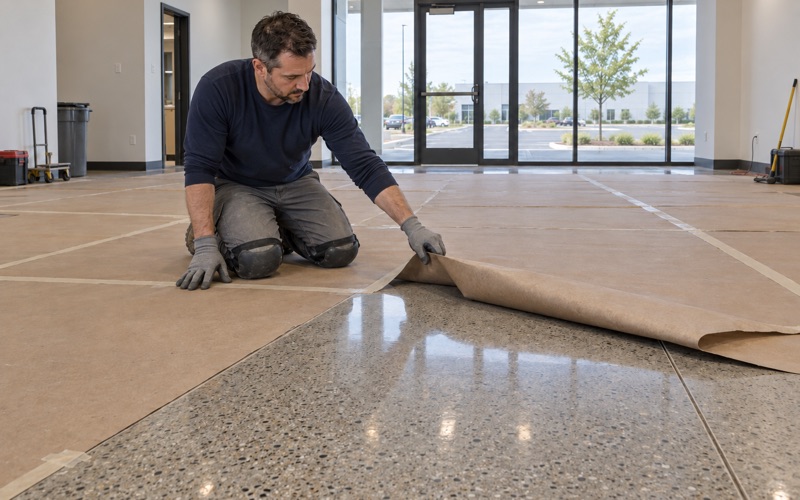
Inside a shutdown or not, every slab is opened mechanically by diamond grinding or shot blasting to an ICRI CSP profile that suits the system, and we do not acid etch. Moisture is tested as a line item, using ASTM F2170 in-situ relative humidity probes or ASTM F1869 calcium chloride tests, because a blister that appears after handback means a second shutdown.
Grinding dust is collected at the grinder with vacuum extraction and never washed toward a floor drain or storm inlet. In a working warehouse, dust that drifts beyond the zone becomes the operator’s problem, so the dust plan belongs in the same document as the schedule. Matteson Public Works maintains 86.43 miles of storm sewer, and none of our slurry belongs in it.
The Home Version: Robots Out of the Garage First
Most Matteson customers will never set foot in a robotic warehouse. Of the village’s 7,631 housing units in the Census count, 5,193 are detached homes, and the garage is where much of our work here happens. The safety idea from the warehouse carries over in a smaller, simpler form, along with the same preparation and paperwork.
Unplug the mower and the vacuum
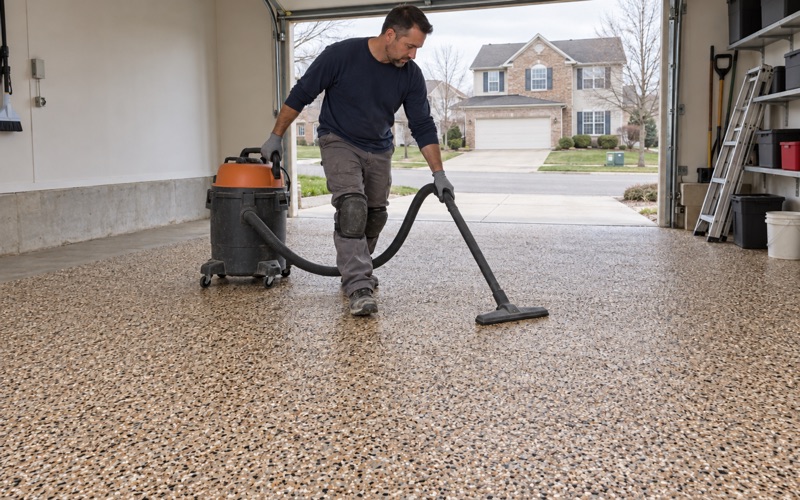
At home the principle shrinks to something simple. A robot mower docked in the garage, or a robot vacuum that roams into it, is unplugged and moved out before prep starts, along with its charging base. A machine that wakes on a schedule and drives across a freshly ground or freshly coated slab can ruin a broadcast layer and trail resin into the house.
We ask about these during the walkthrough, alongside the freezer, the shelving and anything bolted near the floor. Charging docks are often fixed to the wall at floor level, and the coating needs to run beneath where they sit. Once the topcoat has cured for the time the product requires, the dock goes back and the mower returns to its routine.
A garage slab built for a south-suburban winter
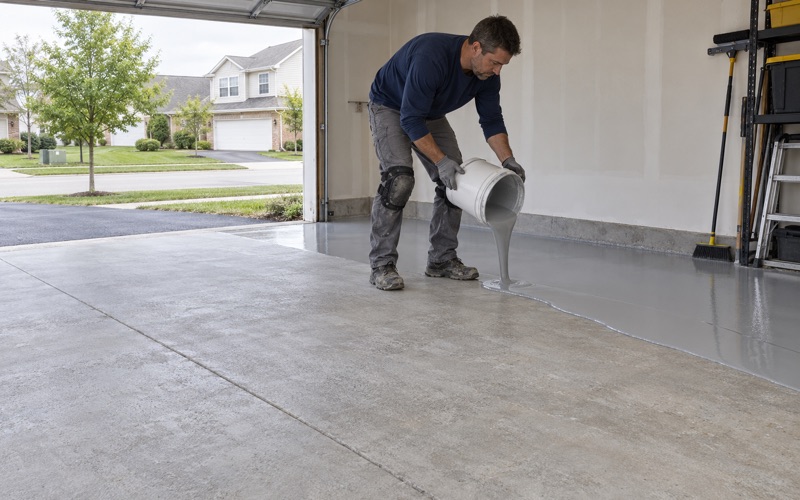
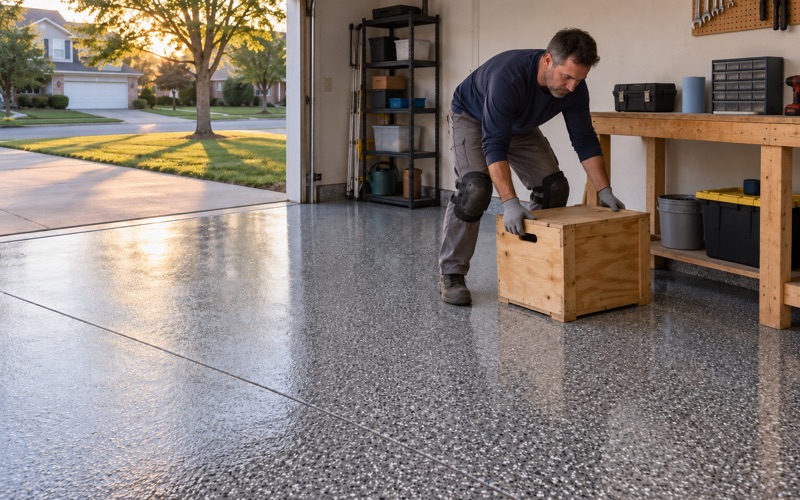
Matteson sits entirely in Cook County, and its garages see the calcium chloride brine and rock salt that south-suburban roads carry through the winter. We build garage floors for that, with a 100% solids epoxy base, a vinyl flake or quartz aggregate broadcast, and a polyaspartic topcoat chosen to stand up to deicing salts and resist hot tire pickup.
Curing follows slab temperature and the dew point spread at the surface. An unheated garage in January may simply have to wait for spring, and we say so rather than coat a cold slab and hope. Moisture is tested here too, since a garage slab can carry vapor from below, and warranty exclusions are read aloud before the sale with moisture named first.
Paperwork the village and the state expect
Illinois issues no state license for flooring or coatings work, so we confirm Matteson’s own contractor registration, bond and insurance terms with Building Services before a job is scheduled. That office registers contractors, issues permits and performs inspections, and the village moved to a new building code edition on December 1, 2021, so permit questions start there.
Every home job gets a written contract and the Home Repair: Know Your Consumer Rights pamphlet before work starts, as the Illinois Home Repair and Remodeling Act requires. Coatings are selected within the VOC limits in 35 Illinois Administrative Code Part 223, which bind the installer as well as the manufacturer, and we never sell a floor coating as radon reduction.
- 20+ Years on Concrete
- Moisture Tested Before Quoting
- Per-Square-Foot Written Quotes