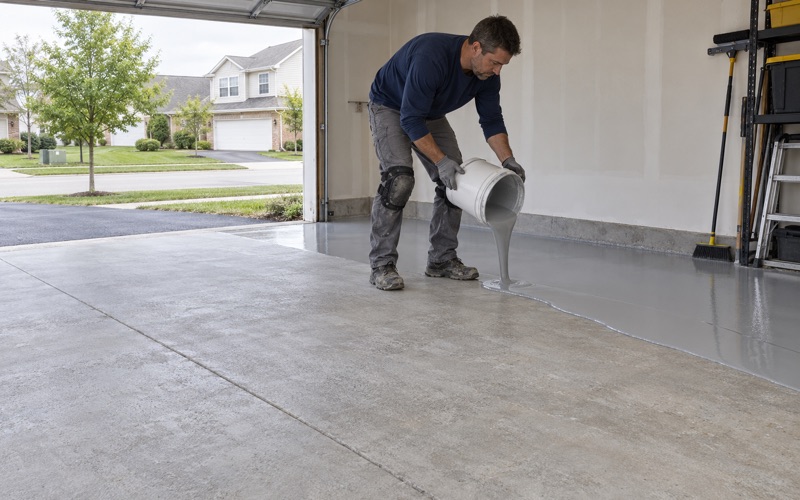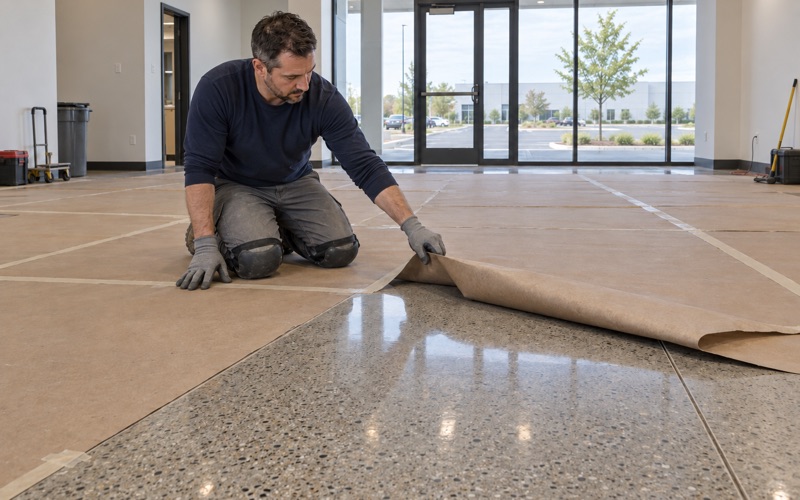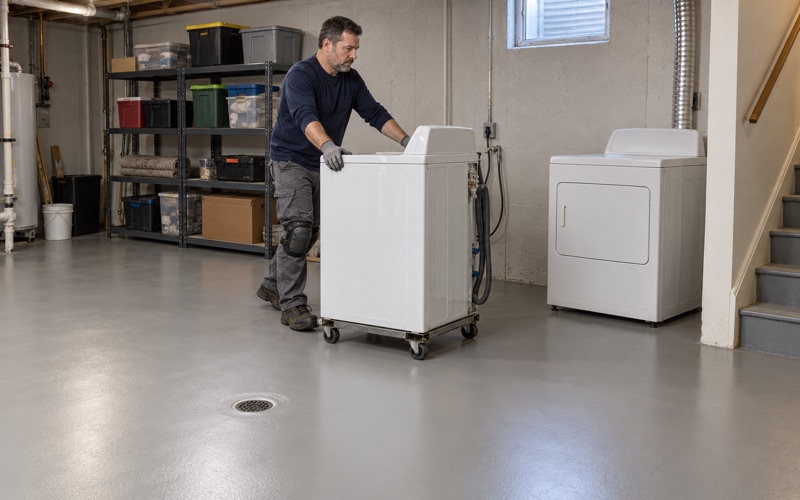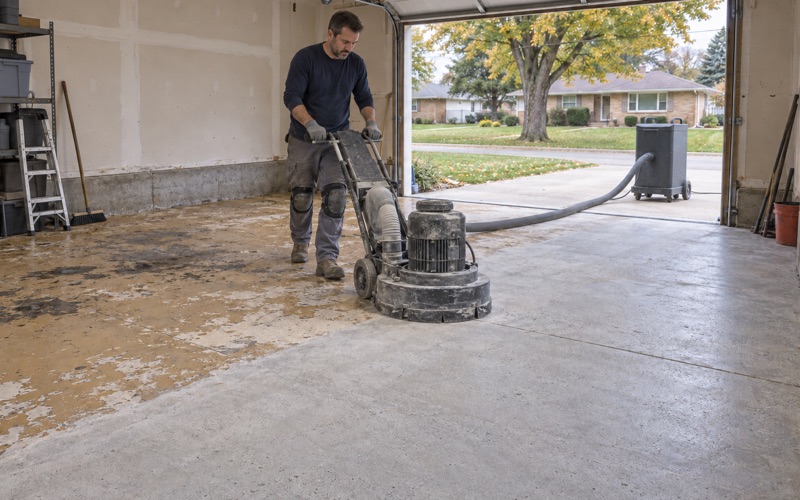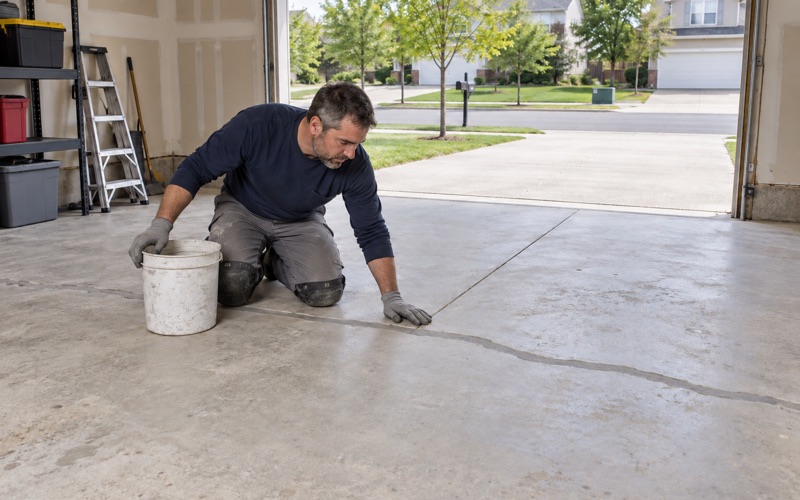
Romeoville Epoxy Flooring has spent 20+ years installing epoxy flooring in Lemont garages, basements and shops, and every job begins the same way. The slab is opened with a diamond grinder or shot blaster, never acid etched, and it is tested for moisture before any resin is mixed. That preparation is what lets a 100% solids epoxy or a polyaspartic topcoat grip the concrete instead of peeling in its first winter.
Our garage systems are built for the calcium chloride brine and rock salt that ride in on tires from December to March, with a vinyl flake or quartz aggregate broadcast for grip and a topcoat chosen to resist hot tire pickup. The written proposal names the product, the system build and the finished thickness, so you can hold what went down against what was quoted.
This page is also about something a floor coating cannot do. Plenty of garages here double as the room where hobby batteries get charged, and a coated floor is the wrong surface for that job. Below we explain why, how to set up a proper charging spot in a coated garage, and how we repair a scorch mark if one ever happens.
Where Lemont’s RC Batteries Get Charged
A Hobby Shop in the Old Mill Shoppes
Just west of the train station in historic downtown Lemont, Oakridge Hobbies, Toys & Gifts sits in Oakridge’s Old Mill Shoppes at 15800 New Avenue. The family-owned store has operated since 1987 and completed a full reset of its downtown location in fall 2025. Its shelves carry hobby-grade ready-to-run electric RC trucks, cars and boats, along with ready-to-fly planes.
Nearly every one of those models runs on lithium-polymer packs, usually called LiPo batteries, and those packs get charged at home between runs. In most houses that means the garage, on a workbench or right on the floor beside the car. We have no connection to the store and have never seen its floors; it simply explains why so many local garages hold a charger.
What the Charger Manual Actually Says
The manufacturer instructions are blunt. Horizon Hobby’s manual for the Spektrum S22 smart charger tells owners to always keep the battery away from any material that could be affected by heat, to charge in a well-ventilated area, and never to charge in extremely hot or cold places or in direct sunlight.
The same page says to monitor the charging area, keep a fire extinguisher available at all times, and end the charge if a pack turns hot to the touch or starts to swell. It also warns against charging dead, damaged or wet packs. In a garage that collects meltwater and road salt all winter, a pack set down on the floor can end up wet without anyone noticing.
Never Charge Overnight, Never Walk Away
Two warnings in that manual are printed in capitals: never leave charging batteries unattended, and never charge batteries overnight. Those rules matter more in a garage than at a kitchen table, because the garage is the room people leave. A charge started before dinner and forgotten until morning breaks both rules at once.
We raise this because a new floor changes habits. Once a garage is coated, bright and easy to sweep, it starts to feel like a workshop, and people move projects into it. That is fine for a workbench, a parts bin and a car on jack stands. A battery charger running with nobody in the room is a separate decision, and the coating does not change the answer.
Looking for epoxy-flooring closer to Shorewood? See Epoxy-Flooring Services in Shorewood.
Why a Coated Floor Is a Finish, Not a Charging Pad
Organic Films and Heat
Epoxy, polyurethane and polyaspartic coatings are organic polymer films bonded to the top of the concrete. They handle abrasion, oil drips and deicing salt very well, but heat is a different kind of load. A hot or venting battery set directly on the coating can scorch it, soften it or raise blisters in the film, and a resin’s chemical resistance does nothing to prevent that.
That is why we never describe any floor system as a place to charge batteries, and why no coating we install is sold as one. Its job is to protect the concrete from wear, stains and road salt. The charger manual’s rule about keeping the battery away from material that heat can affect applies to the coating exactly as it does to the cardboard box beside it.
What the Data Sheets Show
Manufacturers publish heat limits, and they sit lower than most people expect. One industrial epoxy floor system’s data sheet rates dry heat at 122 degrees F for permanent exposure, with higher temperatures allowed only for limited hours or days. Another 100% solids floor epoxy lists a heat distortion temperature of 122 degrees F.
Those figures describe two specific products, not any Lemont floor, but they show the shape of the category: these finishes are designed for everyday room temperatures with occasional warmth. A pack that overheats while charging is a different event entirely, which is why the protection belongs under the battery rather than in the floor.
Lemont Garages and Their Slabs
Most of Lemont’s housing is newer than visitors to the limestone downtown might assume. Census estimates put about 63 percent of homes as built since 1990, so the typical garage slab we grind here was poured somewhere between the 1990s and the 2010s. Most homes are detached single-family houses, and roughly 15 percent are townhomes.
Those slabs usually take a coating well once they are ground to the right ICRI CSP profile and checked with ASTM F2170 in-situ relative humidity probes or an ASTM F1869 calcium chloride test. Moisture testing is a line item in our scope, not something sold after a floor has blistered. A sound slab still does not turn the finish into a place for a charger.
Setting Up a Charging Station in a Coated Garage
Bag, Box and Tray
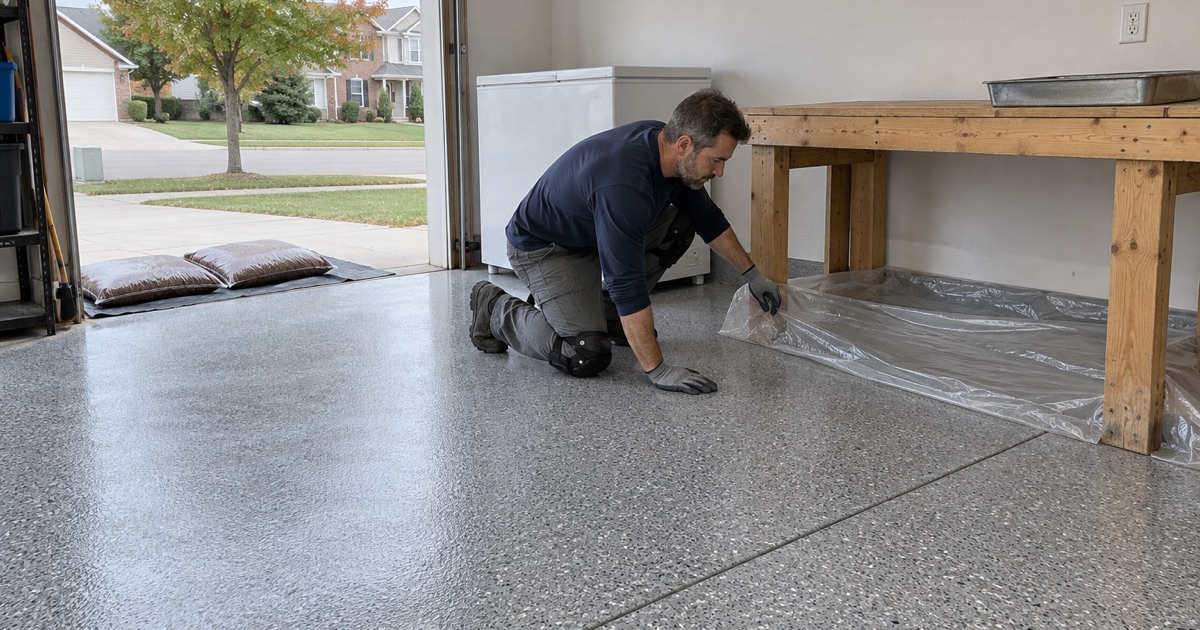
The practical answer is a dedicated charging spot that never touches the coating. Put the pack in a LiPo bag or a steel box, and set that on a ceramic tile or a steel tray. The tile or tray takes the heat, and the coated floor or bench top beneath it stays out of the picture.
A spot at workbench height is easier to watch than one on the floor, and it keeps the pack out of meltwater dripping off the car. Whatever height you choose, keep the charger itself on the same noncombustible base, route cords away from the wet path the tires leave, and pick a place you naturally walk past while the charge runs.
Keep the Corner Clear
Choose a corner away from the parked car, gas cans, paint thinner, cardboard boxes and the recycling bin. Garages collect exactly the materials that turn a small battery problem into a large one. A spot near the service door or a window also makes the manual’s ventilation advice easy to follow.
We are glad to talk through where that corner should go before we coat. If you plan a workbench or a steel cabinet along one wall, we can note it on the layout so the bench legs, cabinet base and charging tray sit where you want them on the finished floor, rather than being shuffled around afterward.
An Extinguisher Within Reach
The charger maker says to keep a fire extinguisher available at all times. Horizon Hobby’s battery guidance points to a Class D dry chemical extinguisher for a LiPo fire, with the pack then placed in an approved LiPo bag. Mount it on the wall near the charging spot, not across the garage behind the car.
Lemont is part of the Lemont Fire Protection District, and for questions about which extinguisher belongs in your own garage, the district is a better source than a flooring contractor. Our role is narrower: making sure the floor under the setup is sound and that nobody mistakes the finish for part of the safety plan.
Spot Repair If a Floor Ever Gets Scorched
Sand, Clean and Recoat the Spot
If a hot pack or charger has already marked a coated floor, the fix is usually a spot repair rather than a new floor. We sand the scorched or blistered area back to sound coating, feather the edges, clean it and rebuild the layers with the same system, matching the flake or quartz broadcast as closely as the original allows.
When the heat reached the concrete, or the film has let go beyond the visible mark, we grind that patch down to bare slab and rebuild it from the primer up. Either way the grinding dust is collected at the grinder and never washed toward a floor drain, and the repair cures against slab temperature and dew point rather than a date on the calendar.
What We Put in Writing First
Before we touch a home floor, you get a written contract and the Home Repair: Know Your Consumer Rights pamphlet, as the Illinois Home Repair and Remodeling Act requires. The price is per square foot for the system actually proposed, and the warranty exclusions are read out before anything is signed, with moisture named first.
We also say plainly that a coated floor is not a heat surface, so a scorch from a battery or charger is a repair, not a defect in the coating. Saying that before the job is better than debating it after a charger fails. We would much rather help plan a proper charging corner than patch the same spot twice.
Who Signs Off on the Work
Lemont spans Cook, DuPage and Will counties, but work inside the village runs through the Village of Lemont Building Department, which has adopted the 2021 International Codes. Illinois licenses no flooring or coatings contractor, so we confirm the village’s own contractor registration, bond and insurance rules before a job is scheduled.
We could not read Lemont’s registration terms online, so we ask the Building Department directly before starting. Some properties with a Lemont mailing address sit outside the village altogether, and for those the right authority is whichever jurisdiction actually contains the building, which we check before the proposal goes out.
- 20+ Years on Concrete
- Moisture Tested Before Quoting
- Per-Square-Foot Written Quotes