Romeoville Epoxy Flooring installs epoxy flooring in La Grange Park garages and basements, and after more than 20 years on Chicago-area concrete we plan each floor around what actually sits on it. Some of the most stubborn marks we find on bare slabs are not oil drips or tire scuffs. They are brown and reddish shadows left by garden material that was stored wet.
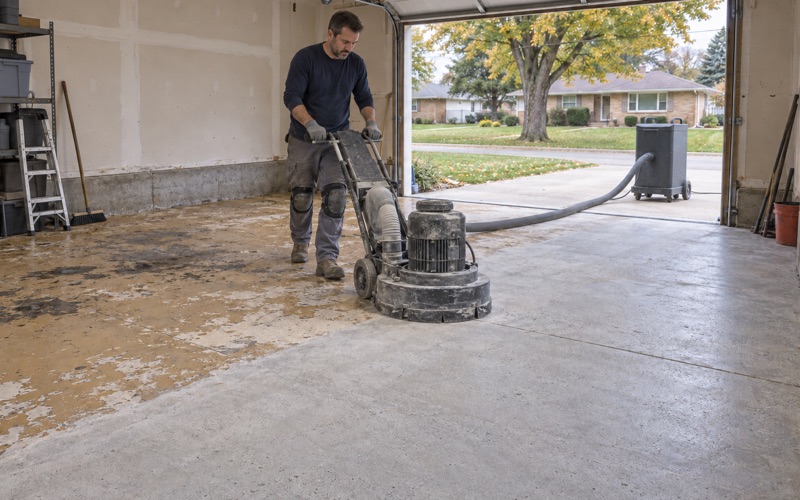
Our work starts with the slab itself. We open the surface with a diamond grinder or shot blaster instead of acid, test it for moisture as a quoted line item, and write the product, the system build and the finished thickness into the proposal. A floor built that way closes the pores that let colored water soak in, which is most of the battle against a garden-season stain.
What a coating cannot do is make concrete immune to staining, and we say so before anyone signs. It changes where a spill sits. On a porous slab, colored water wicks down into the cement paste, while on a sealed topcoat it stays on the surface long enough to be wiped away. The sections below explain why that difference matters here every spring.
Mulch Season in La Grange Park
The village program on Barnsdale Road
Each spring the village makes mulch available to residents outside the Public Works garage at 937 Barnsdale Road. If supply permits, residents can also request a truckload of about 3 yards through the village mulch page, with the request form open from April 1 to April 30. It is a generous program, and it moves a lot of wood chips through local driveways in a short window.
A dumped truckload rarely gets spread in one afternoon. Part of it often ends up shoveled into a wheelbarrow and parked inside the garage, or the edge of the pile slumps onto the apron during a rainy week. Whether the village mulch is dyed was not stated, so we treat it as ordinary wood chips, which carry plenty of natural color of their own.
Bagged garden supplies from 31st Street
Spring shopping adds a second route into the garage. One customer review describes La Grange Park Ace Hardware at 900 East 31st Street as a great place for plants, seeds and soil, and supplies bought for a planting weekend tend to wait on the garage floor until the weather cooperates. Bagged mulch from any source behaves the same way there: bags sweat, split at a corner and leak dark water where they rest.
Why the garage slab takes the hit
Most of the village’s owner-occupied homes are detached houses, 90.5 percent of them, and most of those houses have a garage floor that has never been sealed. Open concrete is exactly the surface that drinks colored water fastest and gives it back slowest. The garage is also where wet bags and wheelbarrow loads wait out a rainy stretch, so it collects the runoff season after season.
Looking for epoxy-flooring closer to Summit? See Epoxy-Flooring in Summit.
Tannin and Colorant: Why Mulch Stains Concrete
Tannin in plain wood chips
Tannin is present in plant tissue, including leaves and wood chips, and it can be a powerful brown or reddish-brown stain. The key detail is that tannins are water-soluble. Dry chips hold on to theirs, while wet chips release them, and the runoff carries that color into whatever it touches. A rain-soaked load or a damp bag is the version that marks a floor.
On bare concrete the tannin-laden water does not sit on top. It follows the capillaries in the cement paste downward, and the stain develops below the surface where a hose and a broom cannot reach it. That is why a brown outline from last spring’s bags can still be visible the following winter, faded at its edges but plain in the middle.
Permanent colorant in dyed mulch
Dyed mulch adds a second, harder problem. One maker’s colorant label describes a blend of permanent colorants mixed with water and applied to faded mulch, and it warns that to avoid permanent staining, care should be taken to avoid accidental application to concrete and other porous surfaces. The manufacturer is telling buyers plainly what its product does to an open slab.
The same label asks for application at least 30 minutes before irrigation or rainfall to prevent wash off, which tells you the color moves with water until it sets. A freshly colored bag or pile that gets wet in the garage can release that pigment. On a pale gray slab it shows wherever the water ran, and on bare concrete it is meant to stay.
Reading the shape of the stain
The outline of a mulch stain usually tells the story. A pile leaves a broad blot, while a split bag leaves a tight ring with a trail toward the floor drain or the garage door, wherever the slab falls. The trail follows the slope because water carried the color there, and on an untreated floor it soaks in along its whole length rather than only under the bag.
Bare Slab Versus a Sealed or Coated Garage Floor
Porous concrete holds the color
Untreated concrete behaves like a sponge with very small holes. Anything dissolved in water, from tannin to colorant, rides into those pores and lodges in the paste. Surface cleaners lift some of it, but the deeper the water traveled, the less any cleaning reaches. On a slab that has absorbed garden runoff for years, the discoloration often sits in layers from several seasons.
A coated floor keeps the spill on top
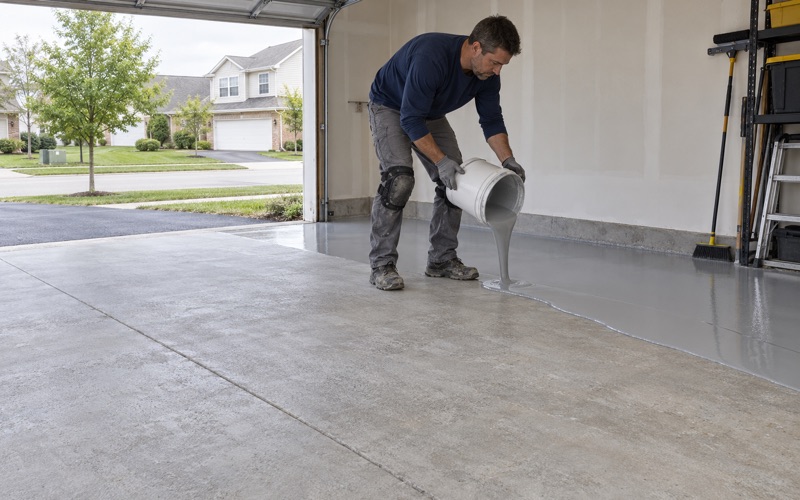
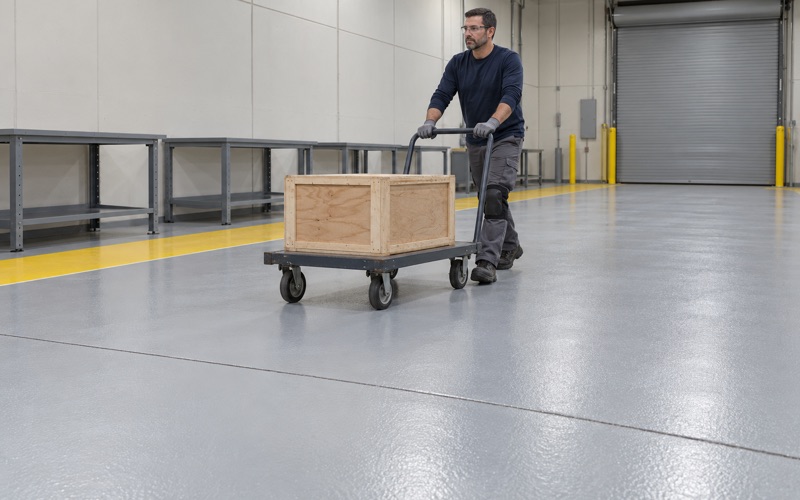
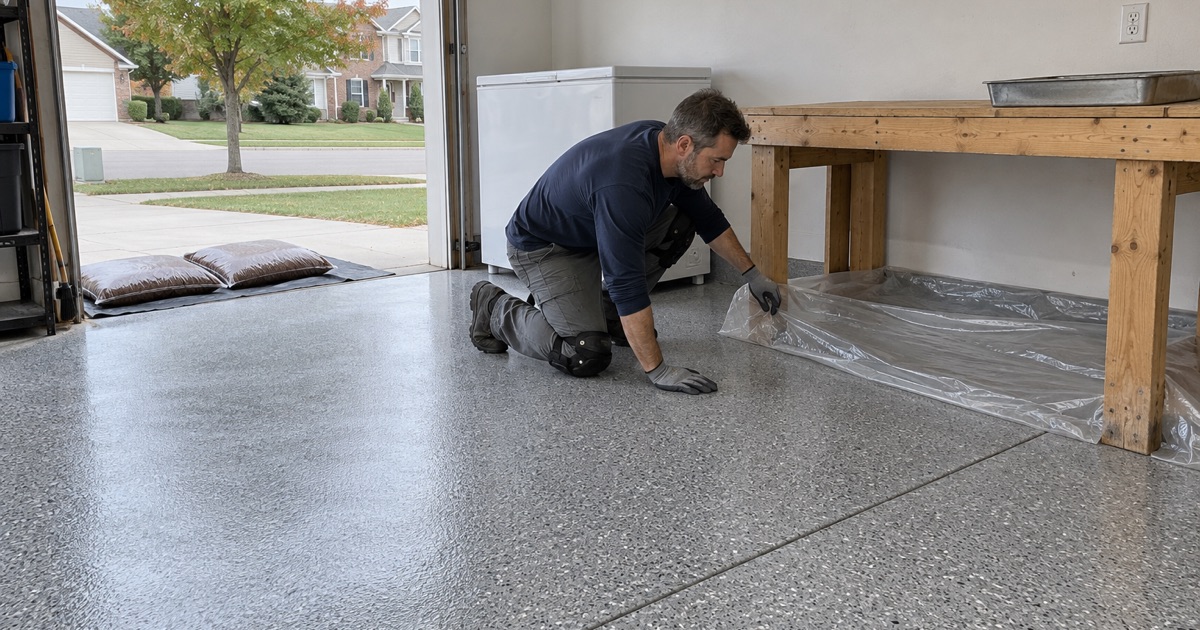
A properly bonded resin floor changes that arithmetic. A 100% solids epoxy base under a polyaspartic topcoat leaves a nonporous film over the concrete, so tannin water spreads across the surface instead of sinking. Wiped up promptly, it usually leaves nothing behind. A coating is not a license to leave wet mulch on the floor for weeks, though, and pigment left sitting can still mark a topcoat.
Bond is the whole game. We grind or shot blast to a measured profile on the ICRI CSP scale and never acid etch, because a coating laid over a weak, etched surface can lift in patches and let water creep underneath. Once colored water gets under a coating, it stains concrete you can no longer clean, which is worse than the bare floor ever was.
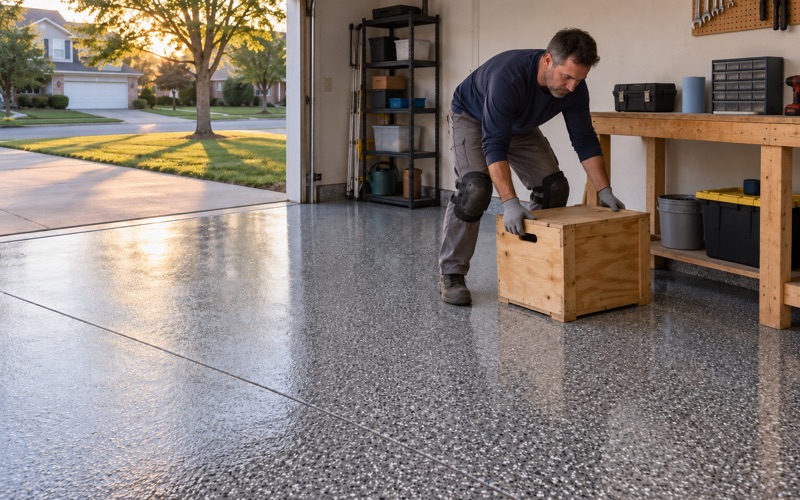
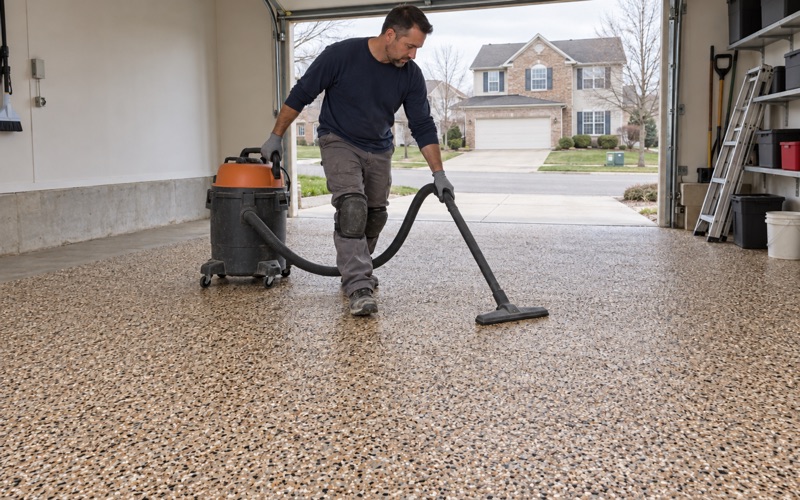
Texture matters for a garage that holds mulch every spring. A vinyl flake broadcast or quartz aggregate broadcast adds grip and visually forgives small marks, while a smooth, solid-color floor shows every shadow. A medium flake blend sealed under a clear topcoat is a practical middle ground: easy to mop, slow to show a faint ring, and still smooth enough that a towel picks up a spill in one pass.
What we check before quoting
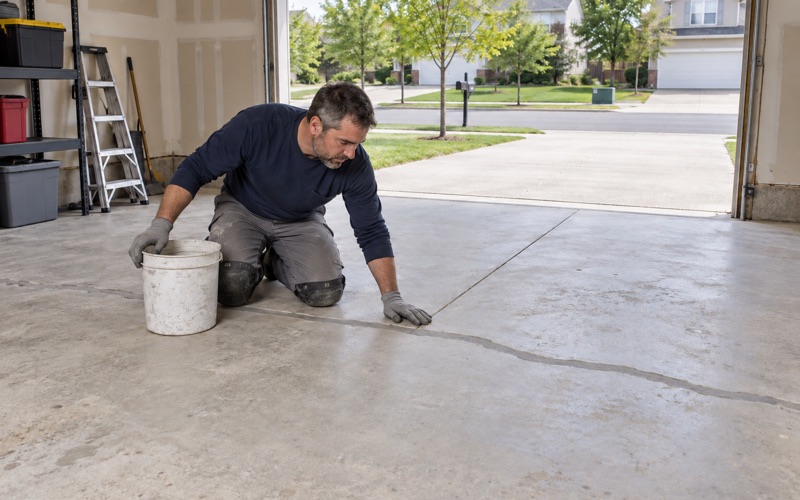
A garage floor gets read before it gets priced. We look at cracks, joints and any old paint or sealer, and we say plainly when a section needs repair or replacement before it can be coated. Moisture testing, whether ASTM F1869 calcium chloride or ASTM F2170 relative humidity probes, is a priced line in the scope rather than an upsell after a blister appears.
Every home job gets a written contract and the Home Repair: Know Your Consumer Rights pamphlet before work starts, as the Illinois Home Repair and Remodeling Act requires. Pricing is per square foot for the system we actually propose, not a national per-garage figure. Coatings are chosen within the Illinois VOC content limit for floor coatings, and warranty exclusions, moisture first, are read out before the job is sold.
Storing Mulch and Getting a Stain Up
Spread a tarp first
The simplest protection is the one already published for wood chips: spread a tarp before a load is delivered. The same habit works indoors. A heavy tarp under bags or a wheelbarrow pile catches the dark runoff before it reaches the floor, coated or not, and it folds up and rinses off outside once planting weekend is over.
If a delivered load stays on the driveway, set the tarp where the slope carries any runoff toward the lawn rather than toward the garage door or the apron joint. A pile left uncovered through a few April showers sends tannin water wherever the concrete falls, and an apron joint is a direct path to the slab edge.
Pallets and timing
Bags kept on a plastic pallet or a couple of scrap boards stay off the floor and dry out between rainy days instead of sitting in their own drainage. Stack them near the door so they leave the garage first. On a coated floor, run a damp mop under the pallet once the bags are gone, since that is where any leaked water collected.
Curing is scheduled against slab temperature and the dew point spread at the surface, not the calendar, and an unheated garage sometimes has to wait for warmer weather. That timing fits the mulch season well. A floor coated once the garage warms up has fully cured long before the following April, so a fresh topcoat never shares its first weeks with a stack of wet bags.
Wiping up on a coated floor
On a sealed or resin floor, treat a mulch spill like any other liquid. Pick up the chips, blot the colored water with a towel, and clean the spot with a neutral cleaner and warm water. Prompt wipe-up is the point: a topcoat holds the color on the surface for a while, but tannin left drying for days can leave a faint shadow.
Lifting a stain from bare concrete
Bare concrete takes more work and sometimes still loses. Scrubbing with a stiff brush and a concrete cleaner can lift fresh tannin from the top layer, while older marks have usually gone too deep. When a stain will not come out, grinding for a coating removes the top of the paste as part of preparation, and a flake broadcast covers whatever color remains below.
Grinding dust is collected at the grinder and never washed toward a floor drain or out the garage door. If your floor carries a few springs’ worth of brown outlines, we can look at the slab, test it and tell you plainly whether it is ready for a coating or needs repair first, with the product, build and thickness written into the quote.
- 20+ Years on Concrete
- Moisture Tested Before Quoting
- Per-Square-Foot Written Quotes