Romeoville Epoxy Flooring installs epoxy flooring in La Grange for contractor shops, fleet garages, storage bays and the basements and garages of the homes around them, drawing on more than 20 years of grinding, priming and coating concrete. Our work in the village starts with a question many floor crews skip: what actually gets spilled on this floor, and how will someone clean it up?
That question matters most where a trade keeps its materials. A floor that holds pails of gel, reels of wire and trucks backing in and out is not a showroom, and the finish that photographs best can be the one that behaves worst once something slick lands on it. We scope the floor around the work done on it, not around a color chart.
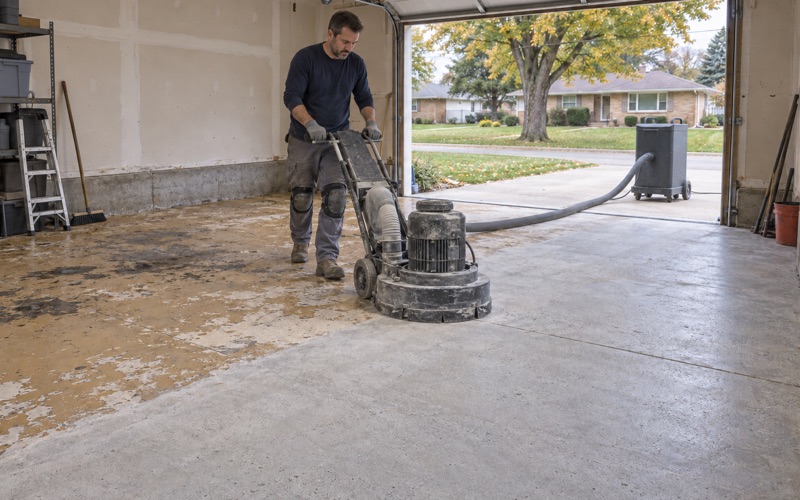
Every proposal we write names the product, the system build and the finished thickness, priced per square foot for that system rather than from a national garage average. The slab is opened with a diamond grinder or shot blaster, never acid etched, and moisture testing appears as its own line item before anything is mixed.
An Electrical Contractor’s Shop in La Grange
La Grange is home base for a working electrical contractor, which says something about the floors the village needs. Lyons & Pinner Electric Companies is listed at 650 E Elm Ave, inside the village in Lyons Township, Cook County, and describes itself as a union shop doing electrical construction, maintenance and design-build work. It was established in 1947 and has worked out of La Grange since.
Its federal carrier record lists 62 power units and 29 drivers, and the village’s FY2022-23 principal-employer table counts 100 employees, ranking it among the ten largest employers in La Grange. We have never seen that shop or its floors, and the company is not a customer. It is simply the clearest local example of a floor that every trade fleet shares.
What a Contractor’s Floor Carries
An electrical shop stages conduit, wire reels, ladders and pails of pulling compound, and trucks are loaded from those staging lanes early and returned late. The floor takes rolling reel stands, dropped fittings and the tires of service vans tracking in road brine. It also takes drips from the gel crews use to ease cable through conduit.
That last load is the one a coating plan usually misses. Abrasion and impact are easy to specify for, because every product sheet lists them. A slick film sitting on top of the coating, invisible once it dries, is a cleanup and finish problem rather than a strength problem, and it decides how the floor should be built.
Who Owns the Floor Decision
In a trade shop the people who stage materials and the people who choose the floor are often different. We walk the building with whoever runs the warehouse side, mark where pails are opened and where reels are loaded, and plan the finish zone by zone. A uniform coat across the whole slab rarely matches how a shop actually moves.
We also ask which products the crews keep on the shelf. Pulling compounds differ, and reading the label or safety data sheet for the one actually in use tells us how it cleans up. That answer shapes the finish we recommend for each lane more than any brochure does.
Looking for epoxy-flooring closer to Bridgeview? See Epoxy-Flooring Services in Bridgeview.
Why Wire-Pulling Lubricant Stays Slippery
Wire-pulling lubricant is engineered to stay slick, which is exactly why it becomes a floor problem. Its job is to let heavy cable slide through long conduit runs without tearing insulation, and a product that dried tacky or chalky would fail the electrician. The same property that protects the cable keeps a drip slippery on the floor below it.
A Film That Keeps Working for Months
One maker, Polywater, describes the residue of its Lubricant J as a thin, slippery film that retains its lubricity for months after use, and calls the gel slow drying. On a cable that is the point. On a smooth coated floor it means a spot that looks dry by afternoon can still be slick weeks later, with nothing on the surface to warn anyone.
That is why we do not treat a dried drip as a finished problem. A wet spill gets noticed and cleaned up. A film that has lost its shine but kept its slip is the one people walk through, carry onto the next lane and track toward the truck bay.
What the Gel Is Made Of
The safety data sheet for 3M’s wax-series wire-pulling lubricant lists it as 90 to 99 percent water, with 1 to 3 percent paraffin wax plus small amounts of polypropylene and polyethylene glycols and sodium polyacrylate. It is a white, odorless gel with no flash point. That blend of water, wax and polymer is why the film is easy to rinse and hard to notice.
Because the base is water, the cleanup is gentle rather than aggressive. Nobody needs a solvent or a heavy degreaser to deal with it, and reaching for a harsh chemical on a coated floor puts the topcoat at more risk than the gel does. The trick is the order of the steps, not their strength.
Why a Glossier Floor Is the Wrong Answer
The instinct after a slip is to ask for a harder, shinier coat that wipes faster. A glossy floor does wipe faster, but it also lets a thin lubricant film sit flat and unseen, and it gives the sole of a work boot nothing to bite through. The better answer is texture where the gel lands and a routine that removes the film.
Cleanup the Safety Data Sheet Calls For
Section 6.3 of the 3M sheet is specific. Working from the edges of the spill inward, cover it with bentonite, vermiculite or a commercial inorganic absorbent, and mix in enough absorbent until it appears dry. Collect as much of the spilled material as possible, then clean up the residue with water.
Absorbent First, Then Water
The order matters on a coated floor. Mopping first spreads a slick gel into a wider, thinner film, which only enlarges the area that stays slippery. Absorbent lifts the bulk of the gel off the surface and water then takes the remaining film, so the sequence is absorbent first, then water, and never the reverse.
A second rinse is worth the minute it takes. Because the dried film is hard to see, the only reliable check is to wipe the spot and feel for slip once the floor is dry, and to repeat the water step if it still drags differently from the floor around it.
Keeping Supplies at the Lane
We suggest a shop keep a lidded bin of absorbent and a dedicated squeegee beside the staging lane, not in a closet at the far end of the building. A cleanup routine works only when the supplies are within reach of the spill and the steps are posted where the newest driver will read them.
Drains, Rinse Water and Sealed Joints
For larger spills the sheet says to cover drains. That fits how we already work, since our own grinding dust is collected at the grinder and never washed toward a floor drain or storm inlet. A shop floor we coat keeps its drain locations clear and known, so a cleanup crew knows where to block before rinsing.
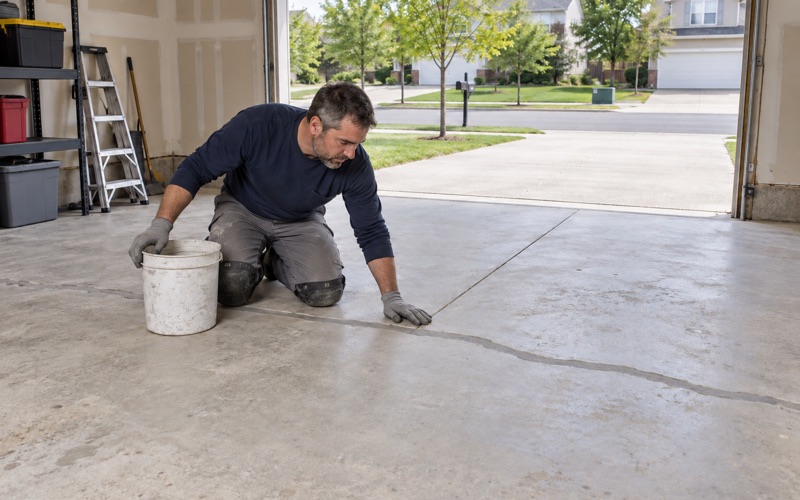
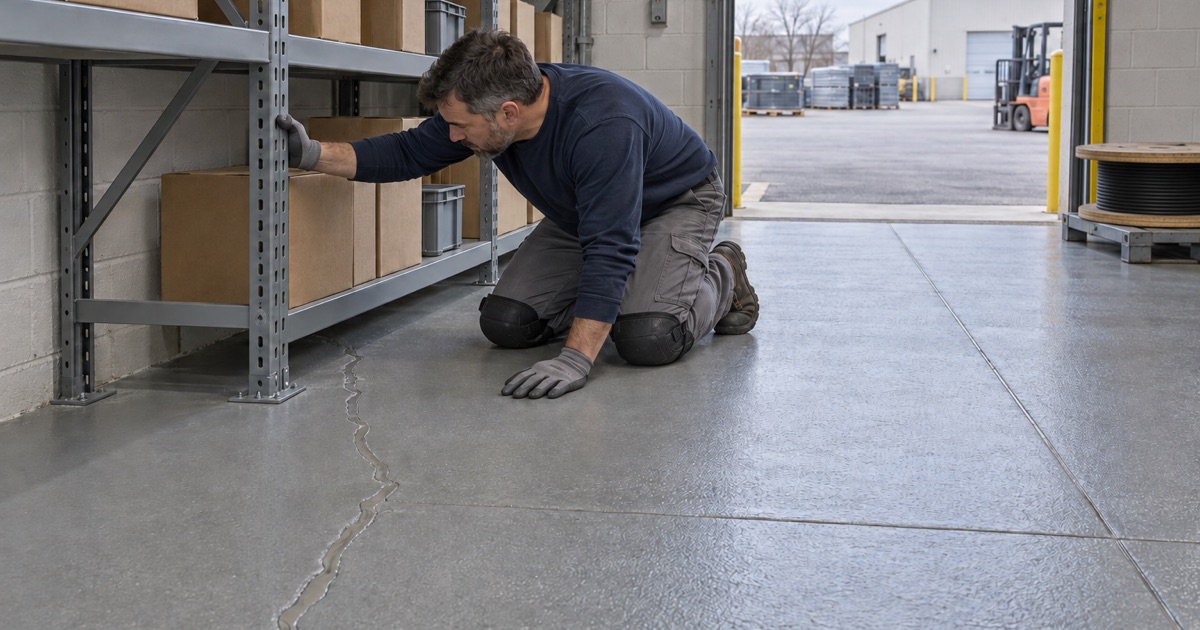
A finish that sheds water helps here too. A seamless resin floor, with saw cuts across the lanes filled with a semi-rigid polyurea joint filler, leaves no gaps for gel and rinse water to settle in. A cracked slab or an open joint holds film where a mop never reaches, which is part of why we read cracks, joints and old coating before quoting.
Texture in Staging Lanes and the Same Film at Home
We zone a shop floor by what happens on it. The lanes where pails are opened, reels are loaded and trucks are packed get a textured finish, while offices, break areas and dry storage can keep a smoother coat that is easier to sweep. Texture helps footing, but it does not make a lubricant spill safe; cleanup still does that job.
Building Texture Into the System
The usual build is a 100% solids epoxy body coat with quartz aggregate broadcast into it, locked in with a polyaspartic or polyurea topcoat. Grit can also be mixed into the topcoat itself for a lighter profile. Coarser texture grips better and cleans harder, so we size it to the lane and leave the cleanup routine as the main control.
Vinyl flake broadcast alone is mostly decorative and leaves a fairly smooth top, so in a staging lane we pair it with aggregate or a textured topcoat. Truck lanes also take hot tire pickup plus the calcium chloride brine and rock salt an Illinois winter tracks in, which is why a fleet garage gets a topcoat chosen for both.
Scheduling Around a Working Shop
A contractor’s shop cannot stop sending trucks out for a week. We phase the floor by lane and schedule the work around the hours the building has to keep running, including overnight and weekend windows. Curing is timed to slab temperature and the dew point spread at the surface, not to the calendar.
After a Service Upgrade or a Long Wire Pull at Home
The film is not only a shop problem. When an electrician upgrades a service panel or pulls new circuits through a basement, the same kind of gel can drip onto the slab beneath the conduit runs. A homeowner who finds a slick patch near the panel weeks later may be looking at that residue, and the same absorbent-then-water routine applies.
La Grange basements deserve a careful start before any coating. More than a third of the village’s homes, 36.1 percent, were built in 1939 or earlier, long before ASTM E1745 defined a modern under-slab vapor retarder, so we test with ASTM F2170 probes or ASTM F1869 calcium chloride tests rather than assume the slab is dry. A coating is not waterproofing, and warranty exclusions are read out before the job is sold, with moisture named first.
The village’s permit page lists no permit for replacing existing flooring, though finishing a basement room does need one, and we confirm La Grange’s own contractor registration, bond and insurance rules before scheduling. Every home job gets a written contract and the Home Repair: Know Your Consumer Rights pamphlet before work starts, as the Illinois Home Repair and Remodeling Act requires.
- 20+ Years on Concrete
- Moisture Tested Before Quoting
- Per-Square-Foot Written Quotes