Romeoville Epoxy Flooring has spent more than 20 years installing epoxy flooring in Hickory Hills shops, garages and commercial spaces, and on a lot that once sold fuel, the first question we ask is not about color or flake. It is whether the concrete under the floor is doing a job someone recorded on paper. On some cleaned-up sites, the slab is part of the remedy.
That changes how a floor gets prepared. Grinding the top of a slab so a coating can bond is routine work. Cutting a trench for a drain, coring for anchors or breaking out a section is a different act, and on a remediated lot it can carry obligations the owner accepted when the site was closed out.
This page walks through that distinction in plain terms: where the rule comes from, what it asks of the owner, which parts of floor work touch it and which do not, and what to settle before a contractor brings a saw. We install coatings and are not environmental consultants, so our part is to ask the question and plan around the answer.
A Filling Station on 95th Street and a Slab That Can Be Part of a Cleanup
Three tanks out in January 2024
The BP station at 7933 W. 95th Street is listed with the Office of the State Fire Marshal as facility 2042168. Its three 15,000-gallon gasoline tanks, two regular and one premium, were removed on January 19, 2024, and the file lists the facility as closed. The state also found the site eligible for the LUST fund, the program that helps pay for leaking-tank cleanups.
The city council’s minutes follow the property from there. In August 2025 they recorded that the lot had been sold for demolition and cleanup, and on March 26, 2026 the council approved a demolition permit for the station. By July 2026 the minutes noted that ComEd had shut off power to the site.
What the record does not say
The tank file stops short of the parts that matter most to a future floor. It does not say what contamination, if any, was found, or which cleanup path the site is on, and we found neither elsewhere. Nor did we find what will go on the lot next. We have no relationship with the owner or the city on this property.
We use it as an example because it is real and current on a busy commercial street, and because 95th Street carries other businesses on lots with their own histories. The same questions apply to any former filling station or service shop once the tanks are gone and a new building goes up.
When concrete counts as the remedy
Illinois cleanups under the state’s tiered approach, known as TACO, can rely on an engineered barrier instead of digging out every bit of affected soil. Section 742.1105 of 35 Ill. Adm. Code lists the barriers Illinois EPA recognizes, and two are familiar to anyone who pours floors: caps or walls built of concrete, and permanent structures such as buildings.
So a slab, or the building standing on it, can be what keeps people from contacting the soil underneath. Whether it is on a given lot depends entirely on that site’s own paperwork, which is why we never assume the answer in either direction.
Looking for epoxy-flooring closer to Manhattan? See Manhattan Epoxy-Flooring.
What a No Further Remediation Letter Asks of the Owner
The letter and its recorded control
When Illinois EPA closes out a site, the owner receives a No Further Remediation letter, and on a barrier-based cleanup that letter carries conditions. Section 742.1100 says a determination built on an engineered barrier requires effective maintenance of that barrier, and the maintenance terms are written into an institutional control, a recorded instrument that stays with the property.
That means a later owner or tenant inherits the duty along with the building. A business leasing a unit on a former station lot years after the cleanup may never have seen the letter, but the slab it plans to coat is still covered by it.
Why the maintenance language matters
The rule is blunt about the consequence. Failing to maintain an engineered barrier as the determination requires is grounds for voiding the No Further Remediation letter and the instrument that records it. For an owner, that can mean the closure the site depended on is no longer in force, a cost far beyond any floor.
Maintenance here means keeping the barrier intact and following what the control says. A coating laid on top does not change the barrier’s status either way. It is a finish on the barrier, not the barrier, and we never present a floor system as part of an environmental remedy.
Temporary breaches are planned, not improvised
The same control expects intrusive work to happen sometimes and sets terms for it. Before a planned breach, construction workers get advance notice of the contaminants known to be present and the protective measures to use, consistent with good industrial hygiene practice. A crew that shows up with a core drill and no notice is working outside those terms.
In practice, the owner or whoever holds the letter tells us what is underneath and what protection the work calls for, and the opening is closed back to the condition the control requires. We schedule around that review rather than ahead of it, even when it pushes the coating date back.
Grinding Is a Finish; Cutting, Coring and Tear-Out Are a Breach
Surface preparation stays in the top layer
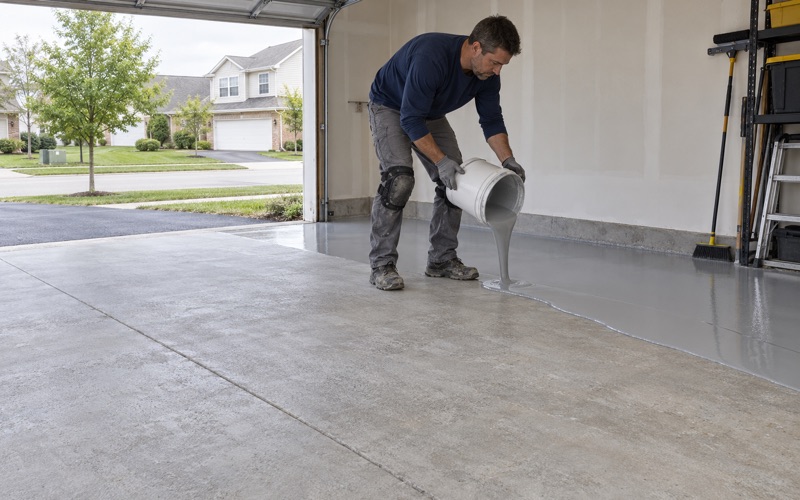
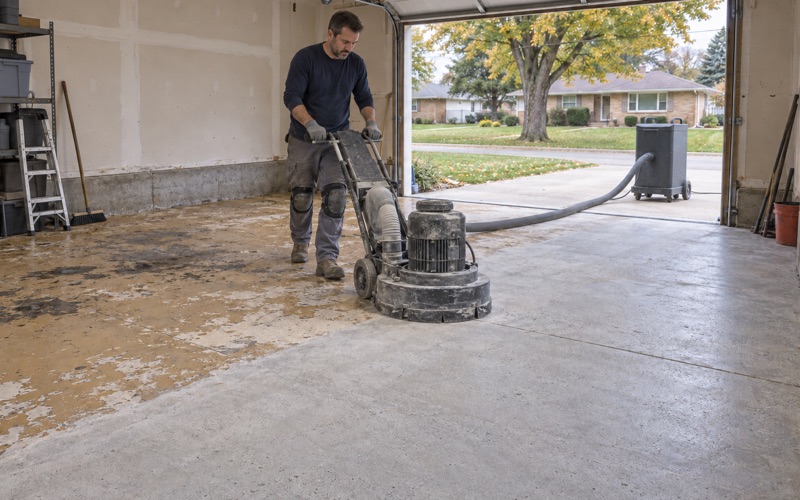
Every slab we coat is opened with a diamond grinder or shot blaster to the ICRI surface profile the primer calls for, typically CSP 2 to 3 for a thin-film system. That removes laitance, old sealers and a thin skin of cement paste. It does not reach the soil, and grinding dust is captured at the machine rather than washed toward a drain or storm inlet.
We do not acid etch, here or anywhere else. Acid leaves residue that weakens the bond, and the rinse water it needs has to go somewhere, often toward floor drains on an older commercial lot whose routing nobody has traced in years.
What counts as intrusive
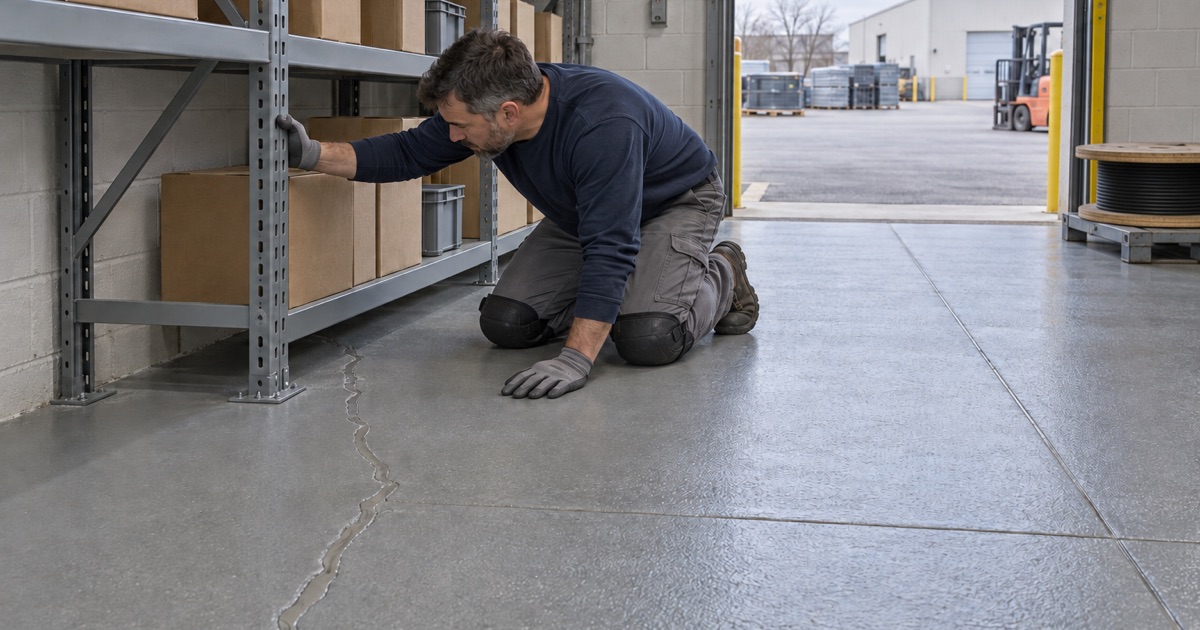
Saw-cutting a trench for a new floor drain, coring through for equipment anchors or a column footing, and breaking out a damaged section to replace it all go through the barrier. So does chasing a cracked joint deeper than the surface to repair it. Each is ordinary concrete work on a clean lot and a planned breach on a remediated one.
Floor coating jobs drift into this territory more often than owners expect. A shop that wants a trench drain under its new floor, or a slab with heaved sections we would replace before coating, is asking for the second kind of work, not the first.
Repair and replacement before coating
We read cracks, joints and any old coating before quoting, and we say plainly when a slab needs repair or replacement before a coating is worth applying. On a lot with a recorded control, that recommendation goes to the owner as a question first: who reviews the plan, what notice the control requires, and who restores the barrier afterward.
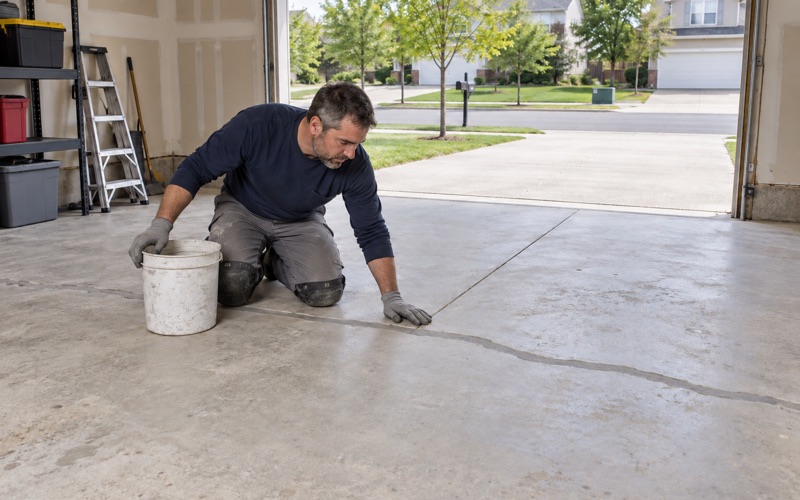
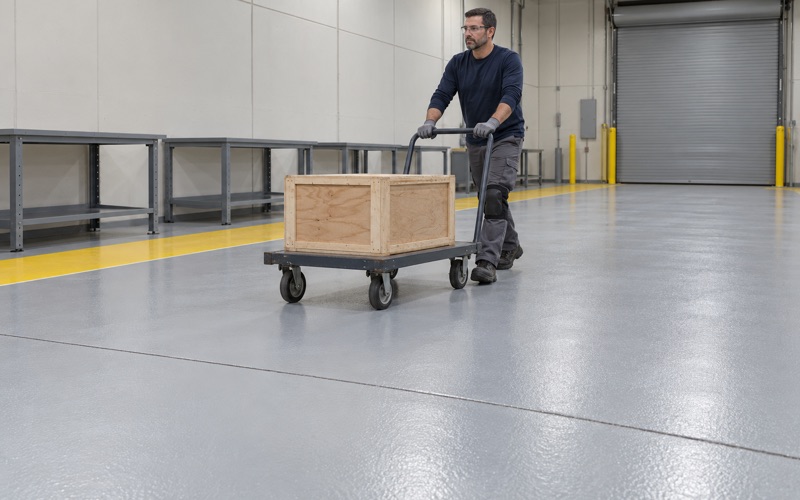
Shallow repairs, such as filling joints with a semi-rigid polyurea joint filler or patching spalls within the top of the slab, stay at the surface. Anything that goes through waits until the owner has confirmed the terms. The system itself, whether 100% solids epoxy, a polyaspartic topcoat or urethane cement, is then chosen for traffic, cleaning and chemicals as on any other slab.
Questions to Ask Before Floor Work on a Former Gas Station or Shop Lot
Does a recorded document name the slab?
Start with the property file. Ask the owner, landlord or property manager whether an NFR letter exists for the site and whether it relies on a concrete cap or the building as an engineered barrier. The title record should carry the institutional control if there is one. If nobody knows, that answer is worth getting before anyone schedules a saw.
Ask too what the lot was before its current building. A former service bay, filling station or shop with an old tank file can carry a closure the current tenant never heard about. The State Fire Marshal’s tank records are where the 95th Street station’s history showed up, and they are a reasonable first look for any older commercial address.
What the city asks of the contractor
Illinois licenses no flooring or coatings contractor, so the City of Hickory Hills contractor license is the one that binds. It costs $100 per calendar year, January through December, with no half-year option and no bond. A certificate of insurance naming the city goes with the application, and the owner gets a copy before work starts.
The city’s hauler does not collect contractor debris, so ground concrete, cut sections and old coating leave with the crew. On a remediated lot, where that material goes is one more thing to settle with the owner before the first load leaves, and we ask rather than guess.
Moisture, scope and what the proposal names
Moisture testing is a line item in our scope on every slab, using ASTM F2170 in-situ relative humidity probes or ASTM F1869 calcium chloride tests. F2170 probe holes are drilled partway into the slab, never through it, but on a slab that may be a barrier we still confirm them with the owner. Our proposal names the product, the system build and the finished thickness.
Curing is scheduled against slab temperature and dew point rather than the calendar, and warranty exclusions are read out before the job is sold, with moisture named first. None of that changes on a remediated lot. What changes is the order: the barrier question gets answered before the floor is even priced.
Scheduling around a working building
Many former station lots become small retail or service buildings that cannot close for a week. We schedule grinding, coating and cure around the hours the building has to keep running, including overnight and weekend windows, so any breach the owner has approved, the repair and the coating follow one sequence instead of three crews guessing at each other’s work.
- 20+ Years on Concrete
- Moisture Tested Before Quoting
- Per-Square-Foot Written Quotes