Romeoville Epoxy Flooring installs epoxy flooring in Crestwood for shops, warehouses, garages and food businesses, and after more than 20 years on Illinois slabs we treat a floor’s past as part of the scope. Before a diamond grinder or shot blaster opens the concrete, we want to know what the room was used for and what may have spilled on it. That question costs nothing to ask and can change everything that happens next.
Most older floors turn out to be ordinary: oil shadows, old paint, anchor holes, a tired sealer. A few carry history that federal rules care about, and on those the coating stops being a cosmetic choice. Knowing which kind of floor we are standing on decides whether we grind, whether we stop, and who else has to be part of the conversation.
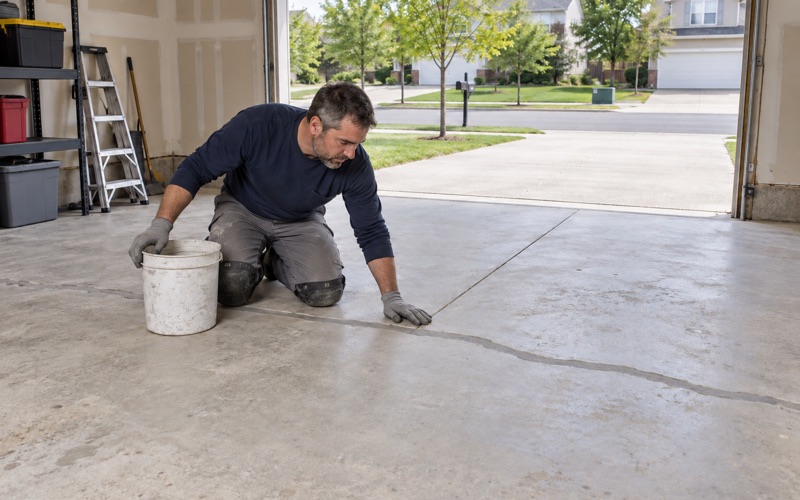
Our proposals name the product, the system build and the finished thickness, so an owner can check what went down against what was quoted. Moisture testing sits in that scope as its own line item. We also read the cracks, joints and any old coating before pricing, and we say plainly when a slab needs repair before it can be coated at all.
A Utility Fleet Yard on 135th Street Since the 1970s
Fuel tanks on the record since 1973
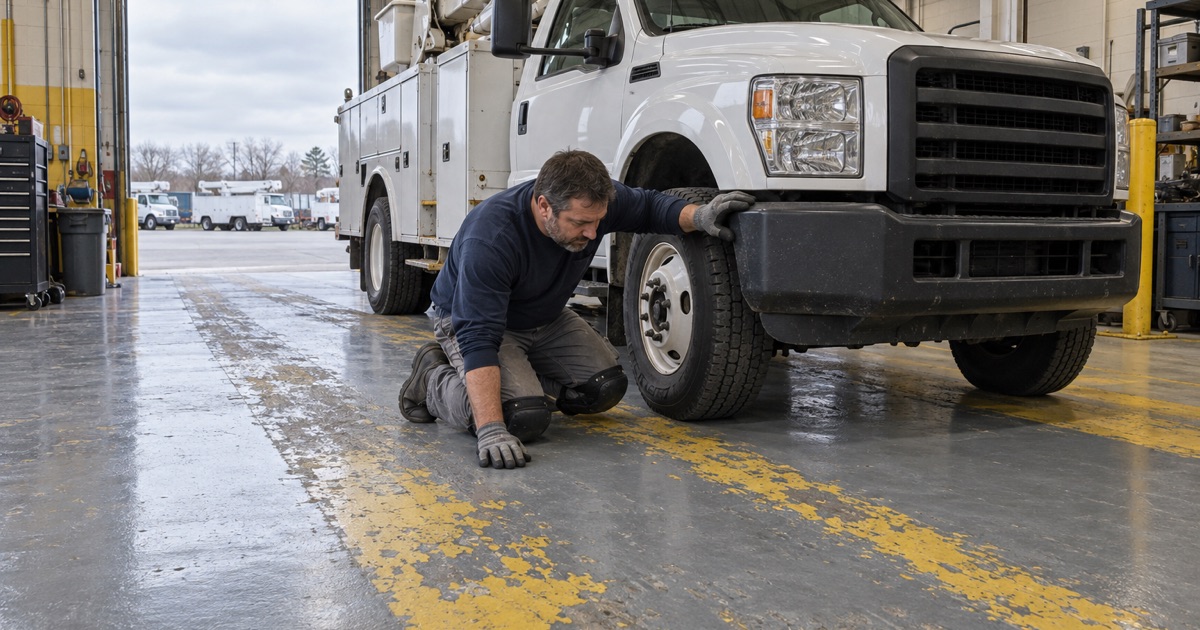
Much of Crestwood’s industrial ground runs along 135th Street, and one of its longest-running occupants is the ComEd Crestwood headquarters at 4401 W 135th Street. The Illinois State Fire Marshal’s underground storage tank record for that address shows fuel tanks installed between 1973 and 1979 and removed in 1995, with two 10,000-gallon tanks in use since then.
That makes the property a utility fleet-fueling site since at least 1973, and the village’s own business database files it under Industry. We mention it only as a picture of how long industrial use has run on this stretch of the village. No PCB spill is known at that site, and we have never worked on its buildings or its floors.
Why a long industrial past matters to a coating
A slab that has served one purpose for decades can hold a record that never shows on the surface. Utility shops, electrical rooms and older industrial floors are the kinds of spaces where transformers, capacitors and fluids from earlier eras were handled, and where an old spill may have been documented and managed in place rather than removed.
For most floors that history is about stains and residues that affect bond, and our prep handles them. For a narrow set of floors it is about federal law instead. The difference matters to us because our work starts with a grinder, and grinding is the one step that cannot be taken back once the dust is in the air.
Looking for epoxy-flooring closer to Westchester? See Westchester Epoxy-Flooring.
What the Federal PCB Rule Says About Spill-Contaminated Concrete
Porous surfaces above 10 micrograms
The rule is 40 CFR 761.30(p), part of the federal regulations on polychlorinated biphenyls. It covers porous surfaces, concrete included, that were contaminated by a spill of liquid PCBs. Where contamination exceeds 10 micrograms per 100 square centimeters, the surface may stay in use for its remaining useful life only if the owner meets a specific set of conditions.
That is an option the rule gives the owner, not an order to keep using the floor. What the paragraph does is describe the terms under which a contaminated slab keeps working as a floor, and those terms reach directly into the coating that sits on top of it. A floor contractor who does not know them can undo an owner’s compliance in an afternoon.
Contain the source, wash twice, dry a day
The first condition is that the source of the spill is removed or contained. Next, the accessible surfaces are cleaned by the double wash/rinse procedure set out in subpart S of the same rule, then left to dry for 24 hours. Only after those steps does any cover go on.
That cleaning is decontamination work, and we do not perform it. A floor under this rule belongs to the owner’s environmental program and the consultants who manage it. Our part, if we find ourselves on a site like that, is recognizing the situation early and leaving the concrete alone until the people responsible for it have decided what happens next.
A coating or a fastened barrier
The rule then requires the cleaned surfaces, and any that cannot be cleaned, to be fully covered. One path is two coats of a solvent-resistant, water-repellent coating. The other is a solid barrier fastened over the area. Either way, the cover is what separates people and equipment from what remains underneath, so it is judged as a cover first.
Two Contrasting Colors and a Mark Anyone Can See
Why the two coats must differ
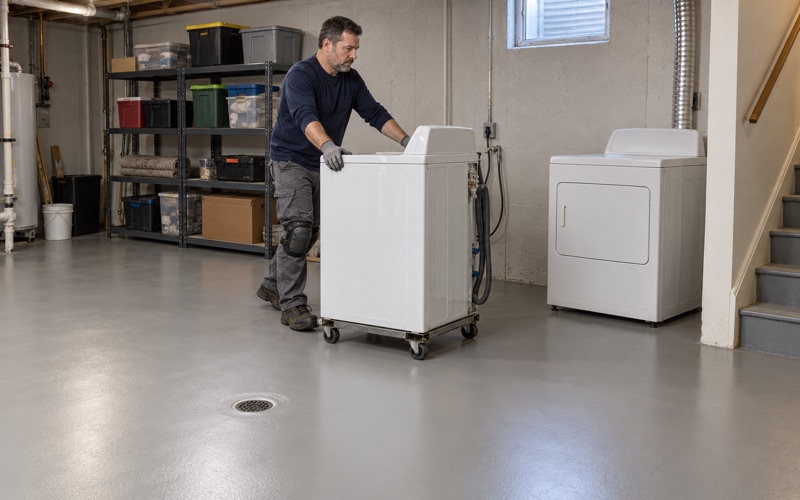
On the coating path, the two coats have to go down in contrasting colors. The reasoning is practical: when the top coat wears through, the different color underneath shows, and anyone walking the floor can see the cover thinning well before the base coat is gone too. The floor reports its own condition.
That turns color into a rule rather than a preference. On an ordinary shop floor we might match a gray base to a gray topcoat for a uniform look. On a regulated floor the layers are meant to look different, and the finish is judged by whether wear will be visible, not by whether the result is attractive.
The ML mark and keeping it legible
The rule also requires an ML mark, the federal PCB marking, placed where people in the area can see it. It tells anyone entering the space that the floor is a regulated surface. When the mark wears or becomes hard to read, it has to be replaced, just as a worn coating has to be restored.
Upkeep on a floor like that is a different job from a cosmetic recoat. Restoring the cover means bringing back both contrasting layers, not one fresh color rolled over a worn spot, and keeping the mark readable afterward. An owner planning that work starts from the environmental requirements and builds the coating plan to fit them.
Why that floor is not ground off or hauled away
Under paragraph (p)(2), a surface kept in use this way may not be removed from its location except for disposal under the rule’s disposal sections. The slab is not something a crew grinds down to fresh concrete and sweeps into a dumpster. Profiling it, cutting it or carrying off its dust becomes waste handling the owner has to plan.
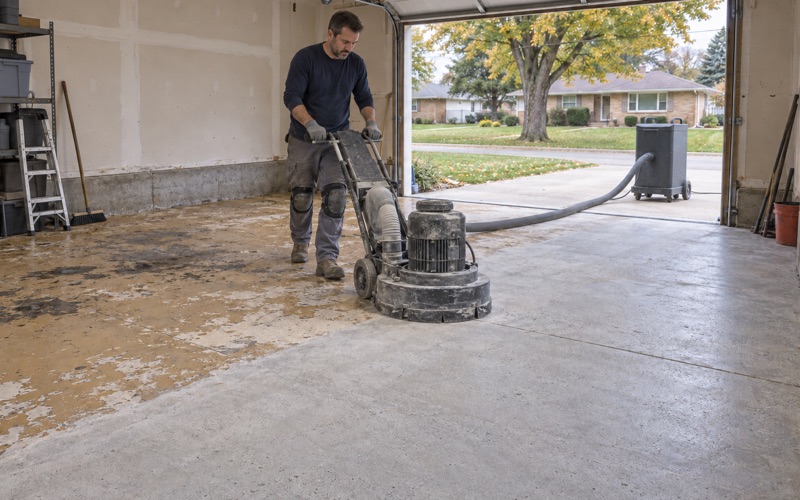
That is the opposite of how we treat an ordinary floor. Our normal prep opens every slab mechanically, with no acid etching, and the dust is collected at the grinder rather than washed toward a floor drain. On a regulated surface even well-collected dust is governed material, so the grinder stays on the truck.
Floor History Questions Before Prep in Crestwood
What we ask on an older industrial slab
Before quoting any older utility, electrical or industrial floor in the village, we ask what the room was built for, what equipment stood on it, and whether a spill was ever reported or cleaned up. We also ask whether an environmental consultant keeps a file on the building. Most answers are simple, and those floors move forward normally.
If a room has transformer pads, a former electrical shop or a gap in its records that nobody can fill, we say so and pause before grinding. Asking costs an owner a phone call. Grinding a regulated surface without knowing can cost a cleanup that nobody had budgeted for.
Registration and the Building and Zoning Department
The Village of Crestwood requires every contractor to register before working there, at $100 for a general contractor and $25 for a sub, with an insurance certificate naming the village as additional insured. Illinois issues no state license for flooring or coatings work, so the village’s own rules are the ones we confirm before a job is scheduled.
The Building and Zoning Department at 13800 South Cicero Avenue lists painting and carpeting as permit-exempt but does not name floor coatings either way, so we ask rather than assume. Some Crestwood addresses carry a 60445 ZIP that Midlothian shares, so we go by the village boundary, not the ZIP, to decide which department applies.
The ordinary floor still gets the full scope
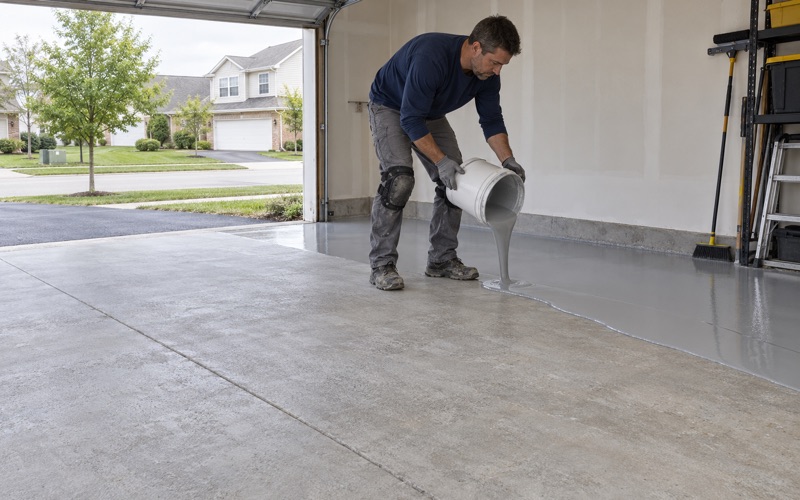
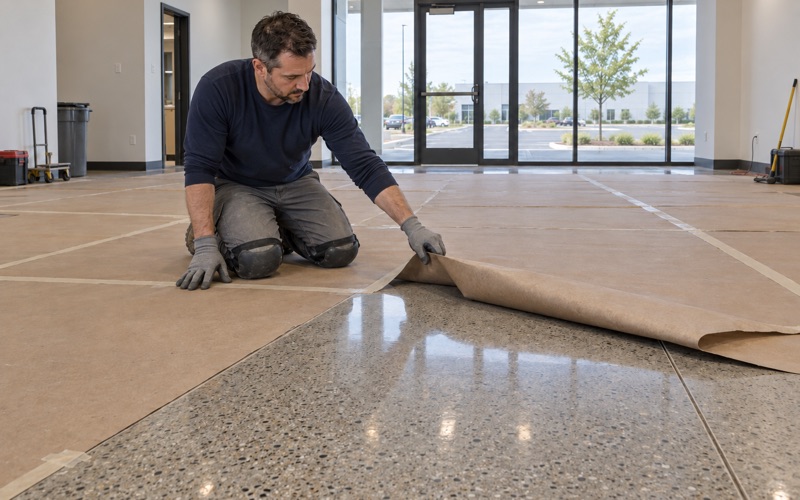
Once a floor’s history is settled, the work follows our normal sequence. Moisture is measured with ASTM F2170 relative humidity probes or ASTM F1869 calcium chloride tests, the slab is ground or shot blasted to the ICRI profile the system needs, and the coating is chosen within the Illinois VOC limits that bind the installer as well as the manufacturer.
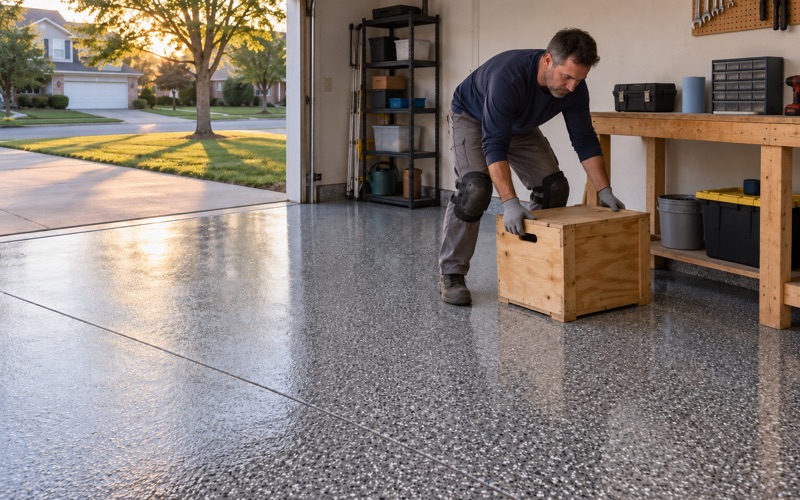
Pricing is per square foot for the system we actually propose, and warranty exclusions are read out before the job is sold, with moisture named first. On an older Crestwood shop floor that might mean a 100% solids epoxy with a quartz aggregate broadcast for traction, or a polyaspartic topcoat where a quick return to service matters most.
- 20+ Years on Concrete
- Moisture Tested Before Quoting
- Per-Square-Foot Written Quotes