
Romeoville Epoxy Flooring provides concrete grinding in Romeoville, IL, serving surrounding cities including Lemont, Shorewood, Burr Ridge, Mokena and Warrenville. For more than 20 years, grinding has been the first step on every floor we coat or polish, and it is the step that decides whether the finish stays bonded.
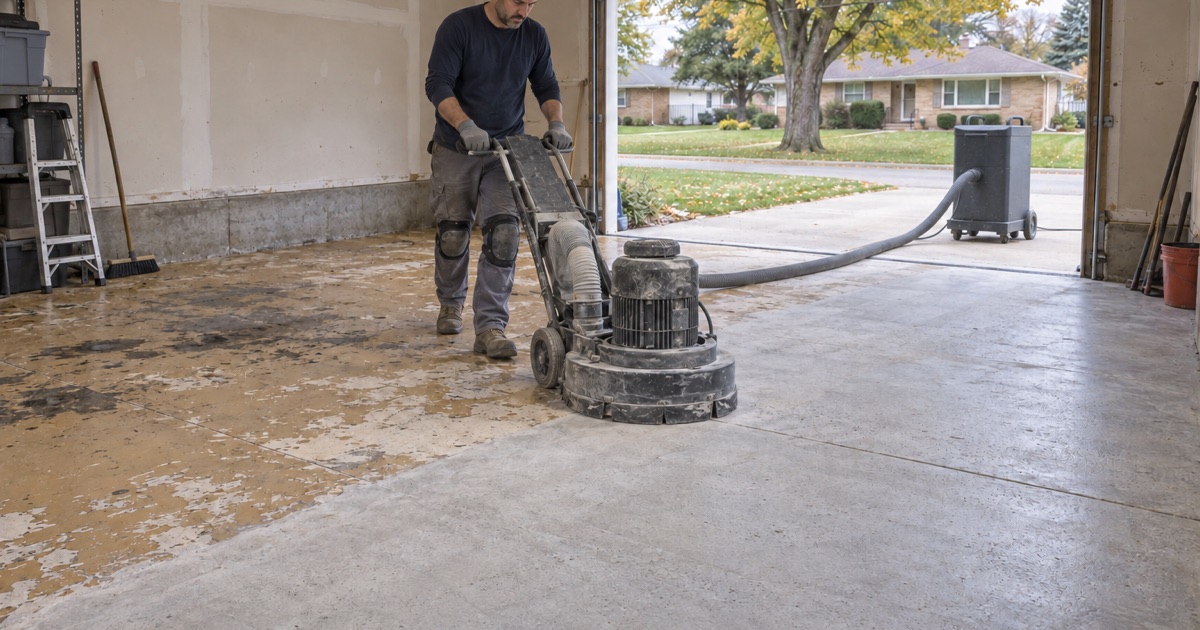
Concrete grinding uses rotating diamond tooling to remove the top layer of a slab, cutting through sealers, paint, adhesive, oil contamination and the weak surface paste left by the original finishing. What remains is clean, sound concrete with an open texture that a coating can grip.
We grind before our own coatings, before polishing, and as a standalone service when a floor needs old coatings removed or a profile prepared for another installer. In every case the dust is collected at the grinder, never swept outside or washed toward a floor drain or storm inlet.
Why Surface Preparation Matters
Coatings Bond to What Is Underneath
An epoxy or polyaspartic coating is only as strong as the surface it sticks to. If that surface is a curing compound, an old sealer, a film of oil or a weak layer of laitance, the coating bonds to it and fails when it lets go of the slab.
Grinding removes all of those layers, so the new coating bonds directly to sound concrete. That is the single biggest difference between a professional floor and one that peels at the tire lines within its first winter.
Why We Never Acid Etch
Acid etching is cheap and quick, which is why kit instructions recommend it. It roughens the surface only slightly, leaves residue that has to be neutralized and rinsed, puts water into the slab right before coating, and does nothing at all to remove sealers or paint.
We do not acid etch any floor. Every slab is opened mechanically with a diamond grinder or a shot blaster, so the profile is consistent and the surface is dry and ready to coat the same day.
Surface Profile and the ICRI Scale
Matching the Profile to the System
The International Concrete Repair Institute rates surface texture on a Concrete Surface Profile scale, from CSP 1, nearly smooth, to CSP 10, very rough. Each coating system needs a particular range, set out by the manufacturer.
Thin coatings and sealers need a light profile, while thick epoxy and urethane cement systems need a deeper one. We match the tooling to the system being installed so the surface is neither too smooth for adhesion nor rougher than the coating can cover.
Checking the Result
After grinding, we compare the surface against ICRI profile chips and check for leftover sealer, soft spots or contamination. Areas that still show sealer or oil are ground again before any primer goes down.
The profile we leave is written into the proposal. That gives you, or another installer, a clear standard to check the prepared floor against.
Grinding Versus Shot Blasting
Diamond Grinding
Diamond grinders work well on garages, basements and most interior floors. They remove coatings and contamination, take down lips at cracks and joints, and leave a uniform profile with good control near walls and edges.
They are also the first stage of polished concrete, where progressively finer tooling refines the surface instead of opening it. The same machine can prepare a floor for a coating or begin a polish, depending on the tooling we fit.
Edge grinders and hand tools reach the last few inches along walls, around posts and into corners that a large machine cannot. Skipping those edges is a common shortcut, and it shows later as peeling along the perimeter of a coated floor.
Shot Blasting
Shot blasting fires small steel shot at the slab and recovers it through a vacuum, leaving a deeper, more textured profile. It is fast on large, open commercial floors and suits thick coatings that need more bite.
We choose between the two, or use both, depending on the floor, the existing coatings and the system that will go on top. The choice is explained in the proposal.
On a large warehouse slab, shot blasting the open field and diamond grinding the edges and joints is often the fastest combination. On a two-car garage, a diamond grinder alone usually gives the best control.
What Grinding Removes
Sealers, Paint and Old Coatings
Many garage and basement floors carry a sealer or paint from a previous owner. Coating over those films is the most common cause of peeling, so we grind them off completely, along with failed epoxy and flaking kit coatings.
Adhesive, Mastic and Carpet Glue
When tile, carpet or vinyl comes up, it leaves adhesive behind. Grinding removes mastic and glue residue so the slab can be coated, polished or prepared for new flooring without the old adhesive reacting with the new material.
Oil, Salt and Surface Contamination
Garage floors absorb oil drips and the residue of years of road salt and calcium chloride brine. Grinding cuts below the contaminated layer where possible, and we degrease deeper stains before coating so they do not bleed through later.
Some oil-soaked areas are too deep to grind out completely. In those spots we use a degreaser and an oil-tolerant primer, and we tell you if a stain is likely to remain faintly visible under a lighter-colored finish.
Cracks and Joints Found During Grinding
Grinding often reveals cracks and pitted joints that were hidden under sealers or grime. We map them as the surface opens up, then route, fill and grind them flush before coating, so the repaired areas carry the same profile as the rest of the floor.
Planning a Grinding Job
Dust Control and Occupied Buildings
Our grinders run with vacuum extraction attached at the machine, which captures most of the dust as it is made. In homes and occupied commercial spaces we also seal off work areas and schedule around how the building is used, including overnight and weekend windows.
Moisture Testing After Grinding
Once the slab is open, we test it for moisture before any coating goes on, using ASTM F1869 calcium chloride kits or ASTM F2170 in-situ probes. A ground surface gives the most accurate reading, and the results decide the primer.
Pricing
Grinding is quoted per square foot, with the price depending on what has to be removed and the profile required. Thick old coatings, heavy adhesive and deep contamination take more passes and more tooling, and the proposal shows those factors so the number makes sense.
- 20+ Years on Concrete
- Moisture Tested Before Quoting
- Per-Square-Foot Written Quotes