
Romeoville Epoxy Flooring handles concrete floor repair in Romeoville, IL, serving surrounding cities including Lemont, Shorewood, Burr Ridge, Mokena and Warrenville. With more than 20 years of grinding and coating slabs, we have worked over cracks, chipped joints and salt-damaged surfaces of every kind, and we have learned to tell the difference between a floor that needs patching and one that needs replacing.
Repair is where a lasting floor really begins. A coating can hide damage for a season, but it cannot hold a broken slab together. Cracks that move, joints that keep chipping and surfaces that have scaled under years of winter salt all have to be dealt with before any finish goes down.
We read every crack, joint and old coating before quoting, and we tell you plainly when a slab needs repair or full replacement before it can be coated. Repair is listed as its own line in the proposal, so you can see exactly what your floor needs.
Common Concrete Floor Problems
Shrinkage and Hairline Cracks
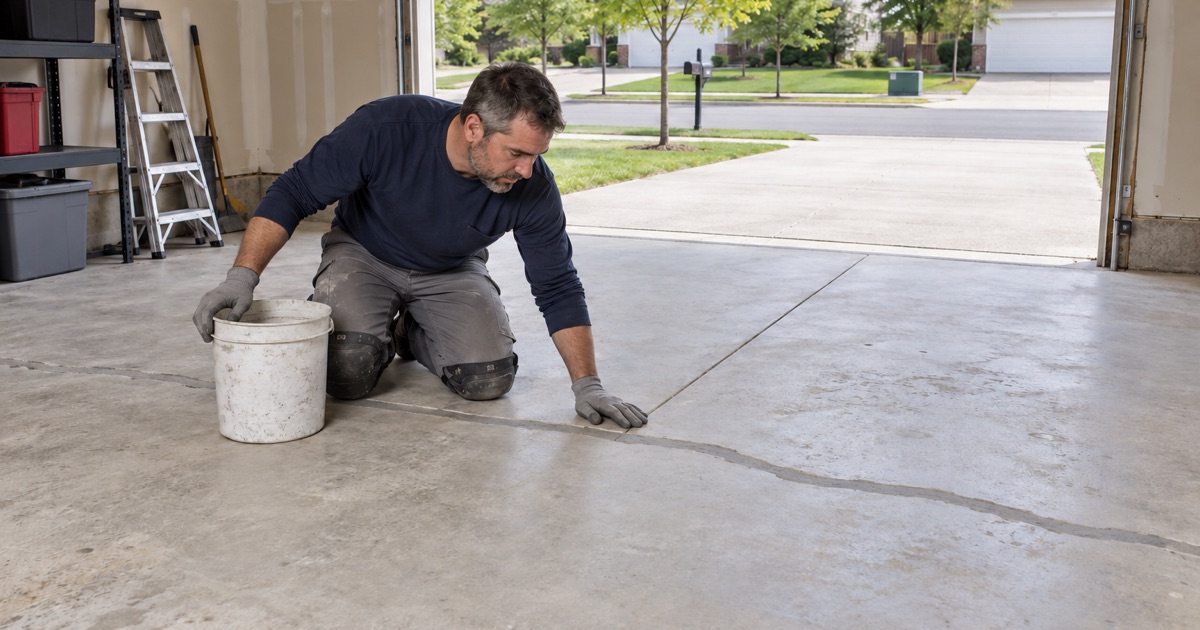
Almost every slab cracks as it cures and shrinks. These fine, often random cracks are usually stable and cosmetic. We route them open, clean them out and fill them with a rigid epoxy or polyurea repair material, then grind them flush so they disappear under a coating.
Routing matters. Filling the surface of a narrow crack without opening it leaves the repair sitting on dust and debris, and it can pop out under the first cold snap or the weight of a car.
Settled and Displaced Slabs
When one side of a crack sits higher than the other, the slab has moved. That usually means soil below has settled or washed out, or frost has pushed part of the slab up. Grinding can take down a small lip, but it does not fix the cause.
We point these cracks out at the walk-through and explain what they mean. Where movement is ongoing, coating over it would only lead to a new crack in the finish later.
Scaling From Salt and Freeze-Thaw
Scaling is the flaking of the top layer of concrete, most common near garage doors and along tire lines. It happens when water and deicing salts soak into the surface and then freeze and thaw repeatedly. Will County winters provide plenty of both.
We grind scaled areas back to sound concrete, then rebuild them with a polymer-modified repair mortar or an epoxy mortar, depending on depth. Once the surface is level and cured, it is ready to coat.
Joints, Spalls and Edges
Chipped Control Joints
Control joints are cut into slabs so cracking happens in a straight line. Over time their edges chip under wheels and freeze-thaw, and debris packs into the open joint. Left alone, the chipping spreads and the joint becomes a trip hazard.
We clean the joints out, rebuild broken edges with repair mortar, and fill the joints flush with a semi-rigid polyurea joint filler. That filler supports the edges against tires and forklift wheels while still allowing the slab a little movement.
Spalled Areas and Pop-Outs
Spalls are areas where chunks of concrete have broken away, often around corroding reinforcement, at slab edges or where something heavy was dropped. Pop-outs are small cone-shaped pits left when a weak piece of aggregate breaks loose near the surface.
Both are cut back to sound concrete, cleaned and filled with a repair mortar suited to the depth and the traffic. On a coated floor they are then ground flush so the finish runs smoothly across them.
Door Thresholds and Garage Aprons
The joint where a garage slab meets the apron outside often takes the most abuse, from salt, snowplows and water running under the door. We repair crumbling edges at the threshold so the coating has a solid edge to stop against.
We also look at how water runs at the door. If meltwater pools against the threshold every winter, the repair includes a profile that sheds it outward, so the same edge is not breaking down again a few seasons later.
Residential Concrete Floor Repair
Garage Floors
Most Romeoville homes were built between 1990 and 2009, and their garage floors now carry two decades of salt, tire traffic and freeze-thaw. Scaling near the door, pitted joints and spalled edges are typical, and all of them are repaired before a coating goes down.
Older neighborhoods such as Hampton Park, begun in 1957, have garage slabs that may already have been patched or partly replaced. We check old repairs for soundness, since a weak patch under a new coating fails just like the original damage would.
Basement Floors
Basement cracks are repaired with water in mind. A dry, stable crack can be filled and coated, but a crack that seeps water after rain needs a different kind of repair, often injection from the wall side or drainage work, before any floor finish makes sense.
The joint between the floor and the foundation wall is a common entry point for water. We inspect it closely and say plainly when it needs a drainage solution rather than a filler.
Commercial Concrete Floor Repair
Warehouse Joints and Forklift Damage
In warehouses and distribution centers, the most common damage is at joints, where hard forklift wheels chip and widen the edges. We rebuild joint edges and fill them with semi-rigid polyurea, which is designed for that kind of traffic.
Work is scheduled around the building’s hours, including overnight and weekend windows, and done in sections so aisles can be reopened quickly. Fast-setting repair materials let a joint return to traffic the same shift in many cases.
Dock Edges and Heavy-Load Areas
Loading dock edges, rack footprints and turning areas take concentrated loads that can crack and spall a slab. These areas are repaired with high-strength mortars and, where a coating follows, ground flush so the finish is continuous.
Where damage keeps recurring in the same place, we look at what is causing it, such as a dock plate striking the edge or a rack leg without a base plate. Fixing the cause along with the concrete keeps the repair from becoming routine maintenance.
Kitchens and Food Facilities
In commercial kitchens, damaged concrete under failed tile or coatings lets water and food waste collect. We cut out the damage and rebuild the slab so a new urethane cement system can go on smooth and seamless.
Slopes to floor drains are restored at the same time. A kitchen floor that holds standing water in low spots is a sanitation problem as well as a slip hazard, and correcting the slope during repair is far easier than after a new system is down.
When Repair Becomes Replacement
Recognizing a Failed Slab
Some floors are past repairing. Large sections that have dropped, heaved or broken into loose plates, or concrete that has crumbled through its depth, cannot be restored with patching materials. Coating them would only waste money.
Romeoville’s Slab Rules for Replacement
Romeoville writes its own rules for house and garage slabs: at least 4 inches thick, with 6x6 wire mesh, on 4 inches of compacted CA-6 gravel. A replacement floor gets poured to that standard and must cure fully before it can be coated.
From November 15 to April 1, the village allows interior flatwork only in a basement or attached garage held at 50 degrees or more for 48 hours. Fuel-fired heaters above fresh concrete have to vent outside, because their exhaust can weaken the very surface a coating later has to bond to.
Coordinating With Concrete Contractors
When a slab needs replacing, we can coordinate the timing with the concrete contractor so the new floor cures properly before we test and coat it. We also confirm that every contractor on the job is registered with the village, as Romeoville requires.
Pricing and Warranties
Itemized Repair Pricing
Repair is priced by the work involved: linear feet of crack and joint, square feet of resurfacing, and the number of spalls or problem areas. Each appears separately in the proposal alongside the coating, so nothing is hidden in a single number.
Honest Warranty Terms
We read the warranty exclusions before you sign, starting with moisture. Repairs to cracks that were already moving, or slabs affected by water pushing up from below, are explained clearly so you know where coverage ends.
- 20+ Years on Concrete
- Moisture Tested Before Quoting
- Per-Square-Foot Written Quotes