
Romeoville Epoxy Flooring installs commercial epoxy flooring in Romeoville, IL, serving surrounding cities including Lemont, Shorewood, Burr Ridge, Mokena and Warrenville. Our crews bring more than 20 years of concrete preparation and coating experience to shops, plants, stores, offices and institutional buildings, where a floor has to perform every working day and look right doing it.
Commercial floors face loads, chemicals, cleaning routines and inspections that a home floor never sees. The right system for a forklift aisle is not the right system for a wash-down room, and neither is right for a showroom. We specify each area for what actually happens on it, and we write the product, system build and finished thickness into the proposal so the facility manager can check the installed floor against it.
Just as important, most businesses cannot simply close while a floor is replaced. We plan commercial work around operating hours, phase it by zone, and use fast-curing products where downtime needs to be measured in hours rather than days.
Commercial Floor Systems
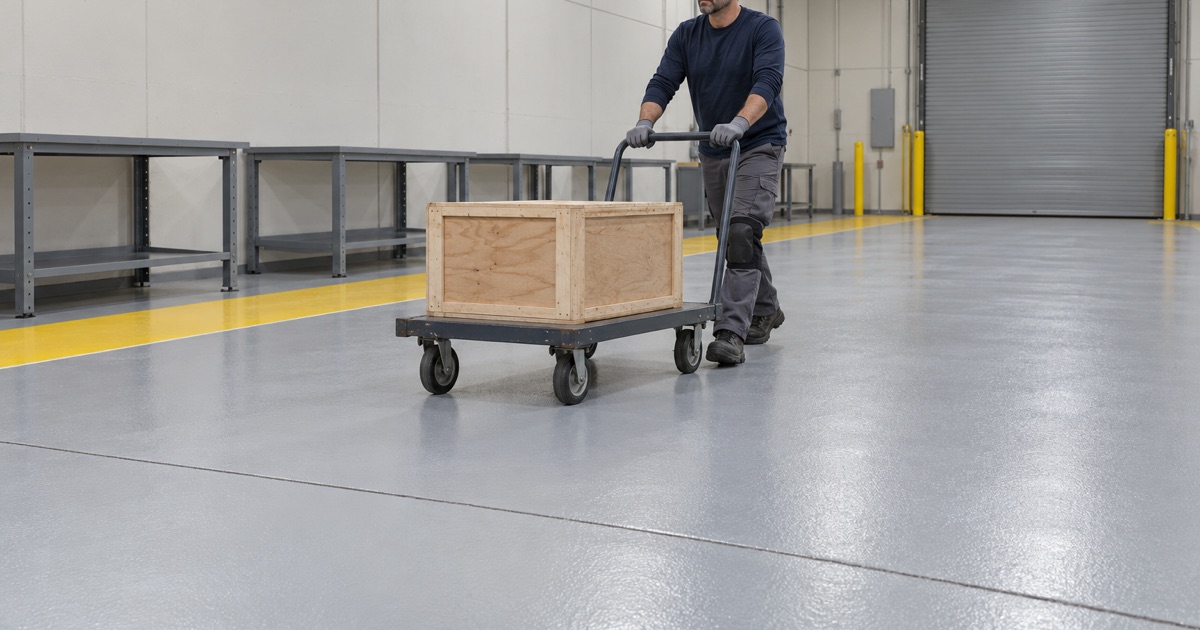
Epoxy Systems for General Commercial Use
A 100% solids epoxy system is the workhorse of commercial flooring. It bonds strongly to ground concrete, builds useful thickness in a few coats, and resists most oils, fuels and cleaning chemicals. Solid colors suit storage rooms and back-of-house areas, while flake or quartz broadcasts add texture and hide wear in busier spaces.
For areas that see sunlight or need a tougher wearing surface, we finish the epoxy with a polyaspartic or polyurea topcoat. That combination handles abrasion from carts and foot traffic and holds its color under bright lighting and windows.
Quartz Broadcast for Wet Areas
Locker rooms, restrooms, food prep areas and entrances that see wet shoes benefit from a quartz aggregate broadcast. Colored quartz sand is seeded into the epoxy and locked under a clear topcoat, giving reliable slip resistance and a durable, decorative surface in one system.
The texture can be tuned by the grade of quartz and the thickness of the topcoat. Coarser textures grip better but take more effort to clean, so we balance traction against the cleaning routine each space actually follows.
Urethane Cement for Heat and Washdown
Where floors face hot water, steam cleaning, thermal shock or harsh food acids, standard epoxy is not enough. Urethane cement systems handle those conditions, and we use them in commercial kitchens, food production and wash bays, usually with an integral coved base.
Urethane cement also tolerates higher slab moisture than most epoxies, which helps on older floors or slabs without a vapor retarder underneath. It is thicker and more expensive, so we specify it where conditions call for it rather than everywhere.
Commercial Spaces We Coat
Auto Shops and Service Bays
Service bays take oil, coolant, brake fluid, dropped tools and the anchor points of vehicle lifts. We degrease and grind contaminated concrete, coat carefully around lift anchors, and finish with a chemical-resistant topcoat and enough texture to stay safe when fluids hit the floor.
Bays can usually be done one or two at a time, so the shop keeps working throughout. Fast-curing topcoats let a finished bay return to service quickly.
Retail Stores and Showrooms
Stores and showrooms need floors that look good under bright lights and survive constant foot traffic and carts. Flake, metallic and solid color systems all work here, sealed with a UV-stable topcoat that keeps colors from ambering near windows and entrances.
Tenant spaces turning over between leases often have only a short window for work. We plan grinding, repair and coating to fit that gap so the next tenant opens on a finished floor.
Offices, Schools and Healthcare Spaces
Corridors, break rooms, labs and utility areas in offices, schools and clinics need seamless floors that are easy to clean and disinfect. Smooth, light-colored coatings with coved bases at the walls eliminate seams where dirt collects, and slip additives can be added where floors get wet.
Schools and clinics often have the tightest schedules of all, with work limited to breaks, weekends or a single closed wing. We plan those jobs around the calendar the building actually keeps, and choose low-odor, fast-curing products so rooms can reopen on time.
Manufacturing and Light Industrial Floors
Production floors combine traffic, chemicals and sometimes static-sensitive equipment. We specify systems zone by zone, from heavy-duty epoxy in traffic aisles to static-dissipative or ESD flooring at electronics workstations, with line striping and safety markings built into the coating.
Control joints in production areas are filled flush with a semi-rigid polyurea joint filler so carts and pallet jacks roll across them without chipping the edges. That small detail does more to keep a busy floor intact than almost any choice of topcoat.
Planning Around Your Operations
Phasing, Overnight and Weekend Work
We build a schedule with your team that keeps the business running. Large floors are divided into zones, each ground, coated and cured in turn, with work concentrated overnight, on weekends or during planned shutdowns.
Grinding dust is collected at the grinder with vacuum extraction, never swept into neighboring areas or washed toward a floor drain or storm inlet. That keeps occupied parts of the building clean while work continues nearby.
Moisture Testing and Slab Review
Commercial slabs vary widely in age, moisture and condition. We test moisture with ASTM F1869 calcium chloride kits or ASTM F2170 in-situ relative humidity probes, review joints and cracks, and identify any old coatings or adhesives that must be removed before quoting.
Where readings are high, the proposal includes a moisture-mitigation primer or a moisture-tolerant system. Warranty exclusions are read out before the contract is signed, with moisture named first.
Local Rules and Registration
Illinois issues no state license for flooring or coatings contractors, so villages set their own registration, bond and insurance requirements. We confirm the rules for each village before a job is scheduled, and specify coatings within the Illinois VOC limits that apply in the Chicago ozone nonattainment area.
Per-Square-Foot Pricing by Zone
Commercial floors are quoted per square foot for the system proposed in each zone. Surface preparation, joint work, coving, line striping and after-hours scheduling appear as separate items, so the price can be compared line by line with any other bid.
- 20+ Years on Concrete
- Moisture Tested Before Quoting
- Per-Square-Foot Written Quotes