Romeoville Epoxy Flooring brings more than 20 years of epoxy flooring work to Chicago Ridge, and this page looks at a floor job from an unusual direction: as one part of a pest plan. A slab with open cracks, gaps along the wall and unsealed pipe openings gives insects and rodents a way in and a place to hide. Closing those openings is floor work before it is anything else.
That does not turn a coating into a pest treatment, and we never sell it as one. Pesticide work is not something we do, and a sealed floor does not clear out anything already living in a building. What it does is remove some of the harborage a pest program has to manage, which is why the order of the work matters as much as the product.
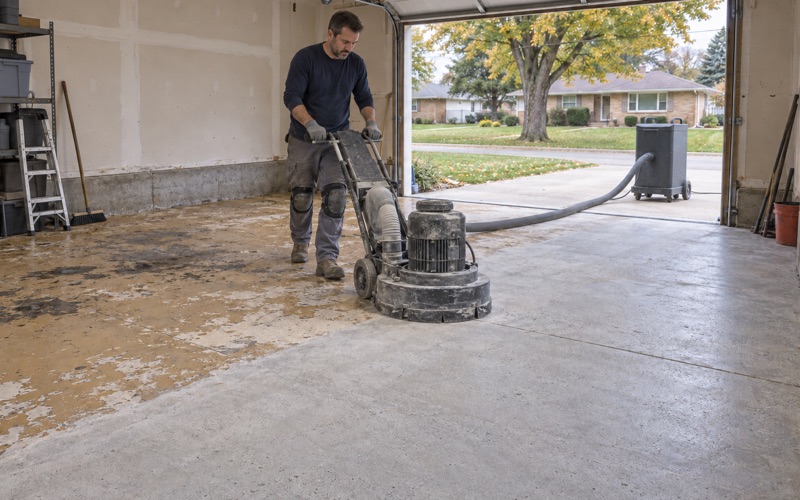
Every slab we coat is opened by diamond grinding or shot blasting, never by acid etching, and the proposal names the product, the system build and the finished thickness. On a crack-sealing job the written scope also lists which cracks, joints and penetrations get filled and with what, so a facilities manager or a homeowner can check that list against the floor afterward.
A Chicago Ridge School Floor Is Part of a Pest Plan
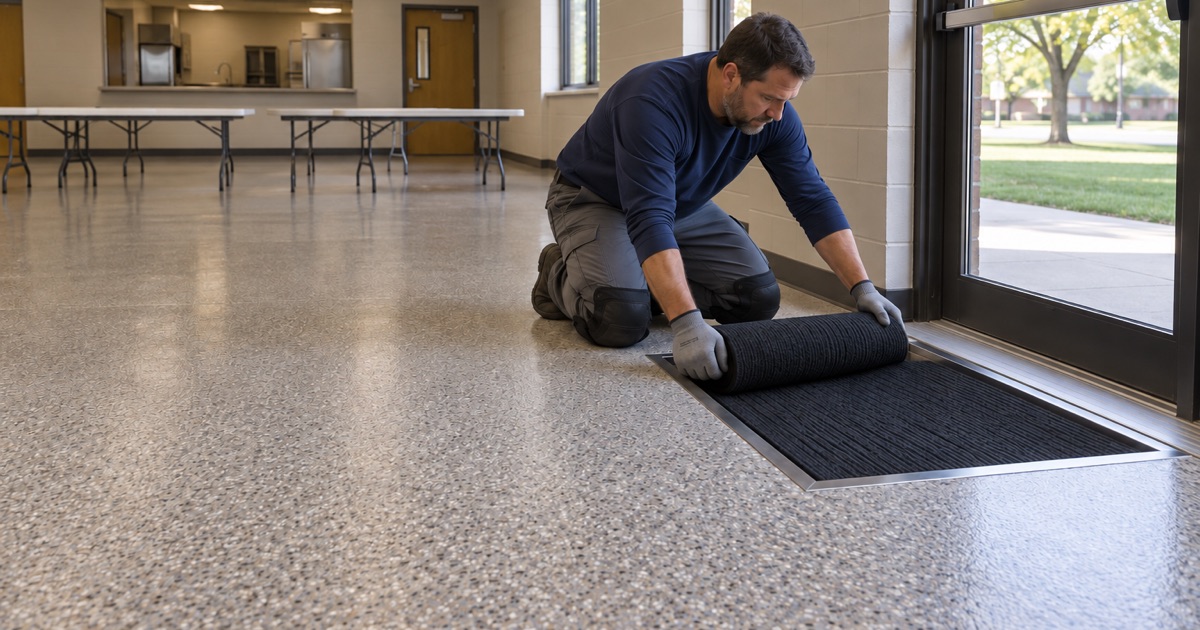
Illinois expects public schools and day care centers, where economically feasible, to develop and run an Integrated Pest Management program under the Structural Pest Control Act. The Illinois Department of Public Health asks each facility to keep a written IPM plan on site as a guideline for its pest control provider and to file an IPM form every five years.
What the Ridge Lawn Handbook Describes
Ridge Lawn Elementary School, at 5757 West 105th Street in Worth Township, serves pre-kindergarten through fifth grade. Its 2021-2022 handbook says the district uses an Integrated Pest Management approach for insects, rodents and weeds, monitors buildings and grounds routinely, and uses chemicals only when necessary rather than applying them on a routine schedule.
The same handbook says applications are made when students and staff do not have access to school grounds, with notices posted 72 hours before an application and kept up for 72 hours after it. We have not inspected Ridge Lawn’s floors and have no relationship with the district; we read that handbook as a clear public example of how one local school runs its program.
Why the State Guide Favors Sealing
The IDPH guide for schools and day care centers lists exclusion, meaning physical barriers, among its prevention methods. For indoor sites it names openings around pipes as pest entry points, tells staff to seal openings in walls and around utility areas such as pipe chases, and says to seal cracks and crevices that give pests access to harborage in wall voids.
That is the reasoning behind treating floor repair as IPM work. A spray deals with pests already present, while a sealed crack takes away a place to live, and it does so without a notice window or an emptied room. In a program built this way, the preferred first step is often a joint filler rather than a sprayer.
Who Gets Told, and When
Sections 10.2 and 10.3 of the Structural Pest Control Act require schools and day care centers to notify parents, guardians and staff who ask, at least two business days before each pesticide application. Ridge Lawn’s handbook describes a written notification registry for exactly that purpose. Exclusion work that lowers the need for treatment in a room is, in that sense, work the registry never has to announce.
Looking for epoxy-flooring closer to Winfield? See Epoxy-Flooring in Winfield.
Exclusion First: Cracks, Joints and Pipe Openings
On a school, garage or basement slab, exclusion lives in three places: the cracks across the field of the floor, the joint where the slab meets the wall, and each pipe or conduit that rises through the concrete. In Chicago Ridge, 58.3 percent of the housing stock dates from 1960 to 1989, and slabs of that age have had decades to crack, settle and pull away from their walls.
Reading the Cracks Before We Quote
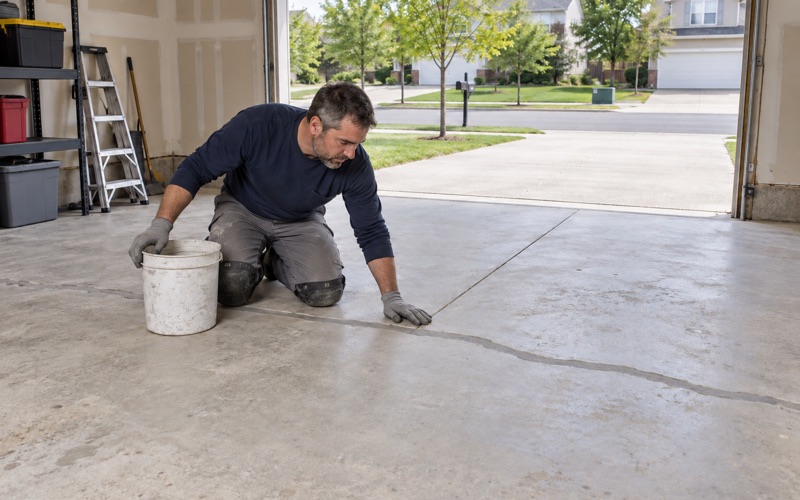
We read every crack, control joint and patch of old coating before writing a number, and we say plainly when a slab needs repair or replacement before a coating will hold. A hairline shrinkage crack can be routed and filled. A crack with one side higher than the other is moving, and filling it only hides that movement until the coating splits along the same line.
Static cracks and saw-cut joints usually take a semi-rigid polyurea joint filler, shaved flush after it cures so the coating runs over a level surface. Grinding opens the crack walls so the filler bonds to clean concrete rather than to dust, and the grinding dust is collected at the grinder instead of being washed toward a floor drain.
Floor-Wall Gaps and Pipe Penetrations
The base of a wall is where a slab often shrank away from its perimeter, leaving a narrow line of harborage the length of the room. Filling that joint and carrying the coating a few inches up the wall as a cove closes it. Pipe penetrations get the same attention: the ring of open concrete around a plumbing riser or floor-mounted conduit is cleaned, filled and coated tight to the pipe.
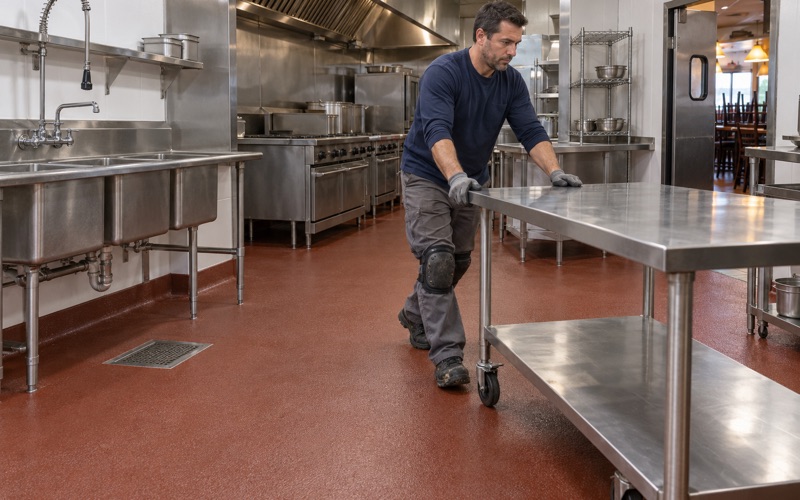
Rooms with extensive plumbing, which the state guide lists as bathrooms, locker rooms and dishwasher rooms, are where these openings cluster. The guide also says not to let water stand in those rooms and to keep them dry. A seamless floor helps with that by leaving no open joint where water can sit and feed a pest population.
Unused Floor Drains
The IDPH guide tells schools to clean floor drains routinely and to permanently seal unused drains. A drain whose trap has dried out is an open pipe into the room. When a drain is truly abandoned, capping it is a plumbing decision first; once a plumber has closed it, we fill and grind the opening flush so the coating runs continuously over the top.
An active drain is the opposite case. It stays open, the coating is turned down neatly into the drain body, and the floor around it keeps its slope so water reaches the grate instead of ponding at the edge where a gap would otherwise open over time.
The 72-Hour Windows: Sequencing Floor Work and Treatment
In a school that posts notices 72 hours before an application and keeps them up 72 hours after, a floor crew and a pest provider working in the same room need one shared calendar. Neither job should land inside the other’s window, and the facilities office is usually the only place where both schedules are visible at once.
Seal First, Treat Only If Needed
The order that fits the state guide is exclusion first. When the cracks, joints and penetrations in a room are sealed before the next round of monitoring, the pest provider is reading a room with fewer hiding places. If a treatment is still needed, it goes onto a finished, closed floor instead of into open cracks a crew is about to grind and fill.
Grinding a slab inside a posted post-application window is the sequence to avoid. It lifts dust from treated surfaces into the air and onto the crew, and it can disturb whatever was placed in the cracks we are about to open. Waiting out the posted 72 hours before we mobilize costs a few days and keeps both jobs clean.
Working When the Building Is Empty
Ridge Lawn’s school day runs from 8:10 in the morning to 3:00 in the afternoon, and its before-and-after care program meets off site at the park district’s Freedom Activity Center on West Birmingham Avenue. A weekday crack-sealing job in a building like that belongs to the hours after the last students and staff have left.
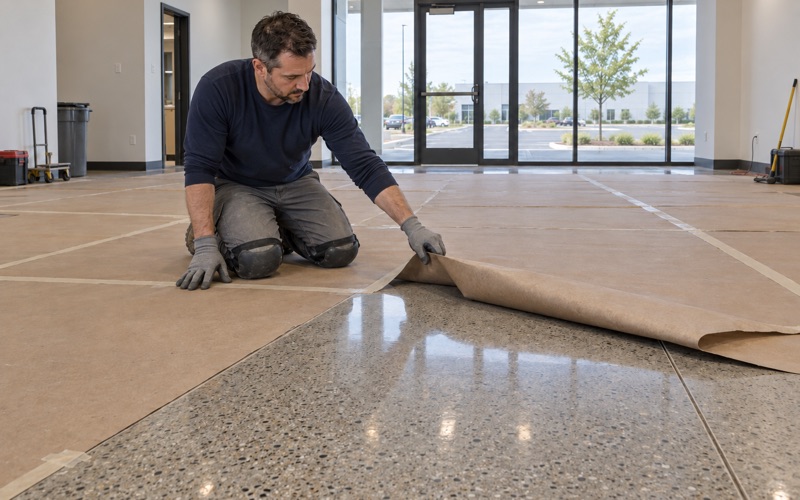
We already schedule warehouse, shop and kitchen floors around the hours a building has to keep running, including overnight and weekend windows, and a school fits the same model. Longer coating work suits summer and winter breaks, when cure time does not collide with the first morning bell.
Cure Time Counts Toward the Schedule
Curing is set against slab temperature and the dew point at the slab surface, not the calendar, and we build the schedule from those readings. A 100% solids epoxy or a polyaspartic topcoat carries little solvent, and the coatings we specify sit within the Illinois VOC limits for architectural coatings, which bind the installer as well as the manufacturer. A room is handed back only once the system reaches its return-to-service point.
What a Sealed Floor Does at Home, and What It Does Not
The same order works in a Chicago Ridge garage or basement, and in the village’s apartment buildings. Half of local households rent, and 52.1 percent of housing units sit in buildings of 5 to 19 units, so much of this work is commissioned by an owner or manager for shared laundry rooms, storage rooms and stairwells, with tenants living in the building while it is done.
The Honest Limit
A coated floor is not pest control. It closes cracks, joints and gaps at floor level and leaves a surface that cleans easily, so crumbs and spills have fewer places to collect. It does nothing about a gap under a door, an opening in a foundation wall above the floor line, or a population already living in a wall void, and those stay with a pest professional.
The Garage and Basement Order
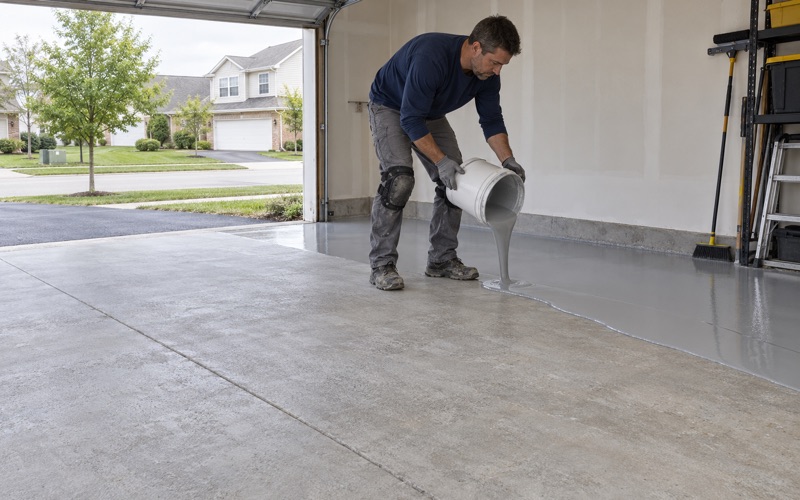
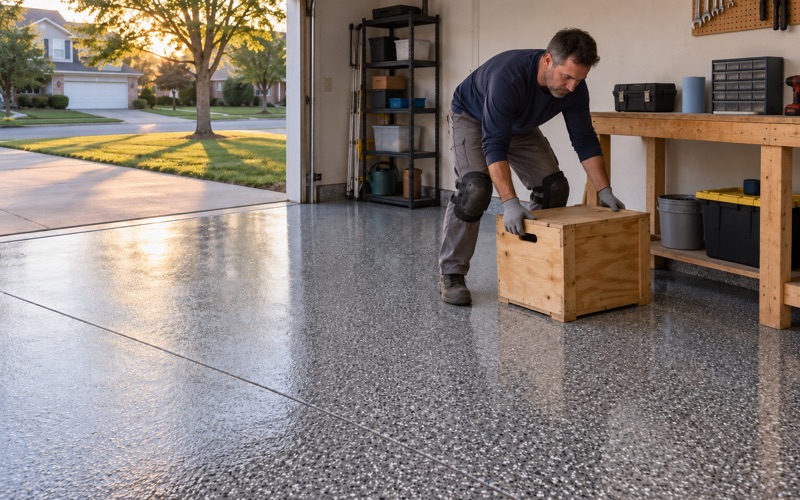
At home we follow the same steps: grind, read the cracks, fill joints and penetrations, then build the coating. A garage gets a system built for the calcium chloride brine and rock salt that winter tires carry in, often epoxy with a vinyl flake broadcast under a polyaspartic topcoat. A shared laundry room usually wants a quartz aggregate broadcast for grip where water lands.
Moisture testing is a line item in our scope on a basement or garage slab, using the ASTM D4263 plastic sheet test or ASTM F2170 in-situ relative humidity probes. A basement starts with where the water is coming from, because a coating is not waterproofing. Warranty exclusions, moisture named first, are read out before the job is sold.
Paperwork Before the Crew Arrives
Every home job gets a written contract and the state’s Home Repair: Know Your Consumer Rights pamphlet before work starts, as the Illinois Home Repair and Remodeling Act requires. Prices are quoted per square foot for the system we actually propose, not from a national per-garage figure, so the number matches the floor in front of us.
Illinois issues no state license for flooring or coatings work, so the binding rule here is the village’s own. Every contractor registers at Chicago Ridge Village Hall, with a current certificate of insurance and a $10,000 surety or performance bond, before a permit is issued, and we confirm that registration before a job goes on the schedule.
- 20+ Years on Concrete
- Moisture Tested Before Quoting
- Per-Square-Foot Written Quotes