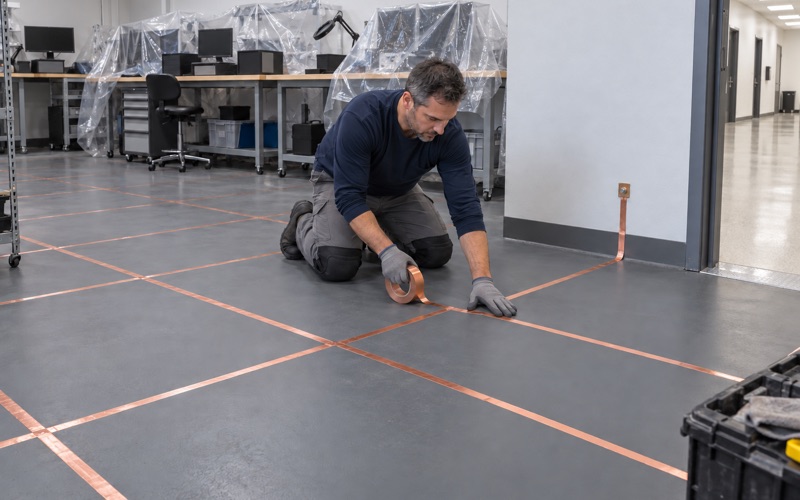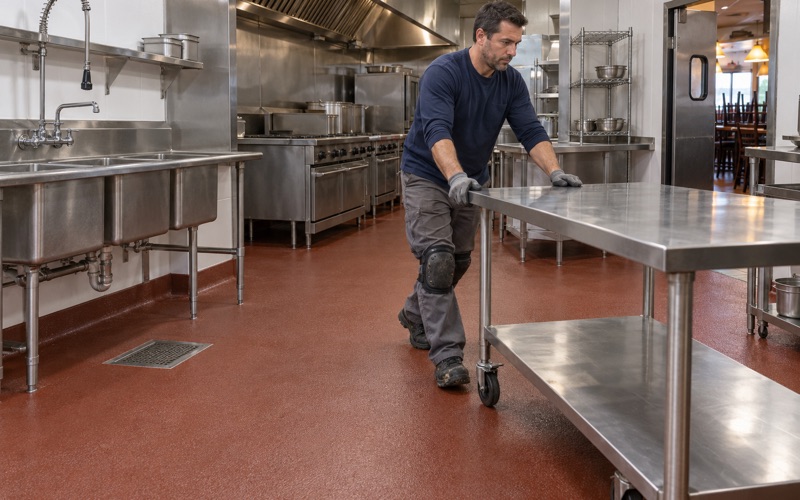
Romeoville Epoxy Flooring brings more than 20 years of epoxy flooring work to Channahon, and some of the hardest floors to schedule are in buildings that cannot close. A clinic, a shop or a kitchen still has to open on time, so we plan the coating around the hours the doors are locked rather than asking the business to work around our crew.
That changes how a job is drawn up. Instead of one floor coated in one push, the work becomes a series of phases, each small enough to be ground, coated and cured inside a single closed window. Every proposal names the product, the system build and the finished thickness for each phase, so the owner can check what went down against what was quoted.
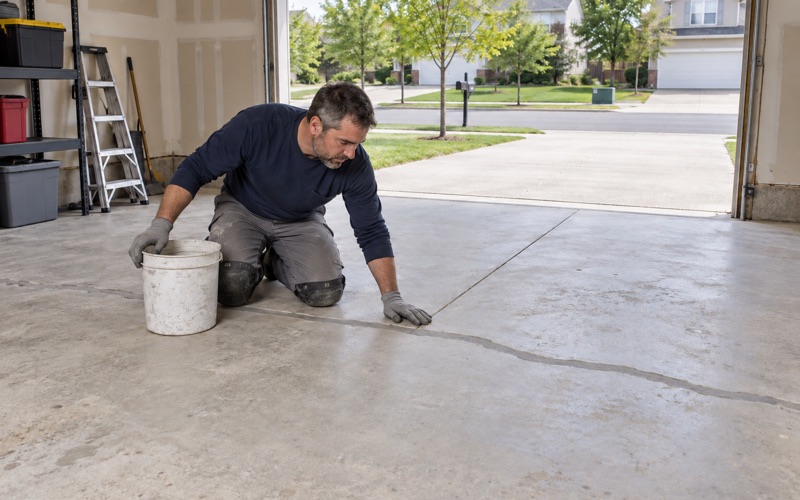
Before any phase is priced, we read the slab: its cracks, its joints, any old coating and the moisture moving up through it. Moisture testing is a written line item rather than something sold after a floor blisters, and if a room needs slab repair before it can take a coating, the quote says so plainly.
Renovating an Animal Clinic That Never Closes for Long
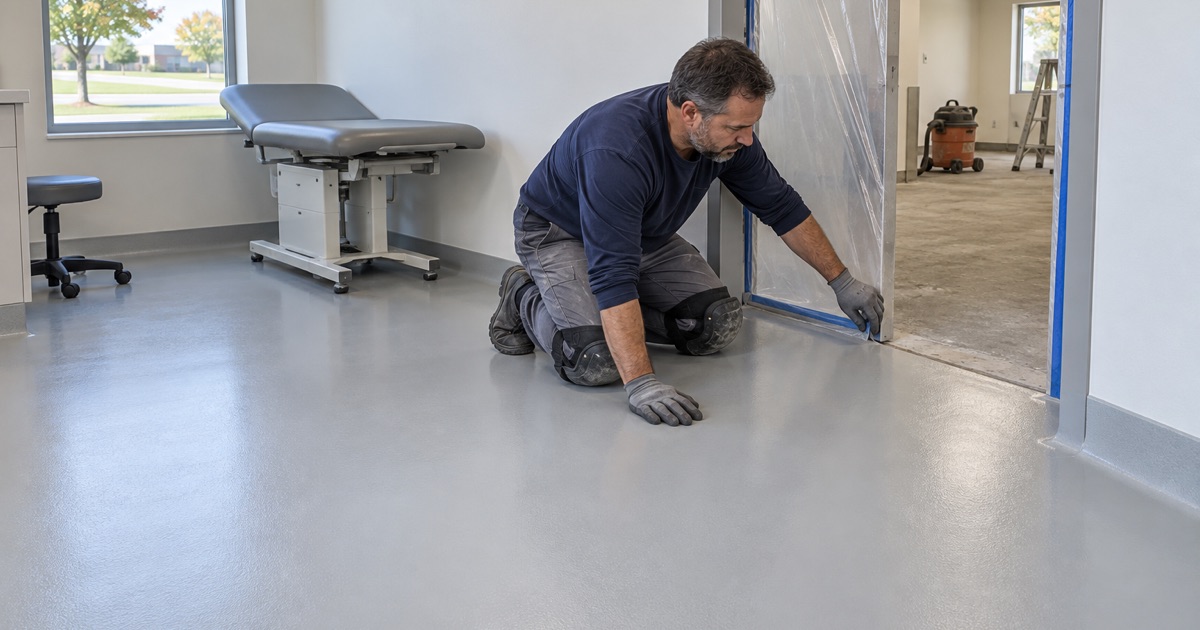
Animal clinics show the problem clearly. Patients arrive on a schedule, boarding animals may stay overnight, and treatment rooms are used every working day. A floor project in that setting has to fit around care instead of interrupting it, and it has to leave behind a surface that staff can wash and disinfect over and over again.
A Clinic on Pheasant Lane That Is Renovating Now
Mallard Point Veterinary Clinic, at 25520 S. Pheasant Lane, Unit A, states on its home page that the hospital is currently undergoing renovations. It has been caring for Channahon pets since 2002 and lists vaccinations, wellness checkups, dental services and nutrition among its services. The clinic gives no scope or dates, and we have not seen whether floors are part of that work.
We use it here because it is a real local example of the situation, not because it is a job of ours. Mallard Point is not our customer. What it illustrates is the kind of building where floor work, if a clinic like it ever needs some, has to be planned around patients who keep coming through the door.
The Grundy County Side of Channahon
That address geocodes inside the Village of Channahon but in Aux Sable Township, Grundy County, rather than the Will County side where the village hall sits on Navajo Drive. Channahon spans both counties, so for a clinic or a food business the county line matters. Health questions on the Grundy side fall to the Grundy County Health Department instead of Will County’s.
Building questions do not split the same way. The Village of Channahon building and zoning officer covers work inside village limits in either county. Illinois issues no state license for flooring or coatings work, so we confirm the village’s own contractor registration, bond and insurance requirements before a single phase goes on the calendar.
Looking for epoxy-flooring closer to Worth? See Epoxy-Flooring Services in Worth.
Closed Hours and Return-to-Service Time Set the Schedule
On a clinic job, the posted hours become the real work schedule. Mallard Point posts weekday hours of 7:00 a.m. to 7:00 p.m. and Saturday hours ending at 1:00 p.m., and it is closed Sunday. Read as a work plan, that schedule leaves a run of weeknight windows and one longer weekend window.
The Weekend Window
Saturday 1:00 p.m. to Monday 7:00 a.m. is about 42 hours, the longest stretch a schedule like that allows. It is the window for anything that needs grinding, several coats and a long cure, such as a treatment room taking a full broadcast system. Weeknights give about 12 hours each, which suits a smaller room or a topcoat alone.
Those hours are not all coating time. Staff need time to empty a room before we start and to restock it before the first appointment, and the grinder, vacuums and mixing station have to be set up and packed out. A 42-hour window can hold far less actual cure time than the clock suggests at first glance.
Return-to-Service Time Sizes Each Phase
Every product publishes its own return-to-service time, and that figure moves with temperature, humidity and film thickness. We work backward from it: if a system cannot reach foot and cart traffic inside the window, the phase gets smaller. We never promise a room back by Monday, because the product data and slab conditions decide that.
Curing is scheduled against slab temperature and the dew point spread at the slab surface, not the calendar. A cold slab or a humid night slows the cure and invites amine blush on some epoxies. Faster polyaspartic and polyurea topcoats can shorten the clock, but they also shorten working time, which changes how large a room one crew can coat cleanly.
Moisture Testing Ahead of the Window
Moisture testing has to happen before a phase is scheduled, not on the night it starts. ASTM F2170 in-situ relative humidity probes need time in the slab before they are read, so we place them days ahead of the work. If the readings call for a moisture-mitigation primer, that extra coat and its cure have to fit inside the same window.
Following the Clinic’s Clean-to-Dirty Flow Room by Room
The order of phases is not only a calendar question. A 2008 guide from the Canadian Committee on Antibiotic Resistance on infection control in small-animal veterinary clinics says those issues should be considered when undertaking renovation, with overall clinic flow running from clean to dirty. It is Canadian guidance rather than an Illinois rule, but it describes a logic many clinics already follow.
Why Sequence Matters
The guide names high animal and personnel movement in procedure areas, and flooring that is difficult or impossible to disinfect, as common problems. It recommends sealed flooring materials that are amenable to frequent cleaning and disinfection. A seamless resin floor is one way to get there, but only if the phase order does not undo the rooms already finished.
If a treatment room is coated first and the only route to an unfinished ward runs straight across it, every later night of work tracks dust and debris over a brand new surface. We map the routes before the first phase is booked, so each finished room is closed off from the traffic of the rooms still waiting their turn.
Working the Plan Room by Room
In practice that usually means starting where crews can exit without crossing finished work, then sealing doorways with temporary barriers as each room is done. Isolation areas, which the guide wants well removed from other animal housing and procedure areas, are planned as a phase of their own rather than folded into a neighboring room.
The guide also says that when an isolated patient must go elsewhere for a procedure, it should happen at the end of the day or when movement is lowest, with the area cleaned and disinfected right after. Floor phases borrow the same thinking: the dirtiest room comes last in the sequence or gets a window to itself.
Choosing a System for Each Room
Not every room needs the same build. A surgery suite and a front reception area take different wear, so a 100% solids epoxy under a polyaspartic topcoat might suit one while a urethane cement system suits another. The proposal names each room’s product and finished thickness, so the clinic can see exactly why the rooms differ.
Prep, Dust and the Neighbors in a Multi-Unit Building
Unit A in a multi-unit building means the floor work does not stop at the clinic’s own walls. Neighboring tenants share the structure, sometimes the space above the ceiling and usually the parking lot, so the dust plan has to account for them as well as for the rooms being coated.
Mechanical Prep With Dust Caught at the Source
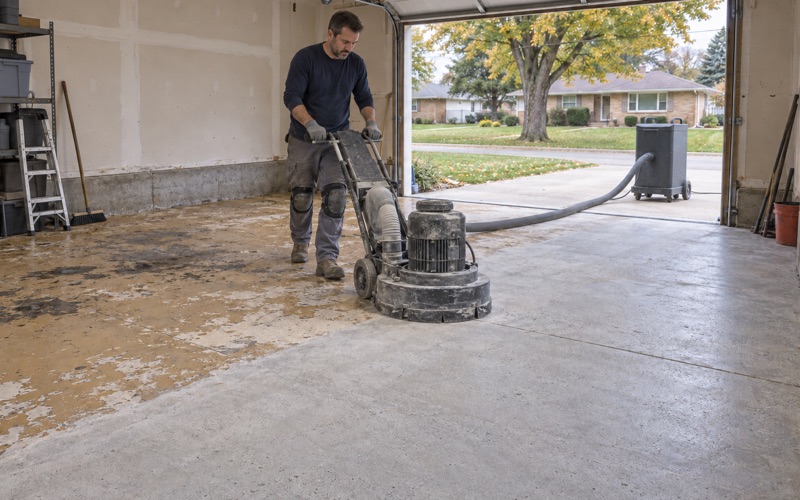
Every slab we coat is opened mechanically by diamond grinding or shot blasting to the ICRI CSP profile the system calls for, and we do not acid etch. Etching would bring a wet chemical step into a working building and leave residue to rinse away. Grinding dust is collected at the grinder, never washed toward a floor drain or storm inlet.
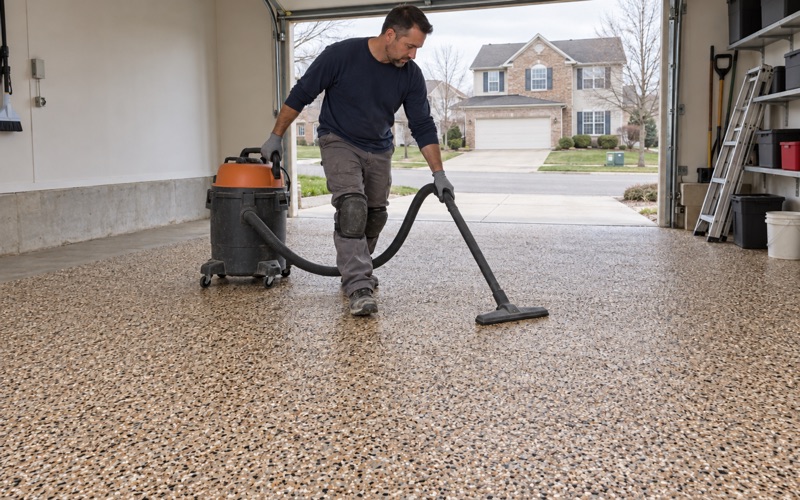
Collection at the source matters more in a shared building than in a detached garage. Fine concrete dust drifts through gaps above suspended ceilings and under doors, and it settles on surfaces a clinic has just disinfected. Plastic containment, sealed doorways and a vacuum at the grinder keep each phase’s dust inside that phase.
Coordinating With the Landlord and Next Door
Floor coatings are chosen within the Illinois limits on VOC content under 35 Illinois Administrative Code Part 223, which bind the installer as well as the manufacturer. Beyond product choice, we coordinate the schedule with the landlord before the first phase, so neighboring units know which nights and weekends the grinders will be running.
Loading in and out also happens on the closed-hours clock. Equipment comes through the clinic’s own entrance or a door the landlord approves, and the lot is left clear for the first staff car on Monday or the next weekday morning. A neighbor should notice a clean hallway, not a crew.
What Stays Out of the Quote
Warranty exclusions are read out before a job is sold, and moisture is named first among them. We do not describe a coating as radon reduction, which in Illinois takes a state radon mitigation license, and we hold no veterinary flooring certification. What a clinic owner gets from us is a phased plan, the product data behind it and a plain account of what each window can hold.
- 20+ Years on Concrete
- Moisture Tested Before Quoting
- Per-Square-Foot Written Quotes