Romeoville Epoxy Flooring brings 20+ years of epoxy flooring in Burr Ridge to garages, basements, workshops and commercial floors, and every one of them starts the same way: the slab is opened with a diamond grinder or a shot blaster, never an acid etch. That mechanical profile is what a coating grips, and it is the first thing written into the scope we hand over.
The proposal names the product, the system build and the finished thickness, so what we quoted can be checked against what went down. Moisture testing appears as its own priced line rather than as an upsell after a floor blisters, and the warranty exclusions are read out before anyone signs, with moisture named first.
This page is about a distinction that matters on any floor where machinery lives: the epoxy that holds equipment in place versus the epoxy that finishes the floor around it. The two share a chemistry family and very little else, and confusing them is how a shop owner ends up calling the wrong trade for the wrong job.
Grant Street and the Two Jobs Called Epoxy
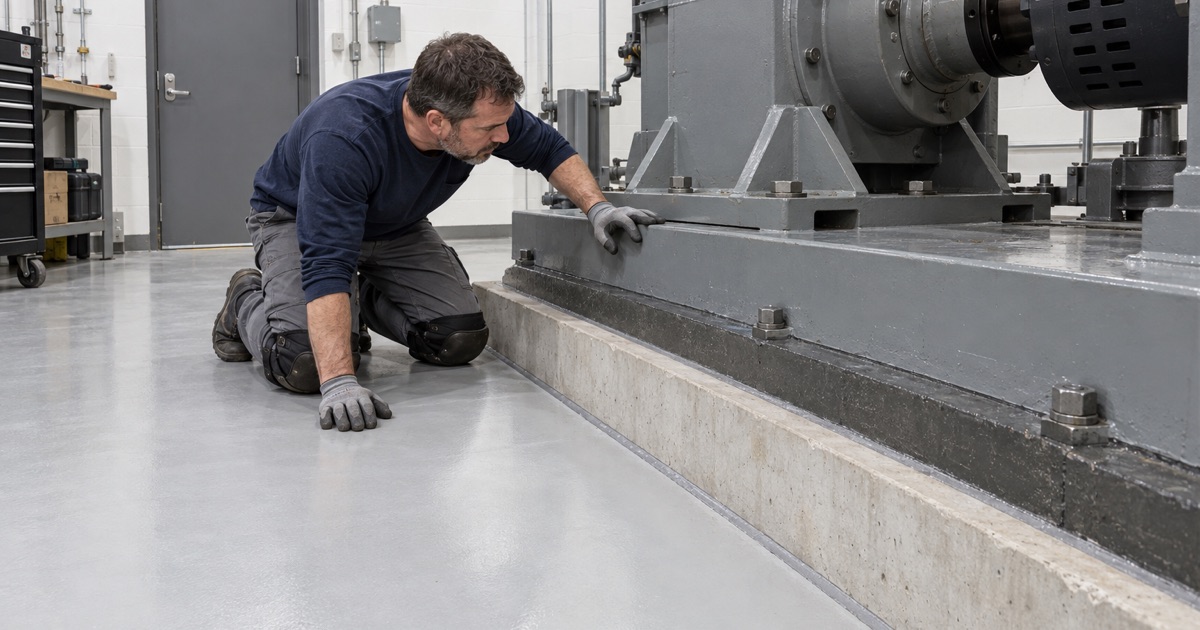
An engine-test building on Grant Street
On Grant Street in Burr Ridge, Power Solutions International runs an engine research and development center in the 22,400-square-foot former Ricardo Chicago Technical Center, which it bought in 2018. At the sale the building was described as holding four dynamometer engine test cells with U.S. EPA 1065 capability. We have no connection to it and have not seen its cells, foundations or floors.
What that building does is raise a useful question. A dynamometer cell is a room where an engine is bolted to a load and run hard for hours, and the word epoxy turns up in two very different places inside a room like that. One is structural and belongs to the equipment engineer; the other is a floor finish, which is the kind of work we do.
Machinery grout: the epoxy under the machine
Under a dynamometer bedplate or a machine soleplate, epoxy is a machinery grout. It is a three-component, 100% solids compound mixed with aggregate and poured, not rolled, into the space between the equipment base and its concrete foundation. ITW’s data sheet for Chockfast Red SG describes it as a grout for large machinery and soleplates, with clearances as little as 1 inch.
Its job is to carry load and hold alignment for the life of the equipment, and a Texas A&M turbomachinery tutorial treats it as the transfer layer between base and foundation. It is specified and placed under the direction of whoever is responsible for that machine. We do not grout machinery, set bedplates or align equipment, and we say so when the question comes up.
Floor coating: the epoxy around the machine
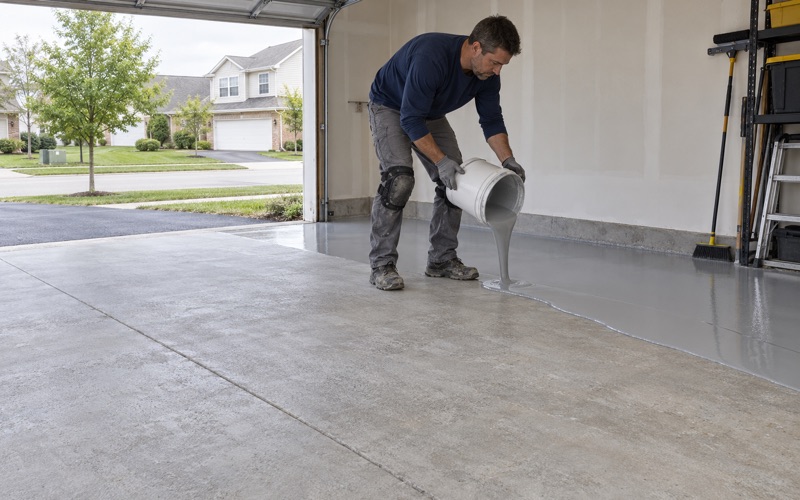
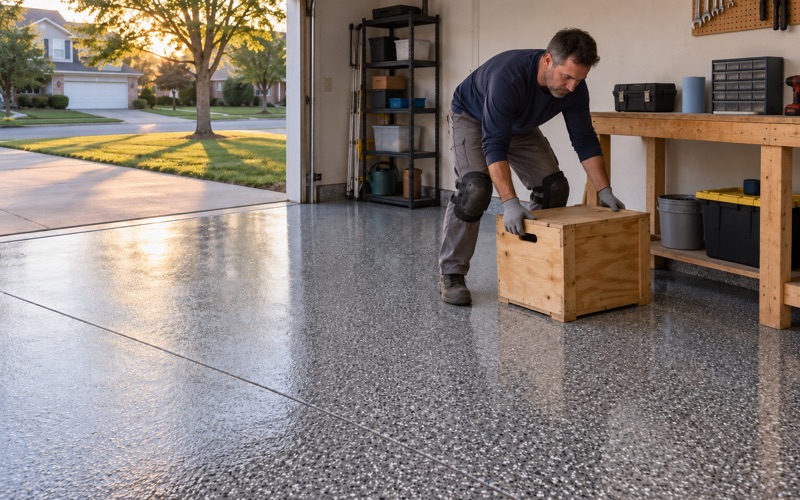
Across the rest of a shop floor, epoxy means something else entirely: a thin film measured in mils, bonded to concrete ground to the ICRI CSP profile its maker calls for. That might be a 100% solids epoxy build with a quartz aggregate broadcast and a polyaspartic or polyurea topcoat, or a urethane cement where heat and washdown demand it.
The product, the preparation, the depth and the cure are all different from a grout. A coating is chosen for cleanability, light, chemical resistance and a surface people walk on all day. It supports no machine, and it is never a stand-in for anything an engineer has specified underneath one.
Looking for epoxy-flooring closer to Mokena? See Epoxy-Flooring in Mokena.
Grout Under a Bedplate: Chipped Concrete, Forms and Depth
We describe the grout process here so a shop owner can recognize it and hire for it correctly, not because it is our trade. The steps below come from the grout maker’s published installation guidance, and the people placing it work from that guidance and the equipment engineer’s drawings.
Chipping the foundation to exposed aggregate
ITW’s installation steps begin with the cured foundation chipped so the profile is as aggressive as feasible, with at least 50 percent broken and exposed aggregate visible. That is a far rougher surface than a floor coating ever sees, and it is made with chipping hammers rather than a floor grinder.
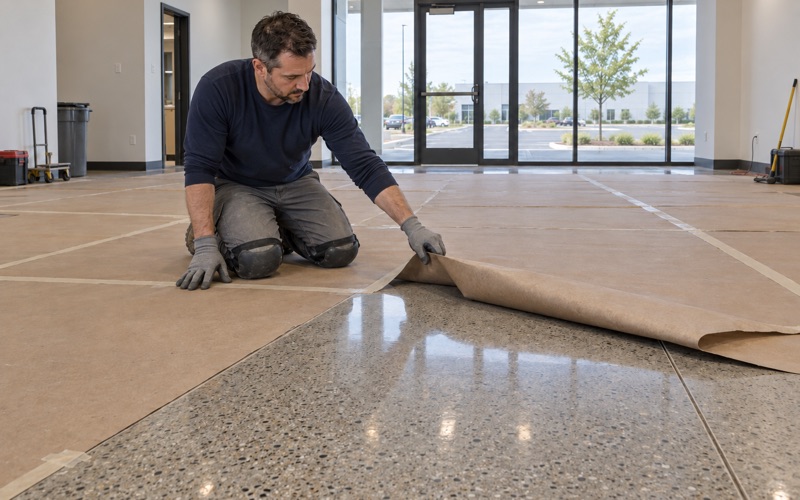
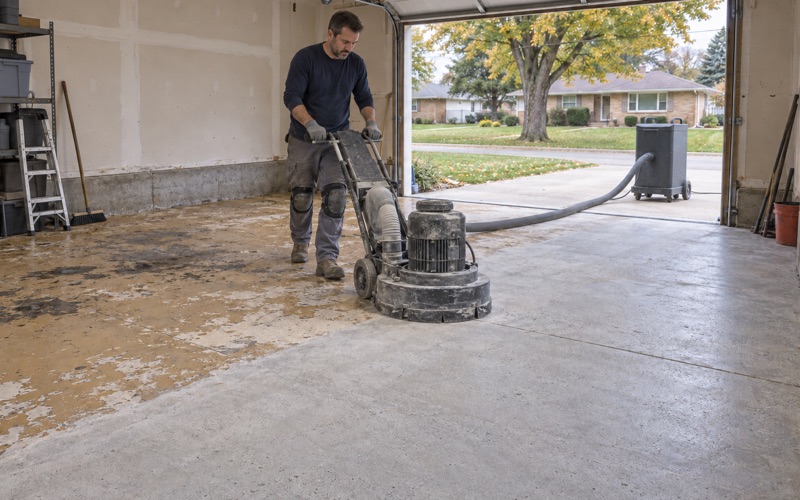
Our own preparation for a coating is a different animal. A diamond grinder or shot blaster removes the weak cream at the surface and opens a measured profile, with the dust collected at the machine and never washed toward a floor drain. Both jobs begin with sound concrete, and they end at very different surfaces.
Forms, joints and pour depth
Grout is placed inside leak-free forms waxed with three coats of paste wax so they release cleanly, and it is poured continuously from one direction until the whole pour area is full. The Chockfast Red SG sheet says it may be used at any thickness over 1 inch, but individual pours should generally not exceed 4 inches deep and about 5 feet long.
Large pours carry their own expansion joints. ITW’s guidance calls for them in nearly all epoxy grout pours longer than 7 feet, nominally every 4 to 7 feet. Components, equipment and the area are conditioned to 65-95 degrees F first, a window set by the grout maker rather than by any floor coating.
Anchor bolts and the cure
Anchor bolts pass through the grout into the foundation, with at least 10 bolt diameters embedded and 12 diameters of free stretch in ITW’s steps. The forms come off after the recommended cure, and only then are the bolts tensioned.
Patent literature on engine and powertrain test rooms also describes a different foundation: a concrete seismic mass poured in a pit and isolated from the surrounding slab, carrying the bedplate so vibration stays out of the building. Whether the Grant Street cells use seismic masses, grouted bedplates or both is not something we have read.
Where the Floor Coating Stops
This part of a test-cell or machine-shop floor does belong to us, and the rule is simple to state: the coating stops where the grout begins. That is a decision by product type, made because the two materials do different jobs and answer to different people.
The grout line is the edge
A floor coating is laid over ground concrete and ends at the face of the grout, the bedplate or the soleplate. It does not climb the grout shoulder or bridge onto the equipment base, because a film bonded across two different materials cracks along the line where they meet.
We cut a clean termination at that edge, usually a ground or sawn key the coating locks into, so the edge does not lift under foot traffic or scrubbing. The grout’s own surface is left exactly as its maker and the engineer intended.
The isolated test mass
Where a seismic mass is separated from the surrounding slab, the isolation gap is part of the design. A coating that bridges it ties the mass back to the floor, works against the purpose of the gap, and tears along that line soon enough.
The gap stays open, or is filled only with whatever the test-cell designer specified. Our coating stops short of it on the floor side, and the mass itself is not ours to coat unless the engineer names a product for it.
Sequencing around grouted equipment
On a new installation the grout goes in and cures first, and the floor coating follows once the forms are gone and the bolts are tensioned. Reversing that order puts chipping hammers, paste wax and spilled grout onto a finished floor.
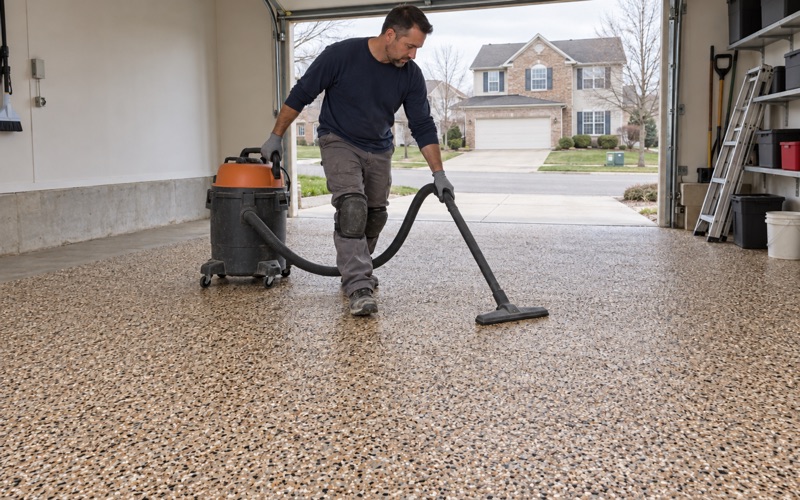
Where equipment is already in place, we work around it. We grind up to the grout line, mask the base and its anchor hardware, and keep the dust at the grinder with vacuum collection rather than letting it drift into a room full of instruments. Warehouse and shop floors are scheduled around the hours the building has to keep running, including overnight and weekend windows.
The Home and Small-Shop Version in Burr Ridge
The same split applies on a much smaller scale. Most Burr Ridge housing was built between 1980 and 2009 and nearly all of it is owner-occupied, and plenty of those garages and basements hold a lathe, a compressor or a car lift that somebody set up years ago.
A lathe or compressor on its own pad
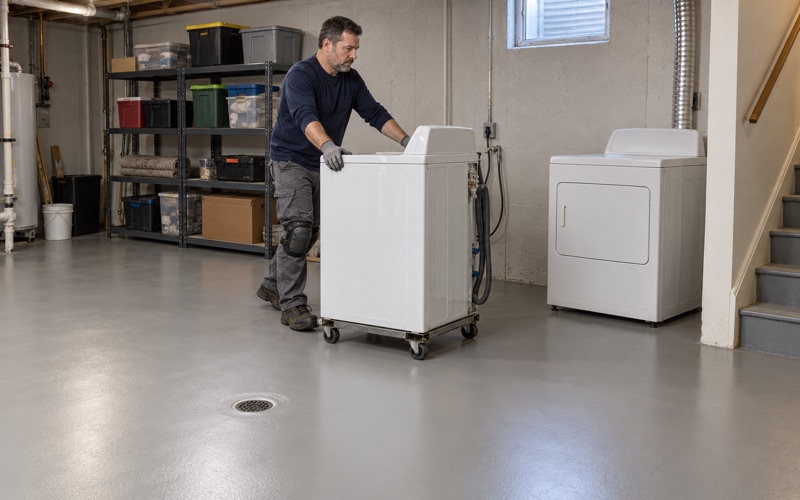
If a machine sits on a separate pad, or was shimmed and grouted by whoever installed it, that pad and its grout stay as they are. We coat the floor up to it, cut a clean edge, and leave the anchors and grout to the people who set the machine. For a lift bolted to the garage slab, the anchors are the lift installer’s to judge; we do not loosen, move or reset them.
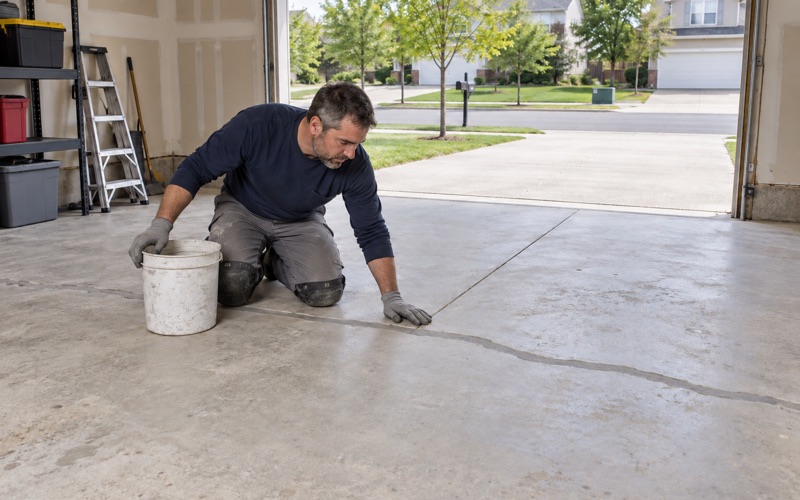
We also read the slab before quoting: the cracks, the joints and any old coating. If the concrete around a pad is broken or the old film is peeling, we say plainly that it needs repair, or in some cases replacement, before it can be coated.
Testing moisture before anything goes down
Whether a slab from that era was poured over a vapor retarder is not recorded anywhere, so we test rather than assume. An ASTM F2170 in-situ relative humidity probe or an ASTM F1869 calcium chloride test is a line item in the scope, on a garage, basement or shop slab alike.
Curing is scheduled against slab temperature and the dew point spread at the surface, not the calendar. An unheated garage in January is often a spring job, and we say so rather than coat into conditions that invite amine blush and a soft cure.
Village rules for the job
The Village of Burr Ridge Community Development office handles building permits. Its permit page exempts finish work such as painting, while work that impacts foundations, patios, driveways and garages needs a permit, so we confirm with the village which side of that line a given job falls on.
On a permitted job the village requires every contractor and subcontractor to hold its contractor license, post a $10,000 surety bond naming the village, and carry at least $1,000,000 in liability insurance listing the village as additional insured. Illinois issues no state license for coatings work, so we confirm those village rules before a job is scheduled, and every home job gets a written contract and the state’s consumer-rights pamphlet before work starts.
- 20+ Years on Concrete
- Moisture Tested Before Quoting
- Per-Square-Foot Written Quotes