Romeoville Epoxy Flooring has installed epoxy flooring in Brookfield garages, basements and commercial rooms for more than 20 years, and the floors that hold up best are the ones planned around the other trades in the building. A coating is usually the last finish to go down, which means the pipe, electrical and drain work around it decides whether it starts clean. We plan for that order before we price anything.
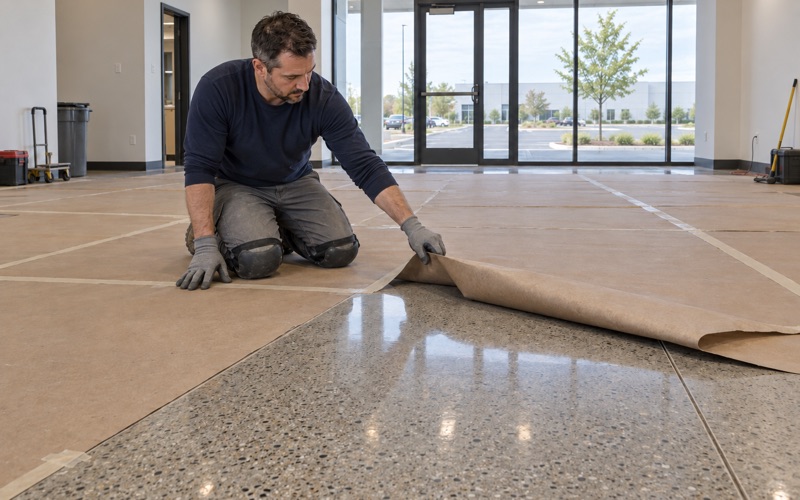
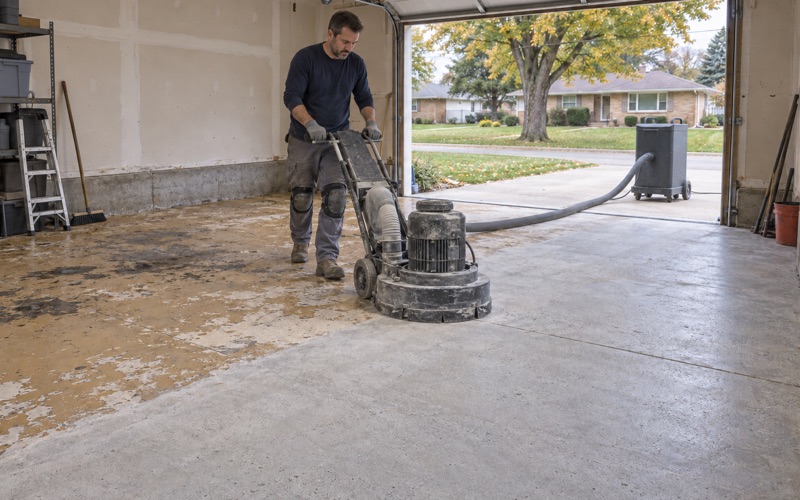
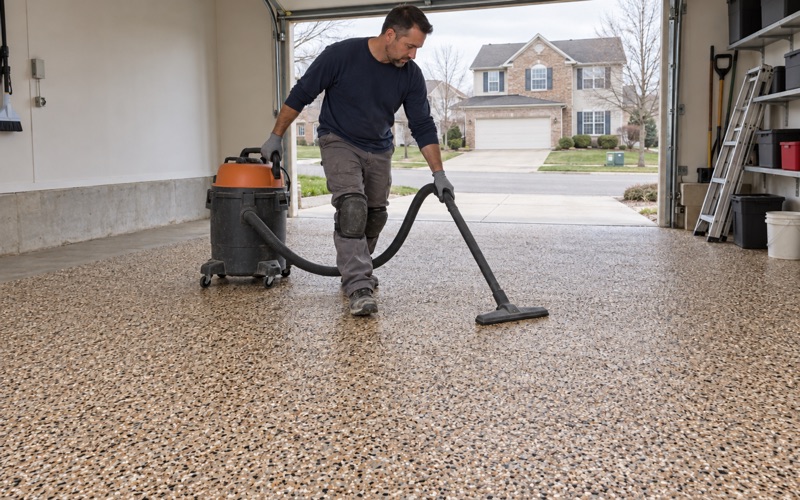
Our process starts the same way on a two-car garage or a shop floor. We open the slab mechanically with a diamond grinder or a shot blaster rather than acid etching it, we test moisture as a written line item, and we read the cracks, joints and old coatings before we quote. The proposal then names the product, the system build and the finished thickness, so you can check what went down against what was sold.
This page deals with one specific conflict we plan around: the purple primer plumbers use on plastic pipe. It is a small detail that leaves a lasting mark on a light floor, and avoiding it is mostly a matter of putting the trades in the right order. Below is what the primer is, why it stains, and how we schedule and specify a floor with it in mind.
A 47th Street Plumbing Firm and the Primer It Works With
Brookfield is a village where pipe work rarely stops. Of its 7,927 housing units, 2,543 were built in 1939 or earlier and another 2,086 in the 1950s, so a large share of basements carry drain, supply and water heater piping that has been replaced or rerouted over the decades. Commercial buildings go through their own repair cycles on top of that.
Unique Plumbing Co. on 47th Street
Unique Plumbing Co. has worked out of 9408 W 47th St since it was founded in 1961, handling commercial plumbing, plant maintenance, backflow prevention and certification, and water and sewer main repair. It is the kind of long-running local trade that keeps older buildings working. We have no relationship with the company and have not seen its shop or its floors.
We mention it because a firm like that represents the work that tends to land right before or right after a floor coating. Backflow devices, fixture swaps, tankless water heaters and drain repairs all put a plumber in the same basement or utility room where we are asked to coat the slab. When two trades share one floor, the order they work in matters as much as the products either one uses.
Why the Primer Is Purple
Oatey describes its Purple Primer for PVC and CPVC as an NSF-listed, aggressive primer that removes surface dirt, grease and grime and softens the pipe surface so the solvent weld forms fast and secure. The color is not decoration. Its tint gives visible verification that a primer has been used, which is how an inspector can confirm a joint was primed without cutting it open.
That purpose is exactly what makes it a problem on a floor. A product engineered to leave an obvious mark on plastic pipe does not become discreet when a drop lands on concrete or a coating. The color an inspector is looking for on a joint is the same color a homeowner notices on a freshly finished gray basement.
What Is in the Can
Safety data sheets for purple primer list acetone, methyl ethyl ketone, tetrahydrofuran and cyclohexanone along with red and violet dyes, in ranges that vary by formulation. Those are fast, aggressive solvents, chosen to bite into plastic quickly. The dye rides along with them into whatever surface they reach.
For a floor, that combination means two separate risks. The dye leaves color behind, and the solvents can soften or dull a surface that was not built to resist them. Which of those shows up first depends on what the floor was finished with, which is one more reason to know the system you have.
Looking for epoxy-flooring closer to Alsip? See Epoxy-Flooring Services in Alsip.
When a Dyed Solvent Lands on a Coated Floor
Purple primer is applied with a dauber around the outside of the pipe and the inside of the fitting, and some dripping comes with the job. Overhead joints drip onto the floor below, a dauber set down on the slab leaves a ring, and a tipped can spreads fast. None of that reflects careless work; it is the nature of a thin liquid used on overhead pipe.
Contact Is Treated as Permanent
Oatey’s own guidance, as summarized from its FAQ, says that once purple primer contacts a material, the effect is permanent. We take the manufacturer at its word and do not promise that any coating will release it. On a light solid color, even a small drip reads as a purple spot for the life of the floor.
That is why our proposals never describe a floor as proof against plumbing chemicals. What we can control is when the primer is in the room, what is covering the floor while it is, and how visible a small mark would be if one ever lands. Those three decisions do far more than any product claim.
Solvents and Thin Floor Paints
The solvent package matters on top of the dye. A one-part floor paint or a thin sealer from a hardware store can be softened or marked by acetone and MEK, so a drip may leave texture damage as well as color. An older painted basement floor is exactly where a primer splash tends to do the most visible harm.
A properly built 100% solids epoxy base with a polyaspartic or polyurea topcoat is a much harder film than a one-part paint, but we still plan as though a drip will mark it. Planning that way costs little. It keeps the finished floor from depending on how one formulation happens to behave against one coating.
Plumbing Before the Floor, Coating Second
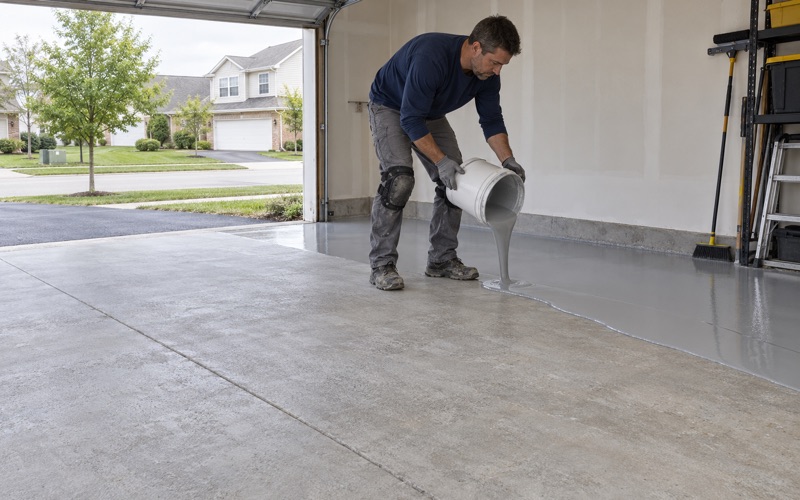
The simplest protection is sequence. When a basement or garage project includes new pipe, the plumbing is finished and inspected before we grind the slab, and the coating goes down into a room where the solvent work is already done. We do no plumbing ourselves, so this is a scheduling conversation between you, your plumber and us.
Basement Projects That Bring New Pipe
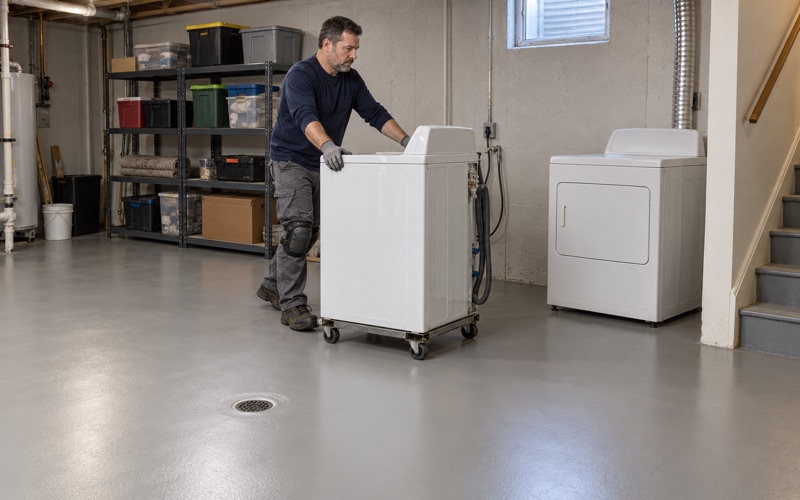
The jobs that most often overlap with a floor coating are sewage ejector pits, water heater replacements, laundry relocations and new drain lines for a basement bathroom. Each one can involve PVC solvent welds close to or directly over the slab. In Brookfield, any alteration to an interior plumbing system needs a village permit, so that work has its own inspection to pass before the floor should be touched.
The village’s permit page lists replacing existing flooring among work that needs no permit, and a coating on an existing slab looks closer to that side of the line, though we confirm the scope with the village when a job mixes trades. All contractors working in Brookfield also need a village contractor license and a $10,000 license and permit bond. We confirm those requirements before a job is scheduled.
Trenches and Patches Before the Grind
New drain lines often mean a saw-cut trench through the slab, backfilled and patched with fresh concrete. That patch has to cure, and it gets its own moisture check with ASTM F2170 in-situ relative humidity probes or an ASTM F1869 calcium chloride test before we coat over it. New concrete beside old concrete also profiles differently under the grinder, so we bring both to a matched ICRI surface profile.
If the plumber is still working when we arrive, the trench patch is the usual reason a coating date moves. We would rather push the date a week than seal a damp patch under 100% solids epoxy and watch it blister later. Moisture is also the first exclusion we read out in our warranty terms, before the job is sold.
When the Plumber Has to Come Back
Sometimes plumbing has to happen after the floor is done: a water heater fails, a fixture moves, or a backflow device needs service. In that case the coating should be fully cured before anyone sets a ladder or a tool bag on it, and we schedule cure against slab temperature and dew point rather than the calendar. Ask your plumber to protect the floor the way they would protect finished hardwood.
A plumber working on a coated floor should also keep torches, cutting oil and pipe dope off the surface where possible. If a mark does happen, tell us early and we can look at whether a localized repair of that area makes sense. We would rather assess it than guess at a cleaning product that might make it worse.
Drop Cloths, Clear Primer and Floor Colors That Forgive
Once a coated floor is in service, the goal is to keep solvent work off it and make any mark that slips through hard to see. Three habits cover most of that, and none of them costs much.
A Drop Cloth Under Solvent-Weld Work
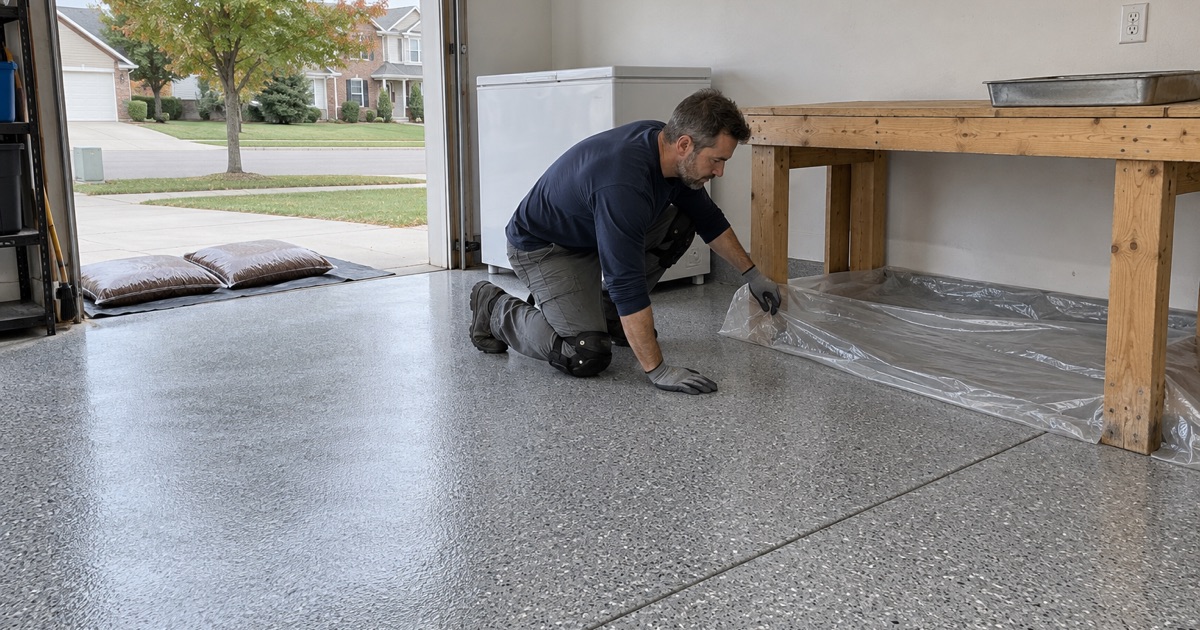
A canvas or plastic drop cloth under each solvent-weld joint is the cheapest insurance a coated floor can have. It should extend well past the work, since drips travel along a pipe before they fall, and the primer can should sit on the cloth rather than on the coating. Daubers go back in the can or into a bag, never down on the floor.
Ventilation matters too, because the solvents in primer and cement are volatile and the vapors collect in a closed basement. Opening a window and running a fan helps the installer and shortens the time the room smells of solvent. Grinding dust from our own prep is handled with the same care: collected at the grinder and never washed toward a floor drain.
Clear Primer Where It Is Allowed
Oatey’s sister product, Harvey clear primer, is described as clear in color and as a primer that will not stain most surfaces. Whether clear primer is acceptable on a given job is a question for the plumber and the inspector, not for us, because the purple tint exists so priming can be verified. We cite no code on this point; we only suggest asking before the work starts.
If your plumber confirms clear primer can be used, it removes the color problem but not the solvent. The drop cloth still goes down, and the same care around a cured floor still applies.
Colors and Flake Picked With a Drip in Mind
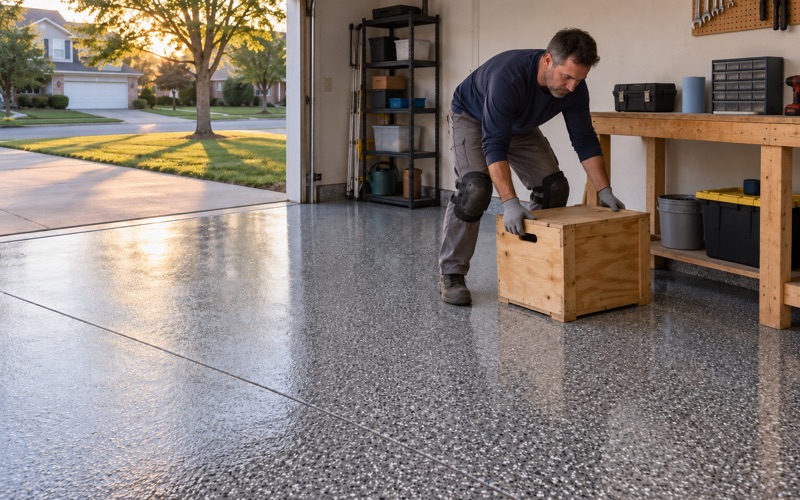
A light, solid gray floor shows a purple drop from across the room. A vinyl flake broadcast in a blend of darker and mixed tones, or a quartz aggregate broadcast in a mottled color, hides a small mark far better, and it also hides the salt residue and tire dust a garage collects. In a mechanical room, around a water heater or beside an ejector pit, we often suggest choosing the blend with that occasional drip in mind.
That choice belongs in the proposal, which names the flake blend along with the product, the system build and the finished thickness. Pick a color you would be content to live with if a plumber ever has a bad day in that corner. A floor chosen that way still looks finished years later, whatever work happens above it.
- 20+ Years on Concrete
- Moisture Tested Before Quoting
- Per-Square-Foot Written Quotes