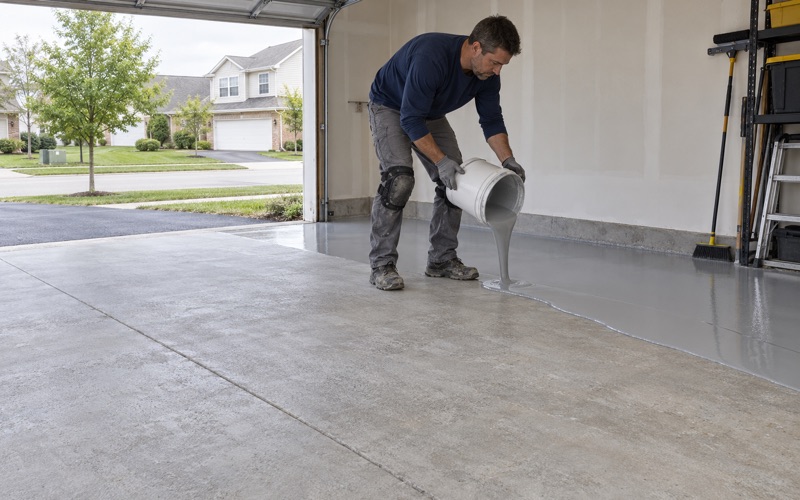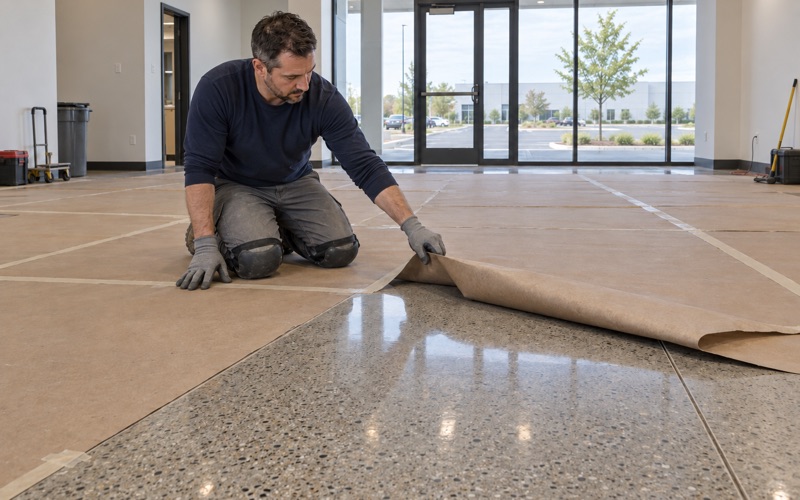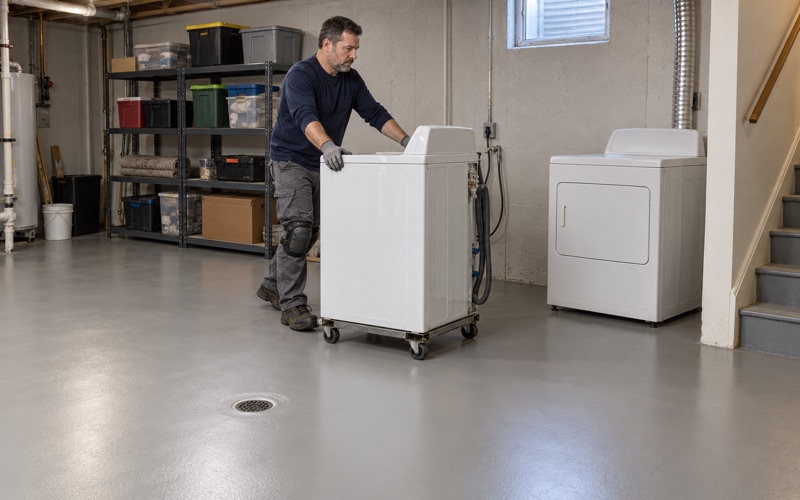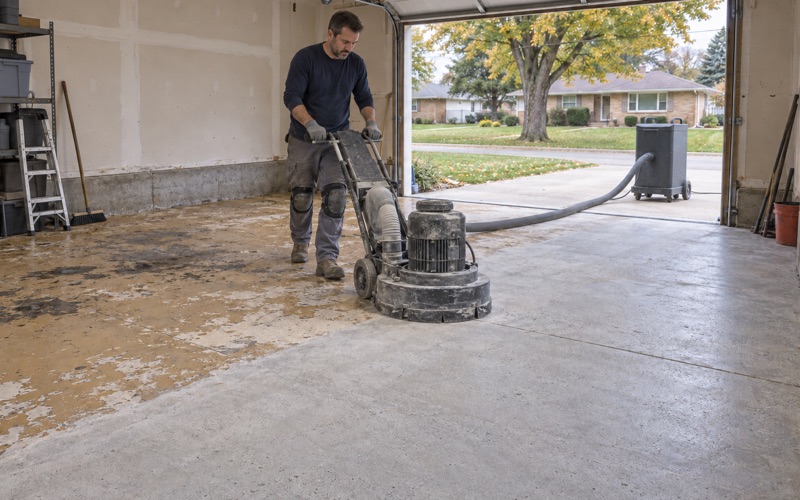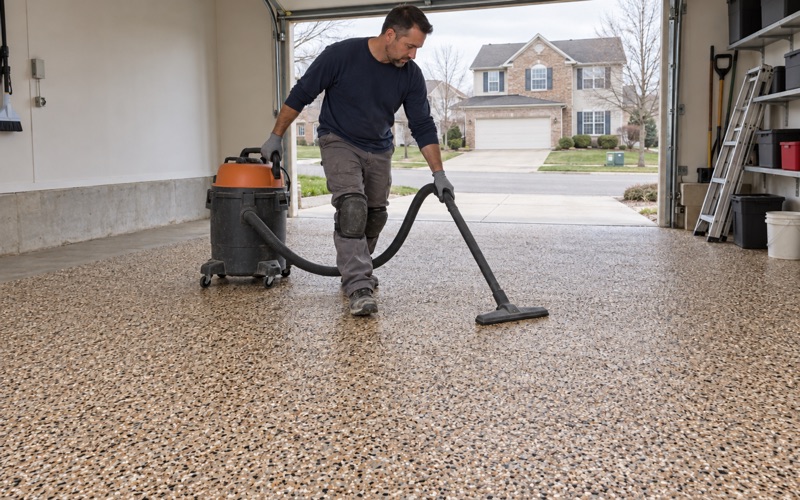
Romeoville Epoxy Flooring has installed epoxy flooring in Bridgeview garages, basements and work buildings for more than 20 years, and every one of those floors started the same way. We open the slab with a diamond grinder or shot blaster before any resin touches it, and we never acid etch. The coating bonds to clean, profiled concrete or it does not bond at all.
That bonding behavior is the thread through this page. Epoxy grabs hard onto concrete and onto other cured coatings, which is exactly what a floor needs. It is also why a resin spill that cures on the wrong surface turns into a repair job, whether the spill came from a contractor’s mixing bucket or from a weekend project on a workbench.
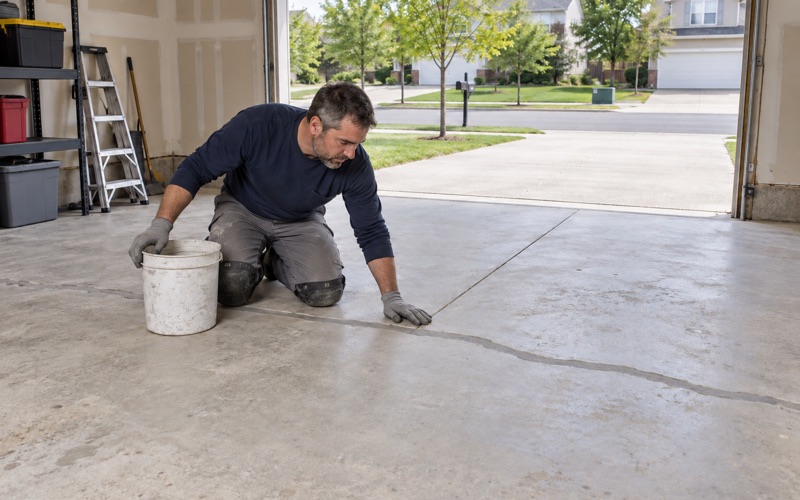
Before we quote, we read the cracks, joints and any old coating, and we test the slab for moisture as a written line item rather than an upsell. The proposal names the product, the system build and the finished thickness, priced per square foot for the system we actually propose, so what was quoted can be checked against what went down.
Craft Resin Is Floor Chemistry on a Smaller Scale
Two-part kits on the shelf at Southfield Plaza
The Hobby Lobby in Southfield Plaza, at 8825 South Harlem Avenue, sits inside Bridgeview in the Worth Township corner of the village. The chain’s own product pages list two-part craft epoxy under casting resin, including an Epoxy Resin Kit, an Alumilite quick coat kit and a Perfect Pour kit. Which kits that particular store stocks on a given day is another matter.
The 32-ounce Epoxy Resin Kit is typical of the category. Resin and hardener mix in equal parts, give roughly 45 minutes of working time, cure in 24 hours and are said to cover about 8 square feet. People use kits like it for coasters, trays and river tables, and plenty of them do the pouring in a garage.
What the hobby kit and the floor system share
Craft resin and a floor coating are both two-part epoxies: a resin and a hardener that react into a hard, crosslinked film. The floor product is formulated for traffic, abrasion and adhesion to concrete, often as a 100% solids epoxy under a polyaspartic or polyurea topcoat. The craft product is formulated for clarity and easy pouring on a tabletop.
Neither substitutes for the other. A craft kit is not a floor coating, and we sell no craft resin. The point is narrower: the chemistry that makes our primer lock into a ground slab is the same chemistry that makes a hobby drip lock onto a garage floor that nobody meant to coat.
Why concrete welcomes epoxy and plastic does not
ArtResin, a craft epoxy maker, says its product bonds well to wood, photographs, prints and fully dried paint, while wax, oil, plastics and silicone repel it. That is why plastic and silicone tools come clean. Concrete sits firmly on the bonding side of that list, and a slab ground open to a proper ICRI CSP profile bonds best of all.
This is also why our own prep matters as much as it does. A garage slab troweled smooth and sealed by a builder decades ago gives a floor coating little to hold, so we grind it open first. A hobby drip finds the same pores our primer looks for, only without anyone having prepared them.
Looking for epoxy-flooring closer to Chicago Ridge? See Chicago Ridge Epoxy-Flooring.
Drop Sheets on the Ground, and What Happens Without Them
What the resin maker tells hobbyists
ArtResin’s instructions are blunt: “Line your work surface with a plastic liner or a vinyl shower curtain, and use drop sheets on the ground for easy clean-up.” The company also says uncured resin left on a plastic-lined surface can cure overnight and be peeled off the next day. The sheet is the release layer, and the floor is not.
Its blog makes the same point about drips that fall while a piece is being coated. Left to cure on the plastic, they peel away. Left to cure on concrete, they stay, because nothing about a bare or coated slab repels epoxy the way a polyethylene sheet does.
A cured drip on a bare slab
On unsealed concrete a drip soaks slightly into the pores before it hardens, so it cannot be lifted with a fingernail or a putty knife. Scraping takes off the raised bead and leaves a glossy stain behind. Getting it flush means sanding or grinding the spot, and on a slab that will be coated later, that spot gets ground with the rest anyway.
That last part matters if a Bridgeview garage is on the list for a new floor. Old drips, paint and sealer are part of what we read before quoting, and a slab with heavy resin spots may need extra grinding passes to reach a uniform profile. We would rather tell you that up front than discover it with the grinder running.
A cured drip on a coated floor
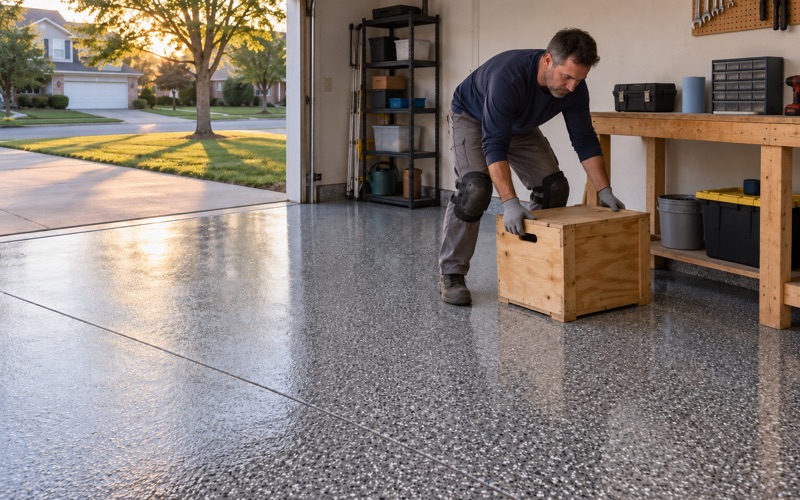
On a finished epoxy or polyaspartic floor, a craft-resin drip bonds to the topcoat just as our own next coat would. It will not wipe off once it has cured. Removal means scraping and then sanding the spot, and sanding cuts through the gloss and any vinyl flake broadcast around it, so the area needs a spot repair to match.
A spot repair on a flake floor is doable, but it is rarely invisible, especially under a high-gloss clear coat. The cheaper fix is a sheet of plastic and a few minutes of setup. A coated floor is a finished surface for parking and walking, not a resin work surface.
A Garage Resin Bench That Protects the Floor
Sheet, tape and a margin past the table
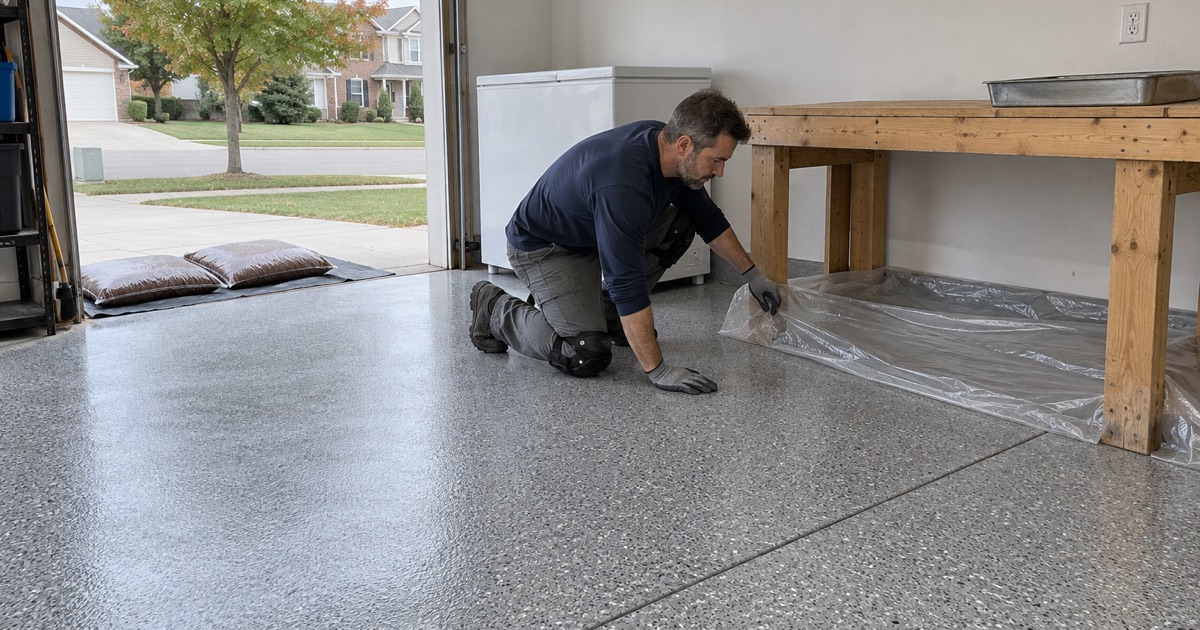
A polyethylene sheet should run well past the table edge, because drips travel when a tray is lifted or a mixing cup is carried across the room. Tape or weight the edges so a foot or a cart wheel does not drag it, and cover the spot where cups are mixed as well as where pieces are poured. A vinyl shower curtain works on the table itself.
Plan the bench where the sheet can stay down for the full cure. With a 24-hour kit, that means a corner the car will not need until tomorrow at the earliest. Pulling a sheet early, while drips are still tacky, smears resin onto the slab and defeats the whole setup.
Dust, air and the garage itself
Garages are dusty, and dust settles into a fresh pour. ArtResin’s suggestion for a dusty space is to mist the air with water from a spray bottle to keep the dust down, then let the piece cure in a dry, room-temperature environment. Sweeping the floor before the sheet goes down keeps grit from pressing through the plastic underfoot.
Grinding dust is the reverse case on our jobs. When we prepare a slab, the dust is collected at the grinder and is never washed toward a floor drain or storm inlet. A hobbyist’s garage and a coating crew’s garage ask for the same discipline: keep loose material where it can be picked up.
Leftover resin and mixing cups
ArtResin is direct about leftovers: “Do not pour leftover epoxy resin down the drain!” Mixed resin left in a cup can cure right on the sheet, and stir sticks set on the plastic come clean once they harden. Whatever happens at the bench, uncured resin never goes down the floor drain in the garage slab.
Where the bench goes on a coated floor
If the garage already has a coated floor, set the bench away from the drive path so tires never roll across the sheet. Our garage floors are built for the calcium chloride brine and rock salt a Chicago-area winter tracks in, and that wet grit dragged onto a plastic sheet becomes both a slip hazard and a mess. A corner near the wall, sheeted wide, keeps the two jobs apart.
A rubber mat over the sheet under a stool or step stool gives solid footing without exposing the coating below. When the project is finished, fold the sheet inward so the cured drips stay inside it, and sweep the area before the car comes back in.
Deep Pours, Flash Curing and the Slab Under the Bench
Why a river table pour gets hot
Epoxy gives off heat as it cures, and the deeper the mass, the more heat it holds. ArtResin warns that its resin can heat up very quickly and start curing faster than expected, sometimes even flash curing, and that this is more likely in deep pours or when the resin has been warmed in a hot water bath. River tables are where hobbyists pour deepest.
The practical answer in a garage is to keep a pour small or build it in layers, letting each one cool before the next goes on. A cup of mixed resin left sitting full is a small deep pour of its own, which is one more reason to mix only what the piece needs.
Our floor cures run on the slab, not the clock
The same heat chemistry runs our floor work in the other direction. A thin floor film loses its heat into cold concrete, so cure speed depends on the slab. We schedule curing against slab temperature and the dew point spread at the slab surface rather than the calendar, and we say plainly when an unheated garage has to wait for spring.
Cold slabs slow a craft pour too, and a garage bench in January can leave a piece soft long after the kit’s 24 hours. That is not a floor problem until someone moves the sheet early. Keep the drop sheet in place until the slowest drip has cured hard, however long the label says.
Bridgeview garages and what we check first
Bridgeview’s housing stock leans older, with more than 2,200 homes built in the 1950s and 1960s and nearly 3,000 owner-occupied detached houses. Many of those garages carry decades of oil, sealer and patch work. Moisture testing with ASTM F1869 calcium chloride kits or ASTM F2170 probes is written into the scope, and warranty exclusions are read out before the job is sold, moisture first.
For any home job we sign a written contract and hand over the state’s consumer-rights pamphlet before work starts, as the Illinois Home Repair and Remodeling Act requires. Illinois licenses no flooring or coatings contractor, so we confirm the village’s own rules first; the Bridgeview Building Department on South Oketo Avenue asks permit applicants for a contractor’s license, a $10,000 surety bond and an insurance certificate.
- 20+ Years on Concrete
- Moisture Tested Before Quoting
- Per-Square-Foot Written Quotes