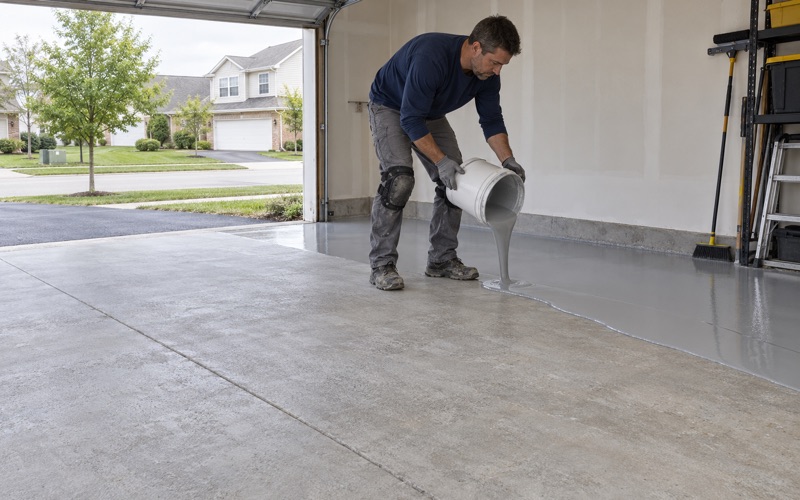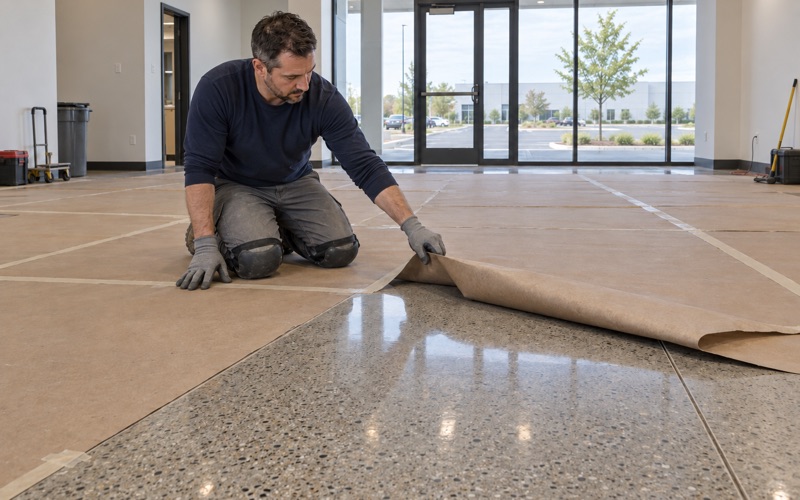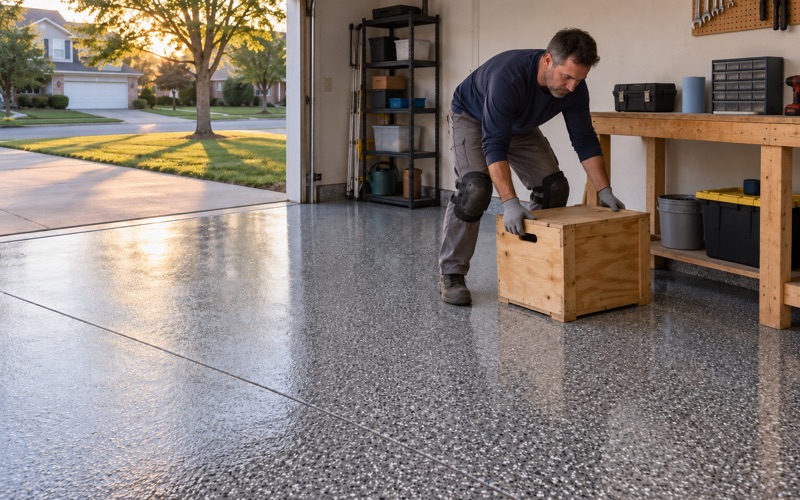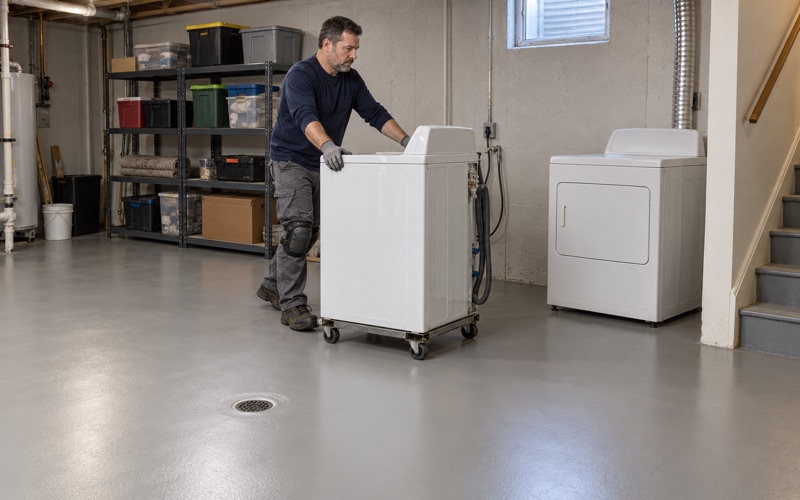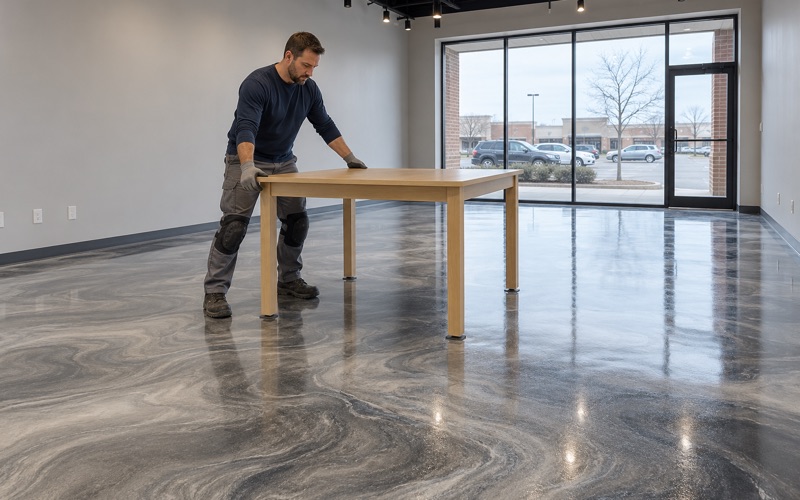
Romeoville Epoxy Flooring installs epoxy flooring in Bellwood for shops, storage rooms, garages and basements where fragile things get handled, dropped and cleaned up off the concrete. Over more than 20 years on slabs, we have learned that the floor a cleanup method assumes and the floor a building actually has are often two different surfaces. This page is about closing that gap for one specific kind of room: the one where old lamps are kept.
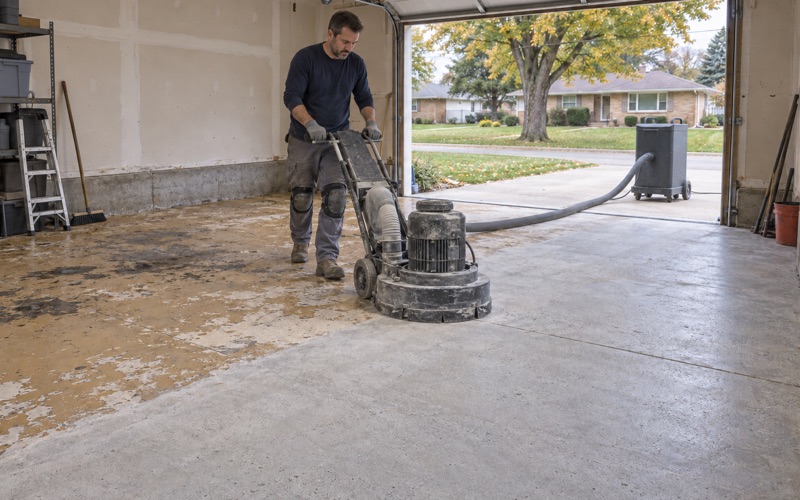
Our starting point is always the slab itself. Before a primer is opened, every floor is ground with a diamond grinder or shot blasted to a measured profile, and we never rely on acid etching to do that work. We also walk the cracks, joints and any old coating before pricing, and we tell an owner plainly when a slab needs repair or replacement before a coating makes sense.
The proposal you receive names the product, the system build and the finished thickness, so the floor that goes down can be checked against the floor that was quoted. Moisture testing sits in that scope as its own line, and warranty exclusions are read aloud before anything is signed, with moisture first on the list. Pricing is per square foot for that proposed system, not a national per-garage figure.
Streetlights, LED Conversion and the Lamps Left Behind
Bellwood Public Works, listed at 203 30th Avenue, describes a workload that runs from branch collection and street sweeping to sewer and storm maintenance and streetlights. The village has also put a Washington Boulevard Street Lighting Project out to bid, with LED luminaires on 30-foot aluminum poles running from Mannheim Road to Addison Creek.
What comes down when a corridor goes LED
A conversion like that tends to create a stretch of time when old lamps and new fixtures pass through the same buildings. A department that maintains streetlights is the kind of operation that typically handles high-intensity discharge lamps and shop fluorescents, and those lamps move through storage rooms, workbenches and truck bays before they leave. We do not know which lamp types the village keeps, and we have not seen its shop floor.
The village is not our customer, and nothing on this page describes its building. The department matters here because it makes the situation concrete: wherever streetlight or shop lamps are swapped out, a lamp can slip out of a carton or off a cart and break on the floor. The same is true in any private shop running its own lighting retrofit.
The lamps the federal rule groups together
EPA’s universal waste page lists lamps including fluorescent and high-intensity discharge types, along with neon, mercury vapor, high-pressure sodium and metal halide lamps. These are the tubes and bulbs that lit warehouses, parking lots and streets for decades. Many contain mercury, which is why the rule treats a broken one differently from ordinary broken glass.
Private shops and old fixtures
The same kinds of lamps hang in plenty of Bellwood garages, maintenance rooms and small plants that have never sent a fixture to a recycler. When an owner finally retrofits, the old tubes often get stacked on the floor of a back room for weeks. That room is worth thinking about before the boxes arrive, because its floor becomes the cleanup surface the moment one of them fails.
Before a lamp room is coated, we ask how lamps arrive, where cartons stack and where carts run. That decides where the floor takes the most abuse and where a break is most likely to happen. A shelf-lined room with a single doorway is a different layout from an open truck bay, and the floor plan should reflect it.
Looking for epoxy-flooring closer to Richton Park? See Epoxy-Flooring Services in Richton Park.
What 40 CFR 273.13 Asks When a Lamp Breaks
The federal universal waste rule for lamps, 40 CFR 273.13(d), says a small quantity handler must manage lamps in a way that prevents releases. Lamps are kept in containers or packages that are structurally sound, adequate to prevent breakage, closed and without evidence of leakage. Illinois has its own universal waste rules, which we have not reviewed for this page.
Clean up immediately, then containerize
Paragraph (d)(2) is the part that touches the floor. A handler must immediately clean up and place in a container any lamp that is broken, and must containerize any lamp showing breakage, leakage or damage that could release mercury or other hazardous constituents. Immediately is the operative word, because the cleanup cannot wait for a floor that is easier to clean.
That timing changes how a floor should be judged. A surface that only comes truly clean after a pressure wash or a grinder pass is not a surface that supports an immediate cleanup. What the rule needs from the floor is that a person with ordinary tools can get every fragment and the powder into a container on the first attempt.
Scoop, tape and damp-wipe
EPA’s guidance for a broken fluorescent lamp, which it applies to straight, U-shaped and circular tubes as well, starts with clearing people out, airing the room for 5 to 10 minutes and shutting off forced-air heating and cooling. On a hard surface, glass and powder are scooped up with stiff paper or cardboard, remaining small pieces are lifted with sticky tape such as duct tape, and the area is wiped with damp paper towels or wet wipes.
The same page says vacuuming a hard surface is not recommended unless broken glass remains, and debris and cleanup materials go outdoors promptly. Notice what the method assumes without saying it. Stiff paper slides across a flat surface, tape lifts what sits on top, and a damp towel wipes a floor that has no gaps, yet EPA’s page does not discuss cracks, joints or porous concrete at all.
What a coating is and is not
A floor coating is not mercury containment, abatement or a compliance program, and we never sell it as one. Closed lamp containers, careful handling and a recycler stay exactly where the rule puts them. What a sealed floor can do is let the cleanup method EPA describes work the way it was written, instead of leaving fragments behind in the floor’s defects.
Joints, Spalls and Bare Concrete Where Fragments Lodge
Many Bellwood work floors carry decades of wear. The village notes that after World War II large industries located in its eastern part along the Indiana Harbor Belt tracks, and slabs from that era have usually seen hard wheels, dropped steel and years of patching. Those are the surfaces where a broken lamp turns a quick cleanup into a hunt.
Saw cuts and control joints
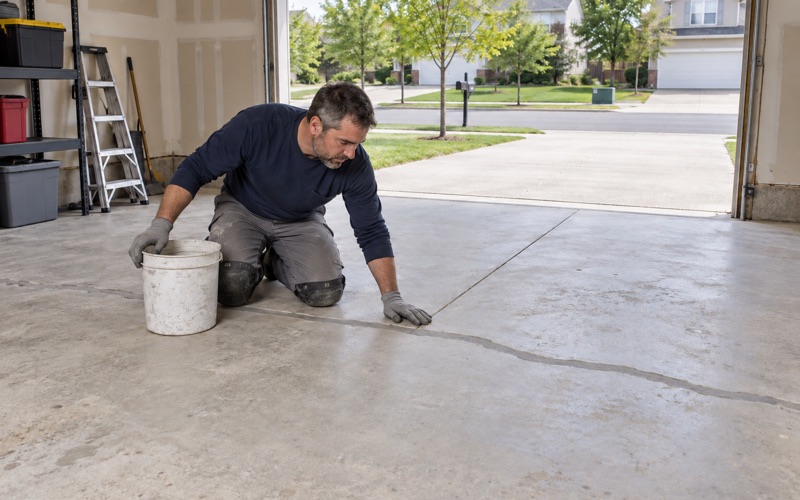
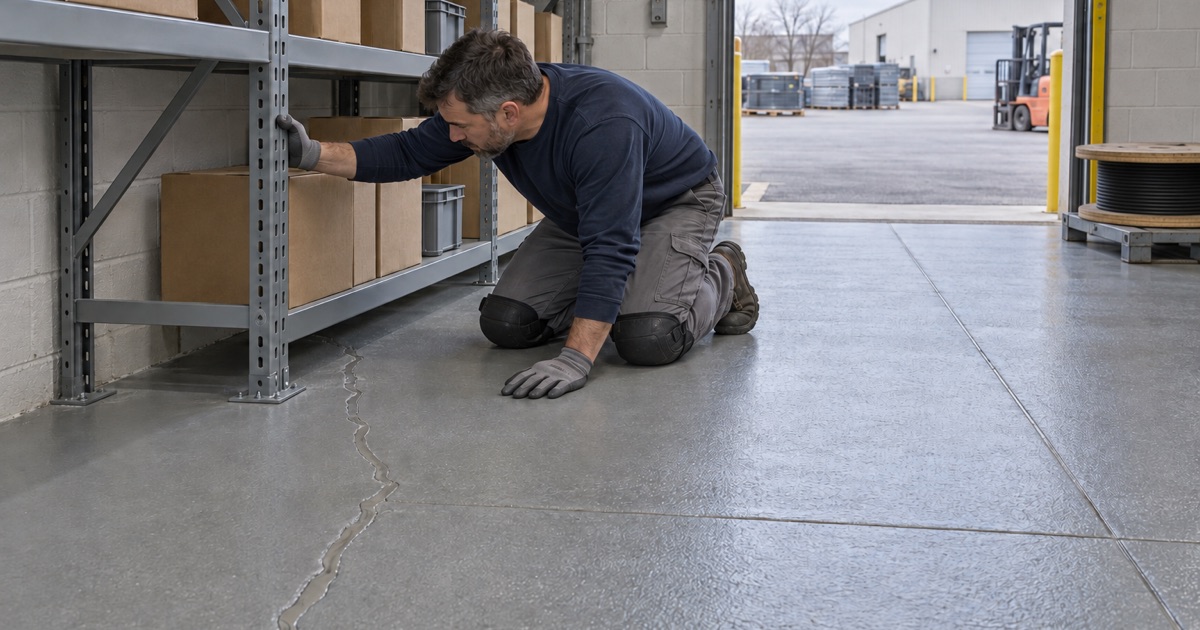
An open saw-cut joint is a narrow trench running across the room, and it is exactly where a sliver of tube glass or a pinch of phosphor powder settles when stiff paper pushes debris toward it. Tape cannot reach the bottom and a damp towel bridges right over it. We fill those joints with a semi-rigid polyurea joint filler, cut flush, so the line stays a joint without staying a trap.
Joints that move still need to behave as joints, so we do not bury active cracks under a rigid coat and hope. Where a crack is moving or a joint edge has broken down, we say so in the quote and price the repair as its own item. A coating stretched over an unstable edge tends to reopen within a season, and the gap returns.
Spalls, pits and old patches
Chipped joint shoulders, popouts and pitted patches leave small cups scattered across a floor. A fragment that drops into a shallow pit is hard to see and harder to wipe out, and the next cart wheel can crush it into finer pieces. Before coating, we grind out loose material and fill these areas with an epoxy repair mortar so the finished surface runs continuous from wall to wall.
Porous bare concrete
Unsealed concrete is open at the surface, and the fine powder inside a lamp has somewhere to go. Damp-wiping bare concrete tends to push fine material into the pores rather than lift it, and a dusty, unsealed slab sheds its own grit into every cleanup. A sealed, coated surface keeps whatever falls on top of the floor, where a scoop and a damp towel can reach it.
Building a Lamp-Room Floor That Wipes Clean
A floor meant to support a scoop, tape and wipe cleanup is built differently from a showroom garage. The priorities are a continuous surface, a color that shows debris and a texture that lets stiff paper slide, all bonded to a slab that will hold it for years.
Profile before primer
For a storage room or shop bay, the work starts with a diamond grinder or shot blaster that opens the slab to the ICRI CSP range the chosen system calls for, with the dust collected at the grinder rather than rinsed toward a floor drain. An acid etch only cleans the skin of a dense troweled slab and leaves a coating bonded to that skin, so it has no place in our process.
We also measure moisture before settling on the build, using ASTM F2170 in-situ relative humidity probes or ASTM F1869 calcium chloride tests depending on the slab. An older slab can carry enough moisture to lift a coating from below. A moisture-mitigation primer is far cheaper to plan into the scope than a blistered floor is to remove.
A system that shows what falls on it
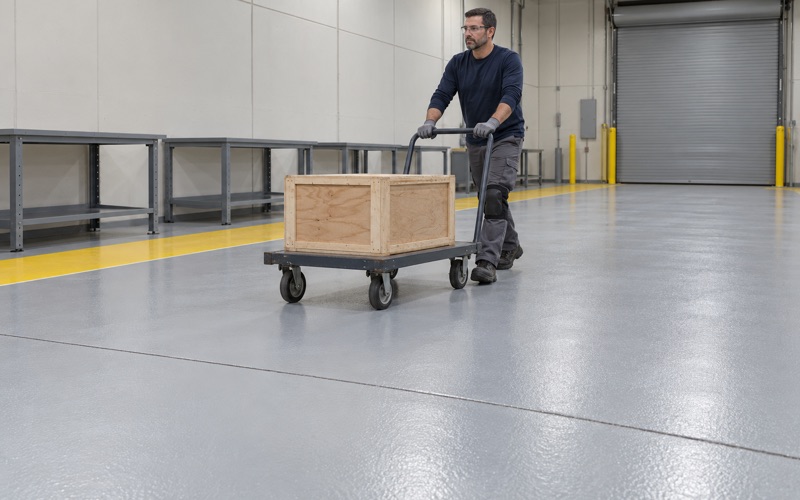
For a lamp room we lean toward a 100% solids epoxy body coat in a solid color with a polyaspartic or urethane topcoat, and either no broadcast or a fine one. A heavy vinyl flake looks good in a garage but hides fine glass and white powder in its pattern. A medium gray or tan, with a texture light enough for stiff paper to slide across, lets someone see a spill and confirm it is gone.
The coating can also turn up the wall a few inches as a cove or meet the base cleanly, so debris has no gap to slip into at the wall line. Shelving that holds lamp containers goes back on the finished floor, and any anchor holes drilled afterward are sealed. Curing is scheduled against slab temperature and the dew point spread rather than the calendar, so the floor is fully hard before carts return.
Broken tubes in a home basement or garage
The same logic carries into a house. A large share of Bellwood’s homes went up in the 1950s, many of them brick bungalows and ranches, and plenty of basements and garages still have a fluorescent shop light hanging over a workbench. When a tube falls, the EPA steps are the same, and how well they work depends on whether the floor is sealed or bare, smooth or cracked.
For a home job, the scope goes into a written contract and the owner receives the Home Repair: Know Your Consumer Rights pamphlet before work starts, as the Illinois Home Repair and Remodeling Act requires. Basement work begins with where any water is coming from, and we say plainly that a coating is not waterproofing. Garage floors get a system built for the rock salt and calcium chloride brine that winter tires carry in.
- 20+ Years on Concrete
- Moisture Tested Before Quoting
- Per-Square-Foot Written Quotes