Romeoville Epoxy Flooring has spent more than 20 years putting down epoxy flooring in Alsip shops, garages and work bays, and this page is about one kind of room where the floor matters more than most owners expect. It is the bay where window tint, paint protection film or detail work happens. In that room, the slab is not just something to stand on: it is either a source of dust or it is not.
A bare concrete floor wears at the surface and gives off fine cement dust every time a cart rolls or a shoe scuffs across it. A film installer spends the whole job keeping particles off an adhesive face, so a floor that keeps shedding is working against them. Sealing that slab is one of the more practical upgrades a film or detail shop can make.
We do not install film or tint, and we do not claim that a coated floor makes a room dust-free. What we do is grind the slab open, test it for moisture, and build a coating that stops the concrete from dusting and wipes clean with a damp mop. Cleaning habits and air handling do the rest.
A Film Bay on 124th Street, and Why Dust Ruins the Job
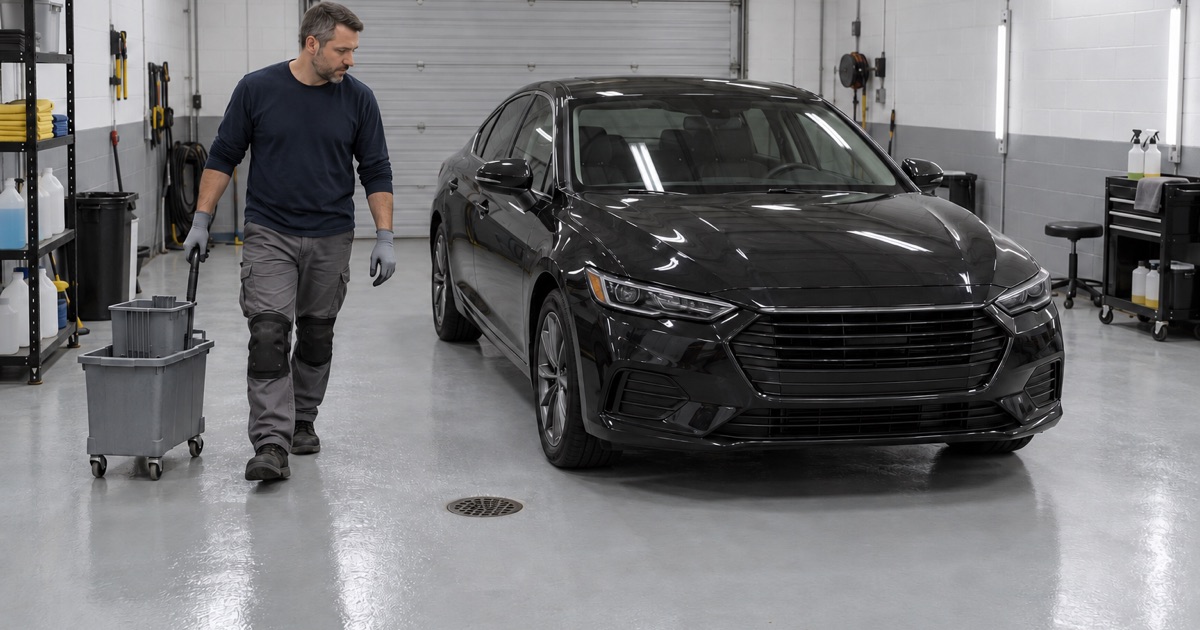
Alsip has film work going on along its industrial side streets. MC Window Tinting at 5330 W 124th St lists appointment-only residential and commercial window tint and paint protection film with a lifetime warranty, and a second film business, National Security & Window Filming, is listed nearby at 5307 W 124th St. We have never seen either floor, and neither business is a customer of ours, but the work they advertise shows why the floor question comes up.
What the film makers ask for
Avery Dennison’s application bulletin for its SPF-XI paint protection film says the film should be applied in a clean, dust-free and well lit environment. The painted panel is washed, dried with a lint-free cloth and degreased before the film goes on, which tells you how seriously the industry treats a single speck.
That instruction is about the whole room, not the floor alone. Still, the floor is the largest exposed surface in a bay, and it is the one every foot, creeper and rolling cart touches all day. If it gives off dust, the room starts every job behind.
A particle under film stays there
Once an adhesive face picks up a grain and the film is squeegeed down, that grain is locked in place. It shows as a small bump or a lifted point, and on a gloss panel it catches light from across the room. Fixing it can mean pulling the panel and starting over with new film.
That is why dust control in a tint or PPF bay reads more like a paint booth than a parking garage. Anything that keeps grit from becoming airborne near the car is worth doing, and a slab that stops shedding removes one steady source.
Where floor dust actually comes from
Plain concrete is cement paste and aggregate, and the top layer of paste is the weakest part of the slab. Traffic grinds at it, and the result is a gray powder that builds up along walls and under benches. Sweeping stirs it up, and the next draft puts it back on whatever is closest.
Bays in older industrial buildings often have slabs that took years of forklift and cart traffic before a film shop ever moved in. That wear shows up as a soft, powdery surface that no amount of sweeping fixes, because the floor keeps making more of it.
Looking for epoxy-flooring closer to Lyons? See Lyons Epoxy-Flooring.
A Slab That Stops Shedding and Mops Clean
The fix is not a thin coat of paint rolled over the dusty surface. A coating only stops dusting if it bonds to sound concrete, and it only bonds if the weak top layer is removed first. That is why every bay floor we do starts with mechanical preparation.
Opening the slab without acid
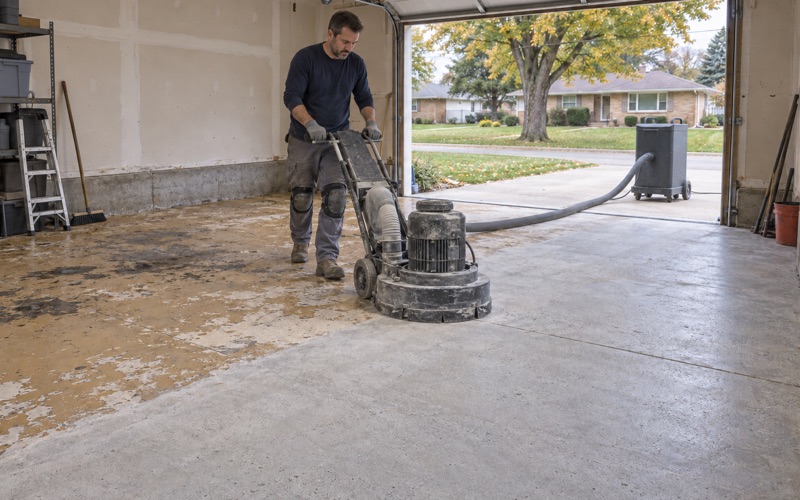
We open every slab with a diamond grinder or a shot blaster to a measured ICRI CSP profile, and we do not acid etch. Grinding takes off the dusting paste, old sealers and oil, and leaves a clean, rough surface the primer can grip. An acid wash leaves residue and an uneven profile, which is the opposite of what a film bay needs.
Grinding is also when we read the cracks, the joints and any old coating. If a slab needs repair before it can be coated, or is too far gone to coat at all, we say so plainly before we quote.
Testing before we coat
Moisture testing is a line item in our scope, not an add-on sold after a floor fails. Depending on the slab, that means ASTM F2170 in-situ relative humidity probes or ASTM F1869 calcium chloride testing. Most homes in Alsip were built between the 1950s and the 1990s, so a home garage or detailing space here is usually a retrofit over a slab that is decades old.
If moisture runs high, a moisture-mitigation primer goes down first, and we read the warranty exclusions out before the job is sold, with moisture named first. A coating that blisters off a damp slab sheds flakes of its own, which defeats the point of coating a film bay.
A system build that holds up to bay work
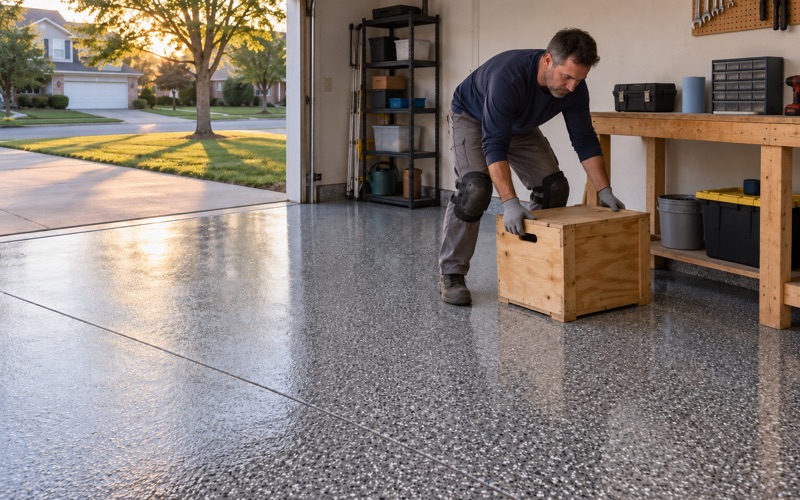
For a film or detail bay we usually propose a 100% solids epoxy base with a polyaspartic or polyurea topcoat. The proposal names the product, the build and the finished thickness, so the floor that went down can be checked against what was quoted. A smooth or lightly textured finish is easier to damp-mop than a heavy broadcast that holds grit in its peaks.
Light, solid colors help too. A pale gray floor shows a stray hair, a sliver of trimmed film or a smear of tire dressing before it gets tracked toward the car, which is exactly what an installer wants to see during the morning wipe-down.
Some owners ask about a lithium silicate densifier instead of a coating. A densifier hardens the surface and reduces dusting on a polished slab, but it does not keep water from soaking in the way a film-forming coating does, so in a wet install bay we usually recommend a coating.
Soapy Water Around the Car
Paint protection film goes on wet. The Avery Dennison bulletin describes a soap solution of water and a small amount of baby shampoo sprayed on the paint, on the exposed adhesive and on the film face throughout the job, with the squeegee pushing air and water out from under the film. Much of that solution ends up on the floor around the car.
What wet work does to bare concrete
On a bare slab, that runoff soaks in, darkens the concrete and carries cement fines with it. When the slab dries, the fines are left at the surface, ready to lift again. Over months, a bare bay floor tends to look blotchy where the car usually sits, and the dusting around it never stops.
Leftover soap matters as well. A slab that holds soap residue in its pores tends to grab dirt from shoes and tires, and it never quite looks clean no matter how often it is swept.
A floor you can damp-mop before each car
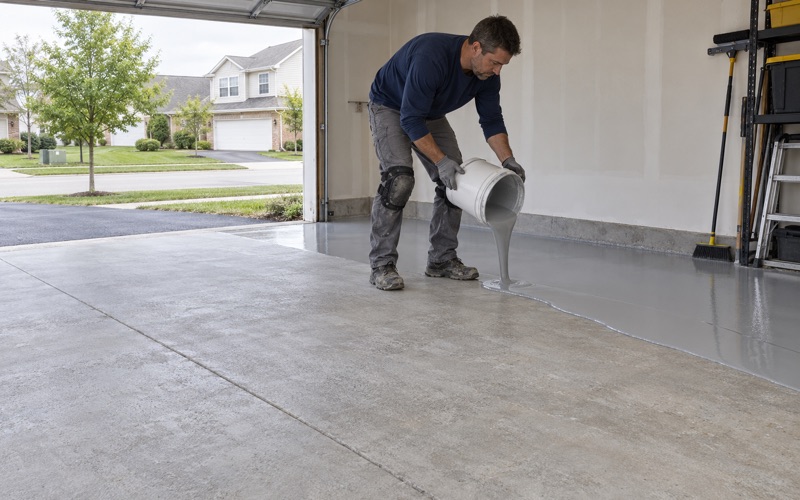
A coated floor keeps the solution on top, where a squeegee and a damp mop can pick it up. The routine many film shops follow is simple: mop the bay before the car comes in, let it dry, and start with a clean surface under the work. A sealed floor makes that routine take minutes instead of a full wash.
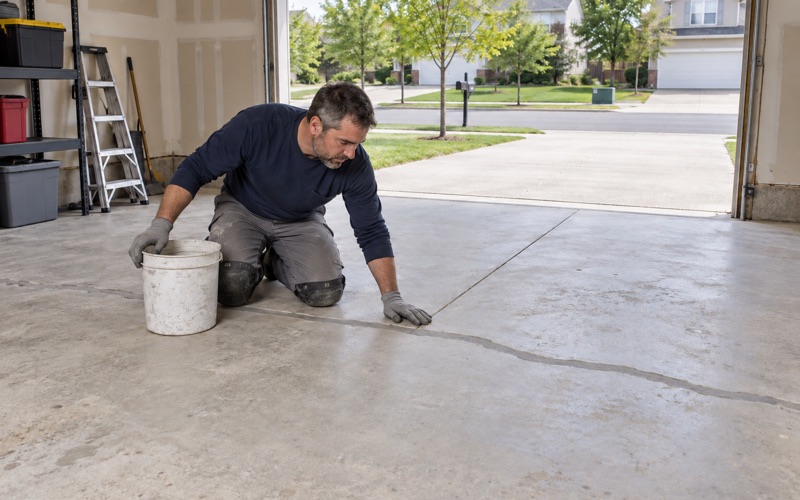
We seal the floor up to the wall line and fill control joints with a semi-rigid polyurea joint filler, so there are no open cracks for dust and soapy water to collect in. A floor drain, if the bay has one, gets a clean coating edge so the coating does not lift where water runs.
The same logic at home
A homeowner who details cars or wraps panels in a garage faces the same problem at a smaller scale. For home jobs we provide a written contract and the Home Repair: Know Your Consumer Rights pamphlet before work starts, as the Illinois Home Repair and Remodeling Act requires. A home garage floor also has to stand up to the calcium chloride and rock salt that winter tires track in.
Doing the Floor Without Dusting the Shop
Here is the irony a film shop owner should plan for: preparing a floor is one of the dustiest jobs that can happen in the building. Grinding throws fine concrete dust, and coatings carry odor while they cure. The floor work has to be fully finished and cleaned out before any film goes on a car in that room again.
Containment during prep
Our grinders run with dust collection at the head, and the dust goes into the collector rather than being washed toward a floor drain or storm inlet. We close off the bay from the rest of the shop with sheeting where the layout allows. Stored film rolls, plotters and hand tools should leave the room before we start.
Containment limits how far dust travels, but it does not make the room ready for film on its own. Ledges, light fixtures and the tops of cabinets catch some fines during any grinding job, and they need a wipe-down before installs resume.
Curing and the clean-out
Curing is scheduled against slab temperature and the dew point spread at the surface, not the calendar. An unheated bay may have to wait for spring, and a heated one still needs the coating to reach full cure before carts and cars roll back in. We give a realistic return-to-service date before work begins.
Before the first car comes back, the shop should plan a full clean-out: walls, shelving and air filters, then a damp mop of the new floor. A coating that has stopped dusting only helps if the dust left from the floor job itself is gone.
Scheduling, licensing and pricing
An appointment-only shop books installs ahead, so we schedule floor work around its calendar, including weekend windows when the bay would otherwise sit idle. Illinois issues no state license for flooring or coatings work, and the Village of Alsip collects a contractor license fee. We confirm the village’s registration, bond and insurance rules with the Alsip Building Department before a job is scheduled.
Coatings are chosen within the Illinois limit on VOC content, which binds the installer as well as the manufacturer. Prices are quoted per square foot for the system we actually propose for the bay, not from a national per-garage figure.
- 20+ Years on Concrete
- Moisture Tested Before Quoting
- Per-Square-Foot Written Quotes